For laboratory research use only. Not for human or veterinary use.
ACETIC ACID WATER
FOR RESEARCH USE ONLYNot for human or veterinary use of any kind
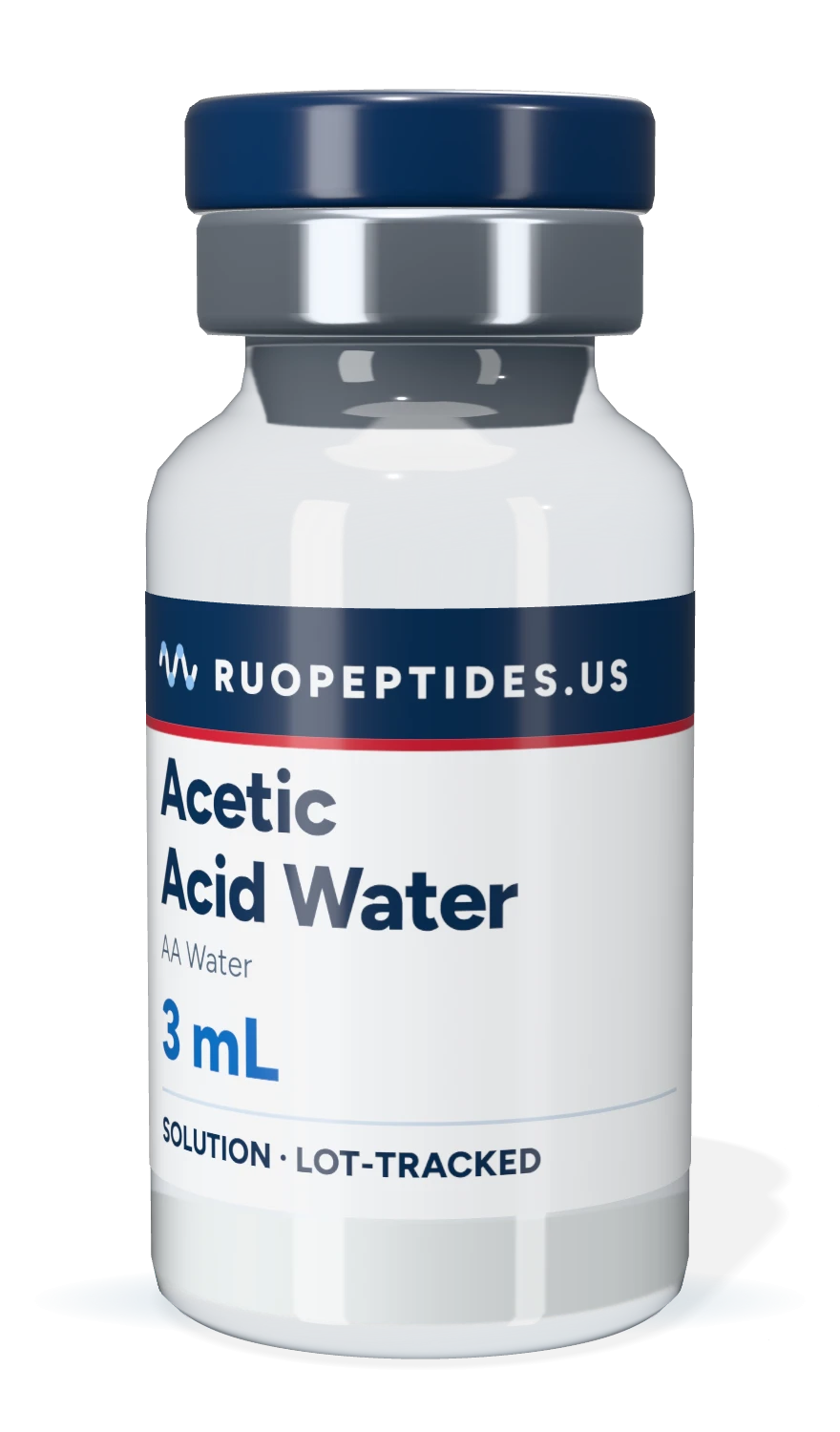
Full label. Lot number and expiry differ per batch and are printed on each vial.
Acetic Acid (AA) Water
Also known as: AA Water
Peptide solubility varies according to amino-acid composition, charge, and pH, making a dilute acetic acid solution the appropriate solvent choice for specific research compounds.
$6.00per vial
Price shown per vial. Quantity discounts below.
In stock
Buy more, pay less per vial
Add 1 more vial to save 3%: $5.82 per vial.
- Safe credit card paymentVisa, Mastercard and American Express
- 30-day money-back guarantee
- Super-fast 1-2 day shippingTo all 50 states and DC
- Free shipping on orders over $200Applied automatically at checkout
Acetic Acid (AA) Water
3 mL · $6.00/vial
Acetic Acid (AA) Water storage
Store sealed at controlled room temperature (15-25 °C), protected from light.
Acetic Acid (AA) Water delivery and shipping
Acetic Acid (AA) Water ships from US stock to United States addresses only. Orders are packed and dispatched within 1-2 business days.
- Standard: $9.95, 1-2 business days after dispatch.
- Express: $24.95, next business day after dispatch.
Solutions ship sealed and upright in protective packaging.
Follow your parcel any time on the Track Order page.
Acetic Acid (AA) Water lab testing and COA
The certificate of analysis for Acetic Acid (AA) Water is being uploaded. Ask support for the current report before you order if you need it now.
Every vial label has a lot number. Check it on the Verify page to confirm the vial is genuine. All reports are on the Lab Reports page.
For laboratory research use only. All products are sold for laboratory research use only. They are not drugs, foods, cosmetics or dietary supplements, and are not for human or veterinary use.
Acetic Acid (AA) Water specifications
- Product
- Acetic Acid (AA) Water
- Also known as
- AA Water
- Compound class
- Laboratory Supplies
- Product type
- Solution
- Form
- Solution
- Amounts available
- 3 mL ($6.00)
- Composition
- 0.6% acetic acid in sterile water
- Volume
- 3 mL per vial
- Form
- Clear solution, ready to use
- Acetic acid CAS
- 64-19-7
- Storage as supplied
- Sealed, protected from light
- Lab report
- COA on request
- Research areas
- Laboratory Supplies
- Intended use
- Laboratory research only. Not for human or veterinary use.
Research overview
About Acetic Acid (AA) Water
Scientifically reviewed by John Johnson · Updated November 2026Peptide solubility varies according to amino-acid composition, charge, and pH, making a dilute acetic acid solution the appropriate solvent choice for specific research compounds.
What Is Acetic Acid Water?
Acetic Acid Water combines water with a small amount of acetic acid to create a mildly acidic solution. This change in pH can modify the conditions under which certain peptides dissolve.
Certain peptides dissolve poorly at neutral pH due to their amino-acid composition and charge characteristics. A dilute Acetic Acid solution for peptides can improve dissolution by shifting the pH away from the peptide's isoelectric point [2].
The appropriate solvent choice depends on the individual peptide's physicochemical properties. Acetic acid in water is a laboratory solvent and should not be confused with a peptide or active research compound.
Why Is Acetic Acid Used as a Peptide Solvent?
Peptide solubility in water depends largely on the peptide’s net charge and the pH of the surrounding solution. Every peptide has an isoelectric point, or pI, where its overall charge is close to zero. Near this pH, reduced electrostatic repulsion can allow peptide molecules to associate more readily, potentially resulting in aggregation, cloudiness, or incomplete dissolution.
Adjusting the pH of the solvent alters the ionization state of charged amino-acid side chains, particularly acidic and basic residues, which in turn influences how readily individual peptide molecules interact with water rather than with each other. Moving the pH away from the isoelectric point restores net charge and improves solubility by increasing electrostatic repulsion between molecules [1].
However, peptides with poor aqueous solubility at neutral pH may require a different solvent environment to achieve consistent, reproducible dissolution. Dilute acetic acid is a commonly applied Acetic Acid peptide solvent in laboratory peptide work precisely because it shifts the solution toward mildly acidic conditions, improving solubility for specific sequences that resist neutral water.
As a peptide solvent, Acetic Acid Water is selected according to the physicochemical characteristics and experimental requirements of the individual compound. No single solvent is universally appropriate across all peptide sequences, and solvent selection should always reflect the specific peptide's documented solubility profile.
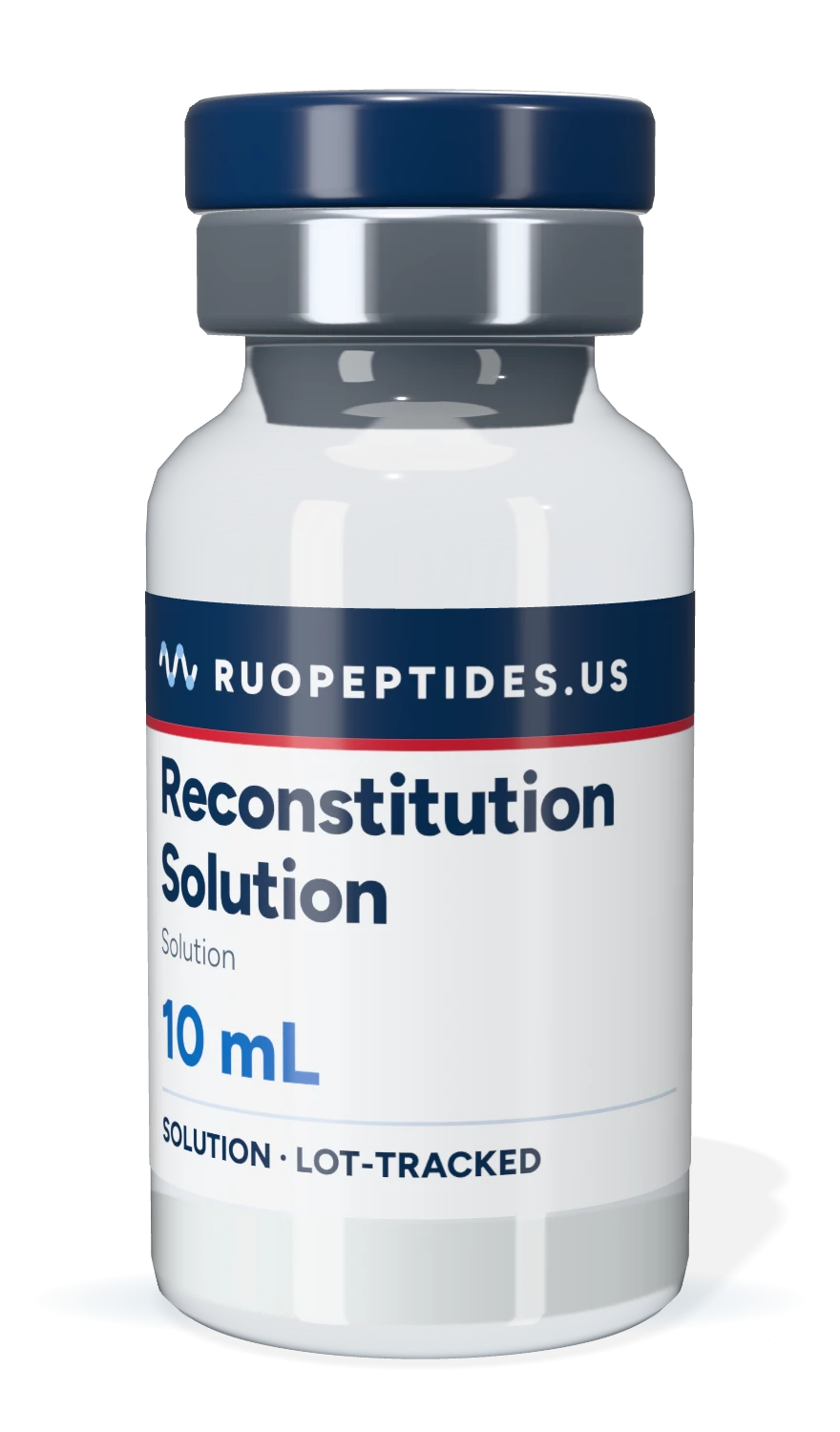
Acetic Acid Water vs Reconstitution Solution
| Acetic Acid Water | Reconstitution Solution | |
|---|---|---|
| Main characteristic | Mildly acidic aqueous solution | Sterile water containing a bacteriostatic preservative |
| Role in peptide research | Solvent for peptides requiring acidic conditions | Common solvent for water-soluble research compounds |
| Effect on pH | Creates an acidic environment | Does not serve primarily as a pH-adjusting solvent |
| Suitable for every peptide? | No | No |
| Selection depends on | Peptide solubility and experimental requirements | Peptide properties and experimental requirements |
Neither solvent is universally appropriate across all peptide sequences. Solvent selection should always be guided by the specific compound's solubility profile and the requirements of the individual research protocol.
Acetic Acid (AA) Water FAQ
What is Acetic Acid Water?
Acetic Acid Water for research is a dilute aqueous solution containing a low concentration of acetic acid.
What is AA Water used for in peptide research?
It provides a mildly acidic environment that can improve solubility for specific peptide sequences sensitive to neutral pH conditions.
Why is acetic acid used to dissolve some peptides?
Dilute acetic acid lowers solution pH, which alters the ionization state of charged amino-acid side chains. This shifts the peptide away from its isoelectric point, restoring net charge and improving intermolecular repulsion, which can produce more consistent and uniform dissolution in experimental preparations.
Is Acetic Acid Water the same as Reconstitution Solution?
No. They are not interchangeable.
How does pH affect peptide solubility?
Peptide solubility is influenced by net charge, which changes with pH. Near the isoelectric point, reduced net charge can cause aggregation and poor dissolution. Adjusting pH with a dilute acid or base shifts charge distribution, improving solubility for specific peptide sequences in laboratory settings.
Do all research peptides require Acetic Acid Water?
No. Acetic Acid Water is reserved for compounds with documented solubility requirements that favour mildly acidic conditions. Solvent selection should always reflect the specific peptide's physicochemical properties and research protocol.
Scientific references
- [1]Mant CT, Chen Y, Yan Z, Popa TV, Kovacs JM, Mills JB, Tripet BP, Hodges RS. "HPLC analysis and purification of peptides." In: Peptide Characterization and Application Protocols. Humana Press. 2007.
- [2]Sigma-Aldrich. "Solubility Guidelines for Peptides." Technical Article, Research and Disease Areas.
Buying Acetic Acid (AA) Water for research in the USA
Price
$6.00 per vial. 3 mL: $6.00. Quantity discounts per size: 3% off 2 vials, 5% off 3-4 vials, 7% off 5+ vials.
Shipping
US addresses only. Orders are packed and dispatched within 1-2 business days. Standard from $9.95.
Proof it's genuine
Check the lot number on your vial on the Verify page.
Lab reports
COA and SDS documents are on the Lab Reports page.
Scientifically reviewed
Scientifically reviewed by John Johnson
Scientific reviewer · Last reviewed November 2026
John Johnson reviewed this Acetic Acid (AA) Water page for scientific accuracy: the compound's identity and specifications, the summaries of published studies, and the references they cite. The page describes laboratory and preclinical research only. It is not medical advice and gives no usage guidance.
Research information on this page summarizes published laboratory and preclinical studies. It is not usage guidance.