For laboratory research use only. Not for human or veterinary use.
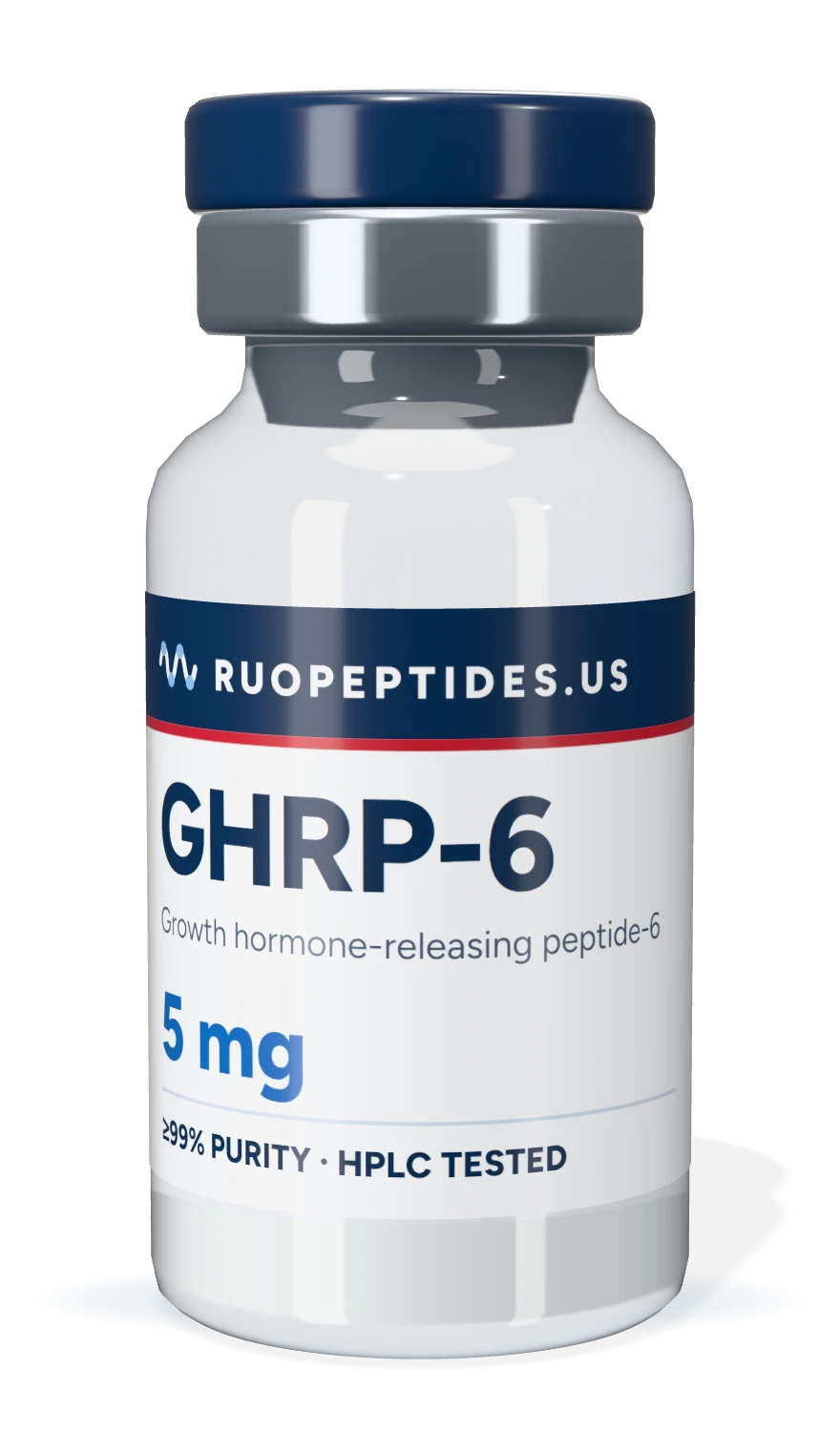
GHRP-6
FOR RESEARCH USE ONLYNot for human or veterinary use of any kind
Full label. Lot number and expiry differ per batch and are printed on each vial.
GHRH Analogs & GH Secretagogues
GHRP-6
Also known as: Growth hormone-releasing peptide-6
GHRP-6 (growth hormone-releasing peptide-6) is a synthetic hexapeptide that activates the ghrelin receptor, GHS-R1a.
- CAS
- 87616-84-0
- M.W.
- 873.0 g/mol
- Formula
- C₄₆H₅₆N₁₂O₆
- Form
- Lyophilized powder
$35.00per vial
Price shown per vial. Quantity discounts below.
In stock
Buy more, pay less per vial
Add 1 more vial to save 3%: $33.95 per vial.
- Safe credit card paymentVisa, Mastercard and American Express
- 30-day money-back guarantee
- Super-fast 1-2 day shippingTo all 50 states and DC
- Free shipping on orders over $200Applied automatically at checkout
GHRP-6
5 mg · $35.00/vial
Lyophilized GHRP-6 storage
Store lyophilized material sealed, dry and protected from light. Refrigerate (2-8 °C) for short-term storage; freeze (−20 °C or below) for long-term storage.
Reconstituted GHRP-6 storage
Material in solution is less stable than the lyophilized form. Keep refrigerated (2-8 °C), protect from light, and avoid repeated freeze-thaw cycles.
GHRP-6 delivery and shipping
GHRP-6 ships from US stock to United States addresses only. Orders are packed and dispatched within 1-2 business days.
- Standard: $9.95, 1-2 business days after dispatch.
- Express: $24.95, next business day after dispatch.
Lyophilized GHRP-6 ships in a sealed glass vial with protective packaging. The dry powder is stable at room temperature for the length of domestic transit, so no cold pack is needed. Move it to the storage conditions above when it arrives.
Follow your parcel any time on the Track Order page.
GHRP-6 lab testing and COA
The certificate of analysis for GHRP-6 is being uploaded. Ask support for the current report before you order if you need it now.
Every vial label has a lot number. Check it on the Verify page to confirm the vial is genuine. All reports are on the Lab Reports page.
For laboratory research use only. All products are sold for laboratory research use only. They are not drugs, foods, cosmetics or dietary supplements, and are not for human or veterinary use.
GHRP-6 specifications
- Product
- GHRP-6
- Also known as
- Growth hormone-releasing peptide-6
- Compound class
- GHRH Analogs & GH Secretagogues
- Product type
- Peptide
- Form
- Lyophilized powder
- Amounts available
- 5 mg ($35.00), 10 mg ($59.00)
- Sequence
- His-D-Trp-Ala-Trp-D-Phe-Lys-NH₂
- Molecular weight
- 873.0 g/mol
- Molecular formula
- C₄₆H₅₆N₁₂O₆
- CAS number
- 87616-84-0
- Storage as supplied
- Sealed, dry, dark; -20 °C for long-term storage
- Lab report
- COA on request
- Research areas
- GHRH Analogs & GH Secretagogues
- Intended use
- Laboratory research only. Not for human or veterinary use.
Research overview
About GHRP-6
Scientifically reviewed by John Johnson · Updated November 2026GHRP-6 (growth hormone-releasing peptide-6) is a synthetic hexapeptide that activates the ghrelin receptor, GHS-R1a. It was one of the first growth hormone secretagogues described and is still a reference compound in ghrelin-pathway and pituitary research. [1][2] RUOPeptides supplies GHRP-6 in 5 mg vials for laboratory research.
What Is GHRP-6?
GHRP-6 has the sequence His-D-Trp-Ala-Trp-D-Phe-Lys-NH₂. Its two D-amino acids make it more resistant to proteases than a peptide built only from L-amino acids. Its formula is C₄₆H₅₆N₁₂O₆ and its molecular weight is about 873.0 g/mol.
Cyril Bowers and colleagues described GHRP-6 in 1984, after developing it from modified enkephalin peptides. It released growth hormone from pituitary cells in vitro and in animals. [1] At the time its receptor was unknown. The receptor, GHS-R1a, was cloned in 1996, [2] and its natural ligand, ghrelin, was found in the stomach in 1999. [3] GHRP-6 therefore predates the hormone it mimics.
GHRP-6 is not ghrelin. Ghrelin is a 28-amino-acid peptide that needs an octanoyl group on serine 3 to activate the receptor, while GHRP-6 is a much smaller synthetic peptide that binds the same receptor without that modification.
Overview of Published GHRP-6 Research
Published GHRP-6 research covers pituitary GH release, ghrelin-receptor signaling in the brain, and receptor-independent effects in the heart. Much of this work comes from cell assays and rodent models. Effects reported for ghrelin do not always apply to GHRP-6, and the reverse is also true.
GHS-R1a Signaling and Growth Hormone Release
GHS-R1a is a G-protein-coupled receptor that signals mainly through Gq/11, raising intracellular calcium. On pituitary somatotrophs this triggers GH release through a pathway separate from the GHRH receptor's cAMP signaling. [2] When GHRP-6 and GHRH are applied together, GH release is greater than with either alone, a synergy that is a classic topic in GH-axis research.
GHRP-6 is less selective than newer secretagogues. In animal studies it also raised ACTH, cortisol and prolactin, which is part of why selective agonists such as ipamorelin were developed later. [4]
Ghrelin-Pathway Feeding Research
GHS-R1a is expressed in the hypothalamic arcuate nucleus on neurons that make neuropeptide Y and agouti-related peptide, two signals involved in feeding behavior. Ghrelin and GHRP-6 have both been used in rodent studies of how these neurons respond to receptor activation and how that relates to food intake.
Cardiac Research and CD36
GHRP-6 binds a second target, the scavenger receptor CD36, which is found on heart and blood vessel cells. Bodart and colleagues showed that CD36 mediates cardiovascular actions of growth hormone-releasing peptides in rat hearts, separate from GH release. [5] This finding made GHRP-6 and hexarelin tools for studying CD36 signaling and cardiac responses in ischemia-reperfusion models.
Inflammation and Gastrointestinal Research
Ghrelin-receptor agonists have been studied in rodent models of inflammation, where researchers measure cytokines such as TNF-α and IL-6, and in models of gastric emptying and gut motility, where ghrelin signaling speeds transit. GHRP-6 appears in both lines of research as a stable synthetic agonist.
GHRP-6 vs Ipamorelin vs Hexarelin: What's the Difference?
All three are synthetic agonists of GHS-R1a, but they differ in sequence, selectivity and the research questions they are used for.
| Feature | GHRP-6 | Ipamorelin | Hexarelin |
|---|---|---|---|
| Length | 6 amino acids | 5 amino acids | 6 amino acids |
| Sequence | His-D-Trp-Ala-Trp-D-Phe-Lys-NH₂ | Aib-His-D-2Nal-D-Phe-Lys-NH₂ | His-D-2MeTrp-Ala-Trp-D-Phe-Lys-NH₂ |
| Main receptor | GHS-R1a | GHS-R1a | GHS-R1a |
| Selectivity for GH release | Also raises ACTH, cortisol and prolactin in studies | Selective for GH in animal studies | Also raises ACTH, cortisol and prolactin in studies |
| Typical research use | Reference GHS-R1a agonist, CD36 research | Selective secretagogue research | Potent secretagogue, CD36 and cardiac research |
GHRP-6 FAQ
Is GHRP-6 the same as ghrelin?
No. Ghrelin is a 28-amino-acid hormone that needs an octanoyl group to activate its receptor. GHRP-6 is a synthetic six-amino-acid peptide, discovered 15 years earlier, that activates the same receptor, GHS-R1a.
Why is GHRP-6 used in feeding research?
It activates GHS-R1a, the receptor ghrelin uses on hypothalamic neurons involved in feeding. Rodent studies use it to examine that pathway. These are findings about receptor signaling in animal models.
What receptors does GHRP-6 bind?
Mainly GHS-R1a, the ghrelin receptor, on the pituitary and in the brain. It also binds CD36, a scavenger receptor on heart and blood vessel cells, which explains GH-independent effects seen in cardiac studies.
How is GHRP-6 different from ipamorelin?
Both activate GHS-R1a. In animal studies GHRP-6 also raised ACTH, cortisol and prolactin, while ipamorelin was selective for GH. Ipamorelin is a pentapeptide with a different sequence.
What is GHRP-6 studied for?
GHS-R1a signaling and GH release, synergy with GHRH, ghrelin-pathway feeding circuits in rodents, CD36 signaling in the heart, and ghrelin-receptor effects in inflammation and gut motility models.
Scientific references
- [1]Bowers CY, et al. Endocrinology. 1984. On the in vitro and in vivo activity of a new synthetic hexapeptide that acts on the pituitary to specifically release growth hormone.
- [2]Howard AD, et al. Science. 1996. A receptor in pituitary and hypothalamus that functions in growth hormone release.
- [3]Kojima M, et al. Nature. 1999. Ghrelin is a growth-hormone-releasing acylated peptide from stomach.
- [4]Raun K, et al. Eur J Endocrinol. 1998. Ipamorelin, the first selective growth hormone secretagogue.
- [5]Bodart V, et al. Circ Res. 2002. CD36 mediates the cardiovascular action of growth hormone-releasing peptides in the heart.
Buying GHRP-6 for research in the USA
Price
From $35.00. 5 mg: $35.00, 10 mg: $59.00. Quantity discounts per size: 3% off 2 vials, 5% off 3-4 vials, 7% off 5+ vials.
Shipping
US addresses only. Orders are packed and dispatched within 1-2 business days. Standard from $9.95.
Proof it's genuine
Check the lot number on your vial on the Verify page.
Lab reports
COA and SDS documents are on the Lab Reports page.
Scientifically reviewed
Scientifically reviewed by John Johnson
Scientific reviewer · Last reviewed November 2026
John Johnson reviewed this GHRP-6 page for scientific accuracy: the compound's identity and specifications, the summaries of published studies, and the references they cite. The page describes laboratory and preclinical research only. It is not medical advice and gives no usage guidance.
Research information on this page summarizes published laboratory and preclinical studies. It is not usage guidance.