For laboratory research use only. Not for human or veterinary use.
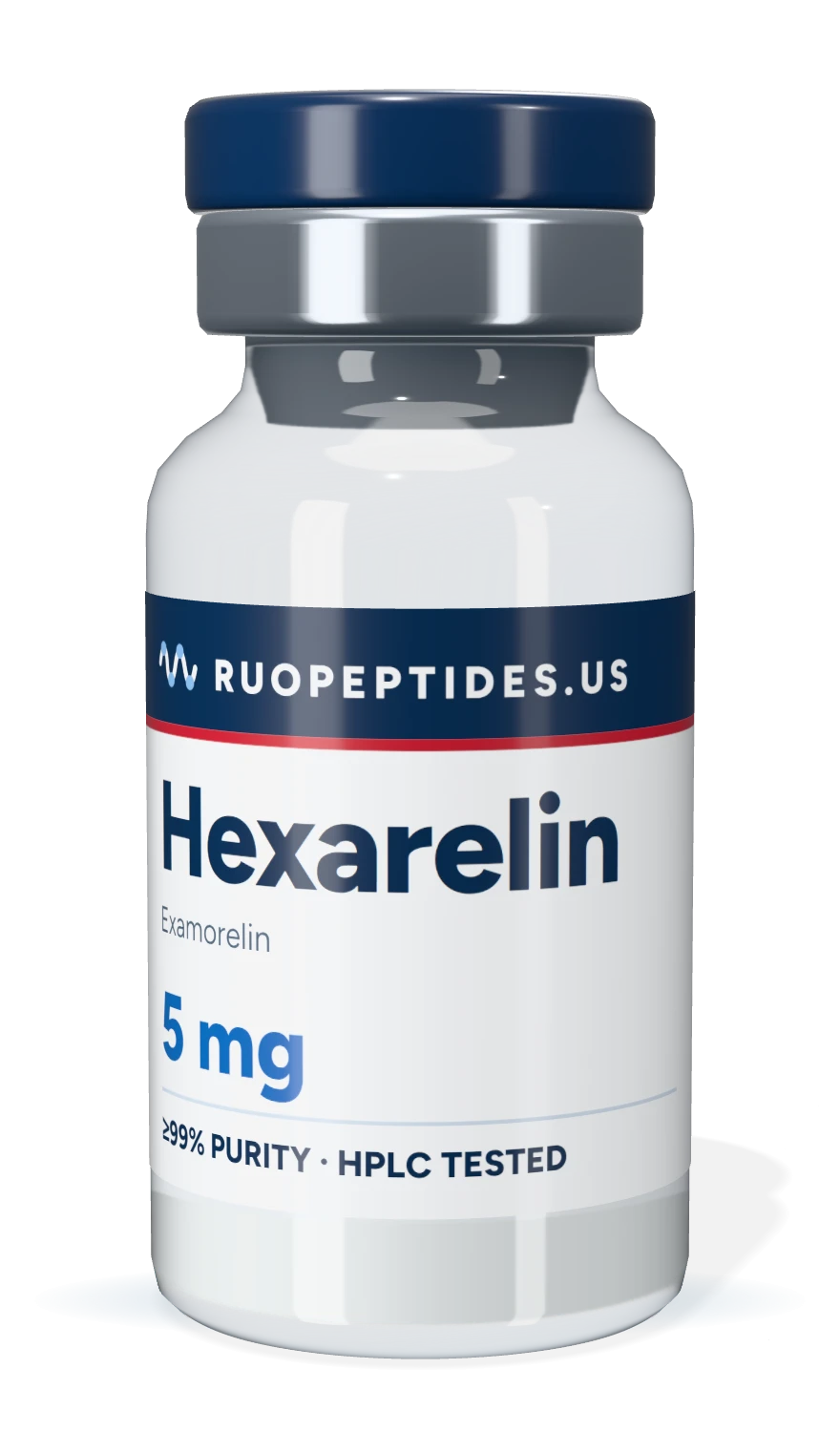
HEXARELIN
FOR RESEARCH USE ONLYNot for human or veterinary use of any kind
Full label. Lot number and expiry differ per batch and are printed on each vial.
GHRH Analogs & GH Secretagogues
Hexarelin
Also known as: Examorelin
RUOPeptides supplies Hexarelin as a 5mg lyophilized vial for laboratory research. It's a synthetic hexapeptide and a growth hormone secretagogue.
- CAS
- 140703-51-1
- M.W.
- 887.04 g/mol
- Formula
- C47H58N12O6
- Form
- Lyophilized powder
$39.00per vial
Price shown per vial. Quantity discounts below.
In stock
Buy more, pay less per vial
Add 1 more vial to save 3%: $37.83 per vial.
- Safe credit card paymentVisa, Mastercard and American Express
- 30-day money-back guarantee
- Super-fast 1-2 day shippingTo all 50 states and DC
- Free shipping on orders over $200Applied automatically at checkout
Hexarelin
5 mg · $39.00/vial
Lyophilized Hexarelin storage
Lyophilized Hexarelin peptide should be stored in a dry place, protected from sunlight and moisture.
The following storage conditions are generally recommended:
- Room temperature (15-25 °C / 59-77 °F): Up to ~3-8 months
- Refrigerated (2-8 °C / 35.6-46.4 °F): Up to 6 months
- Frozen (-20 °C / -4 °F or below): 3-5 years
Prior reconstituting with a suitable solvent or Saline, allow the vial to reach room temperature after taking it out of the refrigerator or freezer.
Reconstituted Hexarelin storage
Once in solution, Hexarelin is generally less stable compared to their lyophilized (powdered) form and should be stored at cold temperatures when possible.
These storage conditions are generally recommended:
- Room temperature (15-25 °C / 59-77 °F): Avoid longer than 2-4 day storage
- Refrigerated (2-8 °C / 35.6-46.4 °F): Typically 4-8 weeks
- Frozen (-20 °C / -4 °F or below or below): Up to 3-4 months
However, to preserve peptide efficacy and amino-acid bonds, avoid repeatedly freezing and unfreezing the peptide.
Hexarelin delivery and shipping
Hexarelin ships from US stock to United States addresses only. Orders are packed and dispatched within 1-2 business days.
- Standard: $9.95, 1-2 business days after dispatch.
- Express: $24.95, next business day after dispatch.
Lyophilized Hexarelin ships in a sealed glass vial with protective packaging. The dry powder is stable at room temperature for the length of domestic transit, so no cold pack is needed. Move it to the storage conditions above when it arrives.
Follow your parcel any time on the Track Order page.
Hexarelin lab testing and COA
The certificate of analysis for Hexarelin is being uploaded. Ask support for the current report before you order if you need it now.
Every vial label has a lot number. Check it on the Verify page to confirm the vial is genuine. All reports are on the Lab Reports page.
For laboratory research use only. All products are sold for laboratory research use only. They are not drugs, foods, cosmetics or dietary supplements, and are not for human or veterinary use.
Hexarelin specifications
- Product
- Hexarelin
- Also known as
- Examorelin
- Compound class
- GHRH Analogs & GH Secretagogues
- Product type
- Peptide
- Form
- Lyophilized powder
- Amounts available
- 5 mg ($39.00), 10 mg ($69.00)
- Full name
- Examorelin
- Parent research context
- Growth hormone-releasing peptide (GHRP) family
- Sequence
- His-D-2-methyl-Trp-Ala-Trp-D-Phe-Lys-NH2
- Molecular weight
- 887.04 g/mol
- Molecular formula
- C47H58N12O6
- CAS number
- 140703-51-1
- Product format
- Lyophilized powder, single sealed vial
- Storage as supplied
- Sealed, dry, dark; -20 °C for long-term storage
- Lab report
- COA on request
- Research areas
- GHRH Analogs & GH Secretagogues
- Intended use
- Laboratory research only. Not for human or veterinary use.
Research overview
About Hexarelin
Scientifically reviewed by John Johnson · Updated November 2026RUOPeptides supplies Hexarelin as a 5mg lyophilized vial for laboratory research. It's a synthetic hexapeptide and a growth hormone secretagogue.
Hexarelin sits in the growth hormone-releasing peptide family, and it acts as an agonist at GHS-R1a, the growth hormone secretagogue receptor. That receptor is better known by its other name: the ghrelin receptor.
What is Hexarelin?
Hexarelin, also written as examorelin, is a synthetic six-amino-acid peptide belonging to the GHRP family. Its primary research characteristic is that interaction with GHS-R1a, the same receptor activated by endogenous ghrelin. Activation there has been studied extensively in relation to growth hormone secretion and neuroendocrine signaling.
The compound was developed as an analogue of GHRP-6, with structural modification intended to produce a chemically stable synthetic secretagogue. The two peptides are closer than most people assume. GHRP-6 runs His-D-Trp-Ala-Trp-D-Phe-Lys-NH2 and weighs about 873.0 g/mol. Hexarelin adds a single methyl group to the second residue and weighs 887.0. Fourteen daltons apart, which is one CH2 and nothing else.
Hexarelin Research Applications
- GHS-R1a Signaling: Activation and downstream signaling at the growth hormone secretagogue receptor.
- Neuroendocrine Signaling: Interactions between the ghrelin and GHS-R pathways and wider endocrine regulation.
- Pituitary Research: Mechanisms involved in secretagogue-mediated pituitary signaling.
- Cardiovascular and Cardiac Signaling: This is where hexarelin stops behaving like a straightforward GHS-R1a agonist. A 2002 study in Circulation Research labeled rat cardiac membranes with a photoactivatable hexarelin derivative, pulled down an 84 kDa binding protein, and identified it as CD36.
- Metabolic Signaling: Broader physiological pathways associated with GHS-R activation.
One finding deserves the attention of anyone planning a repeat-exposure design. Rahim and colleagues ran 16 weeks of twice-daily hexarelin at 1.5 micrograms per kilogram and tracked the GH response by area under the curve. It started at 19.1, fell to 12.3 by week four, and reached 10.5 by week 16. That's a 45% drop. Partial desensitization, and reversible, which is a very different result from either tolerance or no effect at all.
Hexarelin FAQ
Is Hexarelin a GHRP?
Yes. It belongs to the growth hormone-releasing peptide family, and WADA lists examorelin among the GHRPs by name under S2.2.4.
Is Hexarelin a peptide?
Yes, a synthetic hexapeptide. Six amino acid residues, 887.04 g/mol, with two D-amino acids, a methylated tryptophan and an amidated C-terminus.
What type of peptide is Hexarelin?
A growth hormone secretagogue, specifically a synthetic GHRP. That places it alongside GHRP-2 and GHRP-6 rather than with the GHRH analogues such as CJC-1295 and Sermorelin, which act through a different receptor.
What is Hexarelin studied for?
GHS-R1a signaling, growth hormone regulation, neuroendocrine and pituitary mechanisms, cardiac signaling through CD36, and broader metabolic pathways associated with secretagogue receptor activation.
What receptor does Hexarelin target?
GHS-R1a, the growth hormone secretagogue receptor. Cardiac research has separately identified CD36 as a hexarelin binding protein in heart tissue, which is a distinct target from the pituitary receptor.
Is Hexarelin the same as ghrelin?
No. Ghrelin is an endogenous 28-residue hormone. Hexarelin is a synthetic six-residue peptide. They converge at the same receptor, GHS-R1a, but they're structurally unrelated molecules.
What is the difference between Hexarelin and GHRP-6?
One methyl group. Hexarelin is GHRP-6 with a methyl added to the tryptophan at position two, which puts it at 887.0 g/mol against roughly 873.0. Hexarelin was developed as the structurally modified analogue.
Buying Hexarelin for research in the USA
Price
From $39.00. 5 mg: $39.00, 10 mg: $69.00. Quantity discounts per size: 3% off 2 vials, 5% off 3-4 vials, 7% off 5+ vials.
Shipping
US addresses only. Orders are packed and dispatched within 1-2 business days. Standard from $9.95.
Proof it's genuine
Check the lot number on your vial on the Verify page.
Lab reports
COA and SDS documents are on the Lab Reports page.
Scientifically reviewed
Scientifically reviewed by John Johnson
Scientific reviewer · Last reviewed November 2026
John Johnson reviewed this Hexarelin page for scientific accuracy: the compound's identity and specifications, the summaries of published studies, and the references they cite. The page describes laboratory and preclinical research only. It is not medical advice and gives no usage guidance.
Research information on this page summarizes published laboratory and preclinical studies. It is not usage guidance.