For laboratory research use only. Not for human or veterinary use.
MELANOTAN 1
FOR RESEARCH USE ONLYNot for human or veterinary use of any kind
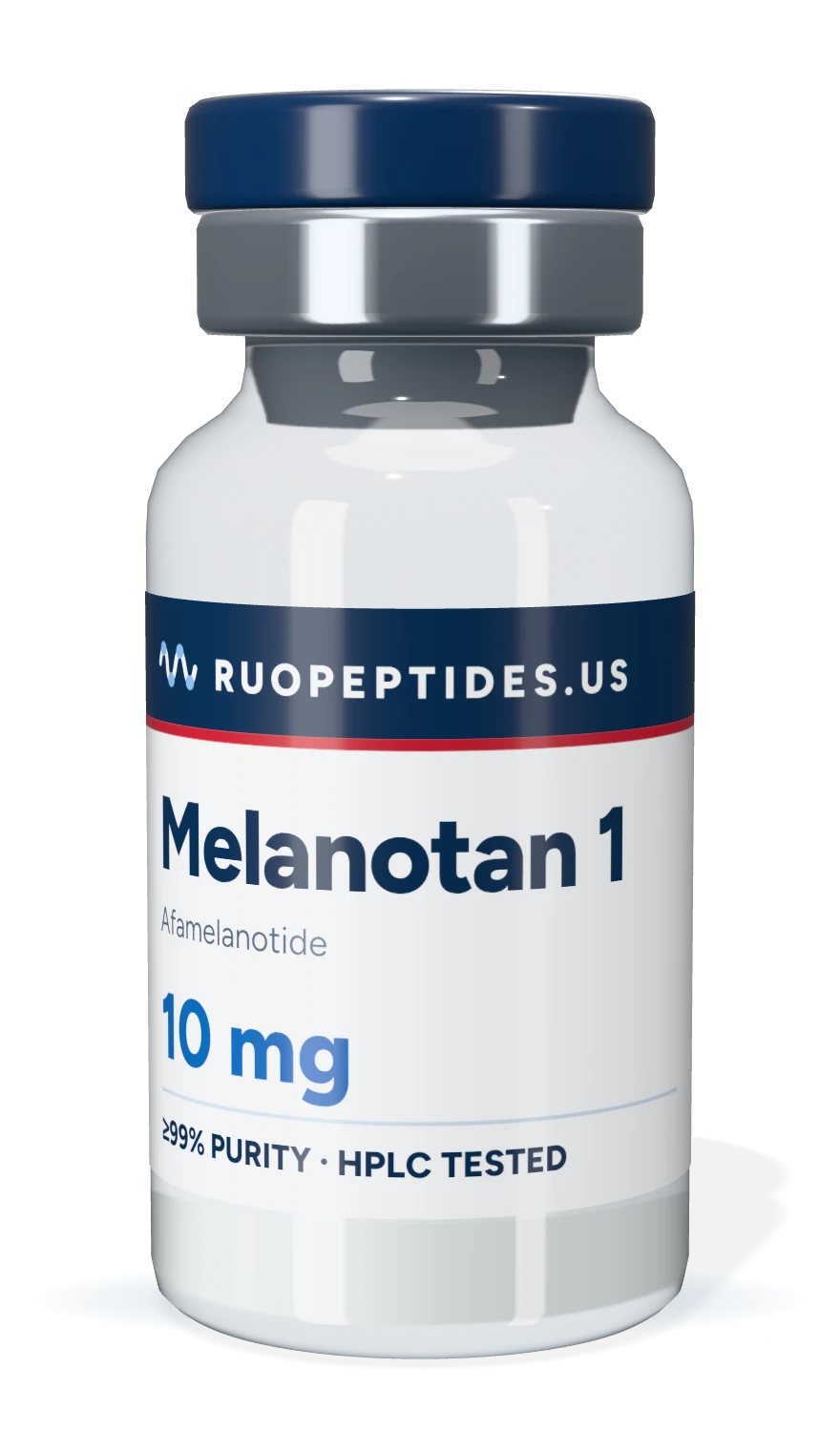
Full label. Lot number and expiry differ per batch and are printed on each vial.
Melanocortin PeptidesSkin & Pigmentation Research
Melanotan 1
Also known as: Afamelanotide, [Nle4, D-Phe7]-α-MSH
Melanotan 1 (MT-I) is a synthetic analogue of α-melanocyte-stimulating hormone (α-MSH) developed to help researchers study pigmentation and melanocortin signaling.
- CAS
- 75921-69-6
- M.W.
- 1646.85 g/mol
- Formula
- C₇₈H₁₁₁N₂₁O₁₉
- Form
- Lyophilized powder
$39.00per vial
Price shown per vial. Quantity discounts below.
In stock
Buy more, pay less per vial
Add 1 more vial to save 3%: $37.83 per vial.
- Safe credit card paymentVisa, Mastercard and American Express
- 30-day money-back guarantee
- Super-fast 1-2 day shippingTo all 50 states and DC
- Free shipping on orders over $200Applied automatically at checkout
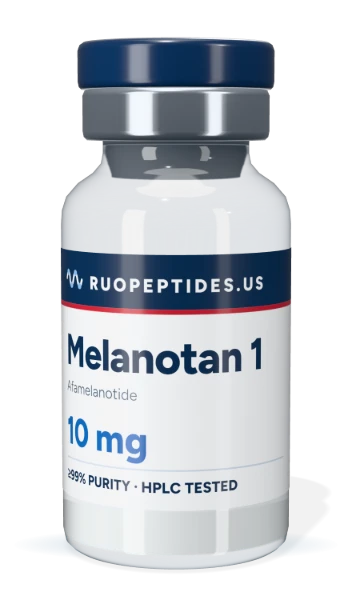
Melanotan 1
10 mg · $39.00/vial
Lyophilized Melanotan 1 storage
Lyophilized Melanotan 1 peptide should be stored in a dry place, protected from sunlight and moisture.
The following storage conditions are generally recommended:
- Room temperature (15-25 °C / 59-77 °F): Up to ~3-8 months
- Refrigerated (2-8 °C / 35.6-46.4 °F): Up to 6 months
- Frozen (-20 °C / -4 °F or below): 3-5 years
Prior reconstituting with a suitable solvent or Saline, allow the vial to reach room temperature after taking it out of the refrigerator or freezer.
Reconstituted Melanotan 1 storage
Once in solution, Melanotan 1 is generally less stable compared to their lyophilized (powdered) form and should be stored at cold temperatures when possible.
These storage conditions are generally recommended:
- Room temperature (15-25 °C / 59-77 °F): Avoid longer than 2-4 day storage
- Refrigerated (2-8 °C / 35.6-46.4 °F): Typically 4-8 weeks
- Frozen (-20 °C / -4 °F or below): Up to 3-4 months
However, to preserve peptide efficacy and amino-acid bonds, avoid repeatedly freezing and unfreezing the peptide.
Melanotan 1 delivery and shipping
Melanotan 1 ships from US stock to United States addresses only. Orders are packed and dispatched within 1-2 business days.
- Standard: $9.95, 1-2 business days after dispatch.
- Express: $24.95, next business day after dispatch.
Lyophilized Melanotan 1 ships in a sealed glass vial with protective packaging. The dry powder is stable at room temperature for the length of domestic transit, so no cold pack is needed. Move it to the storage conditions above when it arrives.
Follow your parcel any time on the Track Order page.
Melanotan 1 lab testing and COA
The certificate of analysis for Melanotan 1 is being uploaded. Ask support for the current report before you order if you need it now.
Every vial label has a lot number. Check it on the Verify page to confirm the vial is genuine. All reports are on the Lab Reports page.
For laboratory research use only. All products are sold for laboratory research use only. They are not drugs, foods, cosmetics or dietary supplements, and are not for human or veterinary use.
Melanotan 1 specifications
- Product
- Melanotan 1
- Also known as
- Afamelanotide, [Nle4, D-Phe7]-α-MSH
- Compound class
- Melanocortin Peptides
- Product type
- Peptide
- Form
- Lyophilized powder
- Amounts available
- 10 mg ($39.00), 20 mg ($69.00)
- Sequence
- Ac-Ser-Tyr-Ser-Nle-Glu-His-D-Phe-Arg-Trp-Gly-Lys-Pro-Val-NH₂
- Molecular formula
- C₇₈H₁₁₁N₂₁O₁₉
- Molecular weight
- 1646.85 g/mol
- CAS number
- 75921-69-6
- Storage as supplied
- Sealed, dry, dark; -20 °C for long-term storage
- Lab report
- COA on request
- Research areas
- Melanocortin Peptides, Skin & Pigmentation Research
- Intended use
- Laboratory research only. Not for human or veterinary use.
Research overview
About Melanotan 1
Scientifically reviewed by John Johnson · Updated November 2026Melanotan 1 (MT-I) is a synthetic analogue of α-melanocyte-stimulating hormone (α-MSH) developed to help researchers study pigmentation and melanocortin signaling. It was designed with structural modifications that improve stability and biological activity compared with endogenous α-MSH. Research has examined its role in MC1R-mediated melanogenesis, pigmentation responses, UV-related cellular activity, and potential photoprotective mechanisms[1]. These features make it useful for investigating melanocortin biology.
What Is Melanotan 1?
Melanotan 1, commonly abbreviated MT-I, is a synthetic linear analogue of endogenous α-melanocyte-stimulating hormone (α-MSH). The MT-I peptide, also called -α-MSH or NDP-MSH, has the sequence Ac-Ser-Tyr-Ser-Nle-Glu-His-D-Phe-Arg-Trp-Gly-Lys-Pro-Val-NH₂. Structural substitutions were introduced to improve its potency, stability, and resistance to enzymatic degradation compared with native α-MSH.
The Melanotan 1 research peptide has been studied primarily for melanocortin signaling and MC1R-associated melanogenesis.
Historically, Melanotan I was a developmental name associated with the peptide later known as afamelanotide. However, research products sold as Melanotan 1 should not be interpreted as the approved afamelanotide medicinal product.
Overview of Published Melanotan 1 Research
Published Melanotan 1 research has focused primarily on melanocortin receptor signaling, melanogenesis, pigmentation, and the biological response of pigmented skin to ultraviolet radiation. Much of this work originated from research into how synthetic α-MSH analogues could reproduce melanocortin signaling while offering greater stability and sustained biological activity than the endogenous hormone.
Melanotan 1 and Melanocortin Receptor Signaling
α-Melanocyte-stimulating hormone (α-MSH) is an endogenous melanocortin peptide involved in the regulation of pigmentation. In melanocytes, α-MSH interacts with melanocortin 1 receptor (MC1R), a G-protein-coupled receptor involved in melanogenesis. MC1R activation stimulates intracellular signaling pathways associated with increased tyrosinase activity and melanin production, particularly eumelanin.
Melanotan 1, also known as -α-MSH or NDP-MSH, was developed as a synthetic alpha-MSH analogue. Changes at positions 4 and 7 produced an analogue with greater biological stability and activity than native α-MSH. Functionally, MT-I acts as a melanocortin receptor agonist and has been studied extensively for its interaction with MC1R.
Research into the analogue helped establish a more durable experimental model for investigating melanocortin signaling and melanogenesis. Later pharmacological reviews also describe the compound now known as afamelanotide as an MC1R agonist that increases melanin synthesis through this signaling pathway [1].
Melanotan 1 and Pigmentation Research
Investigators examined whether exposure to MT-I could alter human skin pigmentation and the relative production of different melanin types.
Researchers reported increased pigmentation at several anatomical sites. Skin samples also showed increases in eumelanin following MT-I exposure, while pheomelanin levels did not change significantly. These findings helped connect the observed pigmentation response specifically with increased eumelanin production [2].
Subsequent controlled research further evaluated the pigmentation response to -α-MSH. In a randomized study involving 65 participants, researchers measured melanin density using reflectance spectroscopy and reported increases across treated participants compared with placebo conditions. The response differed according to baseline skin characteristics, with larger relative increases reported among participants who began with lower melanin levels [3].
Together, these studies established MT-I as an experimental tool for investigating melanocortin-driven melanogenesis and the regulation of human pigmentation. They should not, however, be interpreted as recommendations for cosmetic use of research-grade Melanotan 1.
Melanotan 1 in UV and Photoprotection Research
Another area of research examined whether melanocortin-induced increases in eumelanin could influence biological responses to ultraviolet radiation. Eumelanin absorbs and dissipates portions of incoming UV radiation, which makes its regulation relevant to photobiology and photoprotection research.
Researchers assessed changes in pigmentation as well as cellular markers associated with UV-related skin injury. One randomized study reported increased melanin density following -α-MSH treatment and observed reductions in UV-associated sunburn cells and thymine-dimer formation under the experimental conditions studied [3].
Earlier clinical research also examined MT-I in combination with controlled UV-B or sunlight exposure. Investigators reported enhanced pigmentation responses and persistence of pigmentation compared with control conditions, helping researchers explore whether melanogenesis could be stimulated with less dependence on ultraviolet exposure itself [1].
These findings provided a scientific basis for continued investigation of melanocortin signaling in photobiology. They do not establish that research-grade Melanotan 1 prevents sunburn, prevents skin cancer, or provides clinically validated photoprotection.
From Melanotan 1 Research to Afamelanotide
Research involving -α-MSH, historically referred to as Melanotan I, eventually contributed to the development of afamelanotide, a controlled-release α-MSH analogue developed for pharmaceutical use.
Later clinical investigation shifted toward specific photosensitivity disorders.
Afamelanotide subsequently became an approved medicinal product for EPP in certain jurisdictions. Importantly, these pharmaceutical findings relate to regulated afamelanotide formulations studied in controlled clinical programs. They should not be interpreted as evidence that RUOPeptides' research-grade Melanotan 1 is pharmaceutically equivalent to approved afamelanotide products.
Melanotan 1 vs Melanotan 2: What's the Difference?
| Feature | Melanotan 1 | Melanotan 2 |
|---|---|---|
| Common abbreviation | MT-I | MT-II |
| Relationship to α-MSH | Synthetic α-MSH analogue | Synthetic α-MSH analogue |
| Structure | Linear peptide | Cyclic heptapeptide |
| Receptor profile | More closely associated with MC1R-mediated melanogenesis | Broader melanocortin receptor agonism |
| Main research areas | Pigmentation, melanogenesis, UV response, photobiology | Pigmentation, CNS signaling, sexual-function research, appetite/metabolic signaling |
| Related pharmaceutical development | Historically associated with the development path that later led to afamelanotide. | No equivalent approved MT-II medicine |
Both compounds originated from α-MSH research, but their structures and pharmacological profiles differ substantially. The Melanotan I peptide is a linear α-MSH analogue studied mainly in pigmentation and melanogenesis research, while MT-II is a cyclic analogue with broader melanocortin activity and a different research profile. Importantly, MT-I terminology is historically linked to the development of afamelanotide, but research-grade MT-I should not be treated as interchangeable with approved afamelanotide pharmaceutical products.
Melanotan 1 FAQ
What is Melanotan 1?
Melanotan 1, commonly abbreviated MT-I, is a synthetic analogue of α-melanocyte-stimulating hormone (α-MSH). It was developed for research into melanocortin signaling, melanogenesis, pigmentation, and related photobiology.
What is another name for Melanotan 1?
Melanotan 1 is also known as MT-I, NDP-MSH, or -α-MSH. The term Melanotan I is historically associated with the development of afamelanotide, but research-grade MT-I should not be treated as interchangeable with approved afamelanotide products.
Is Melanotan 1 the same as Melanotan 2?
No. Both are synthetic α-MSH analogues, but they differ structurally and pharmacologically. Melanotan 1 is a linear peptide more closely associated with MC1R-mediated melanogenesis, while Melanotan 2 is a cyclic peptide with broader melanocortin receptor activity.
How does Melanotan 1 interact with melanocortin receptors?
Melanotan 1 acts as a melanocortin receptor agonist. Its research is particularly associated with MC1R activation on melanocytes, which stimulates intracellular signaling involved in melanin synthesis and melanogenesis.
What is Melanotan 1 studied for?
Melanotan 1 has been studied mainly for melanocortin signaling, melanogenesis, skin pigmentation, eumelanin production, UV-related responses, and photobiology. Later pharmaceutical research involving the same peptide sequence contributed to the development of afamelanotide.
What is the relationship between Melanotan 1 and α-MSH?
Melanotan 1 is a synthetic analogue of endogenous α-MSH. Structural substitutions were introduced to increase its stability, resistance to enzymatic degradation, and biological activity, making it useful for experimental investigation of melanocortin signaling and pigmentation pathways.
Scientific references
- [1]Levine N, Sheftel SN, Eytan T, et al. “Induction of Skin Tanning by Subcutaneous Administration of a Potent Synthetic Melanotropin.” JAMA. 1991;266(19):2730-2736.
- [2]Dorr RT, Dvorakova K, Brooks C, et al. “Increased Eumelanin Expression and Tanning Is Induced by a Superpotent Melanotropin -α-MSH in Humans.” Photochemistry and Photobiology. 2000;72(4):526-532.
- [3]Barnetson RSC, Ooi TKT, Zhuang L, et al. “-α-Melanocyte-Stimulating Hormone Significantly Increased Pigmentation and Decreased UV Damage in Fair-Skinned Caucasian Volunteers.” Journal of Investigative Dermatology. 2006;126(8):1869-1878.
Buying Melanotan 1 for research in the USA
Price
From $39.00. 10 mg: $39.00, 20 mg: $69.00. Quantity discounts per size: 3% off 2 vials, 5% off 3-4 vials, 7% off 5+ vials.
Shipping
US addresses only. Orders are packed and dispatched within 1-2 business days. Standard from $9.95.
Proof it's genuine
Check the lot number on your vial on the Verify page.
Lab reports
COA and SDS documents are on the Lab Reports page.
Scientifically reviewed
Scientifically reviewed by John Johnson
Scientific reviewer · Last reviewed November 2026
John Johnson reviewed this Melanotan 1 page for scientific accuracy: the compound's identity and specifications, the summaries of published studies, and the references they cite. The page describes laboratory and preclinical research only. It is not medical advice and gives no usage guidance.
Research information on this page summarizes published laboratory and preclinical studies. It is not usage guidance.