For laboratory research use only. Not for human or veterinary use.
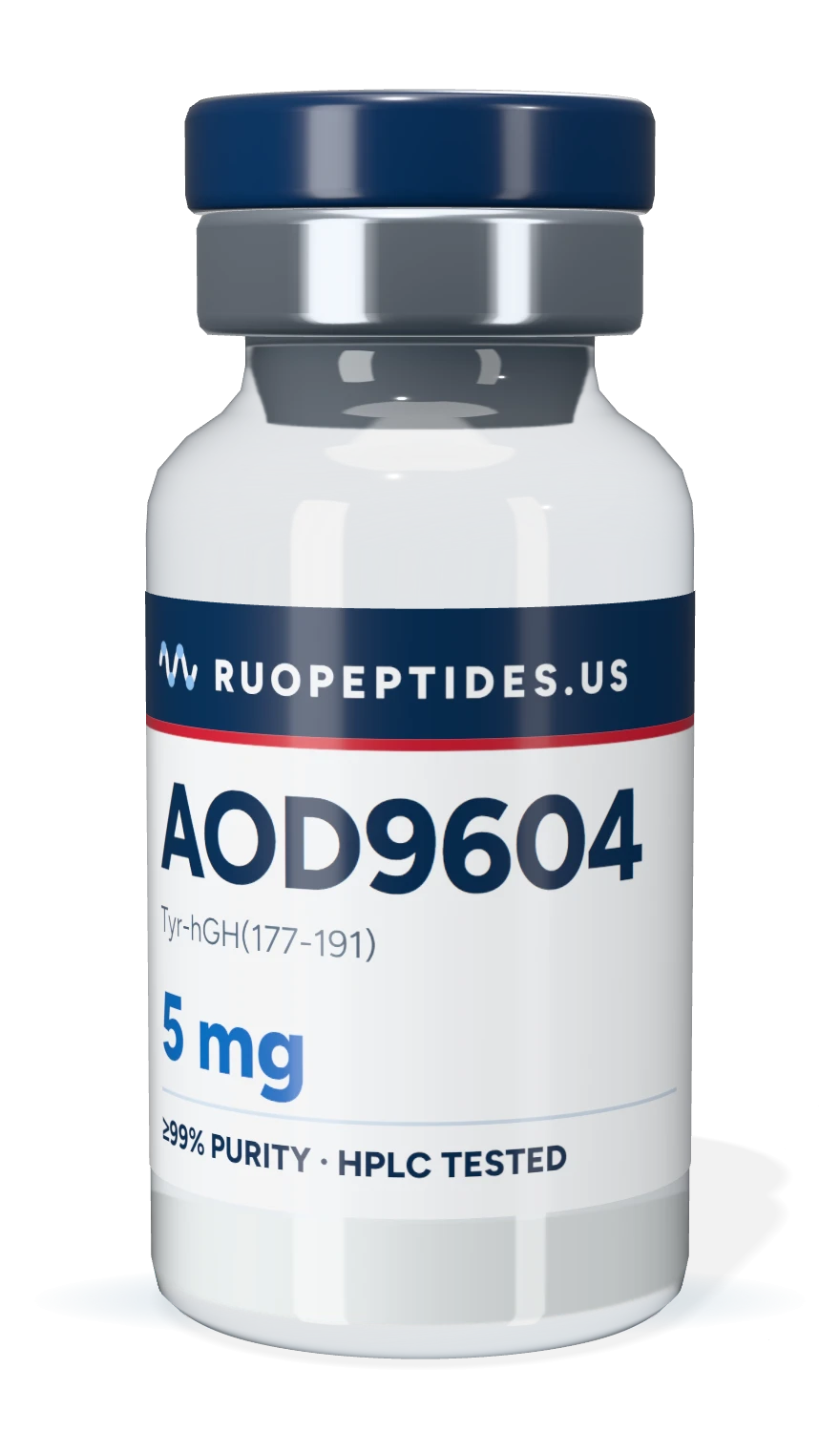
AOD9604
FOR RESEARCH USE ONLYNot for human or veterinary use of any kind
Full label. Lot number and expiry differ per batch and are printed on each vial.
AOD9604
Also known as: Tyr-hGH(177-191)
AOD9604 is a synthetic peptide fragment derived from the C-terminal region of human growth hormone (hGH), comprising amino acids 177-191 with an N-terminal tyrosine modification.
- CAS
- 221231-10-3
- M.W.
- 1,815.1 g/mol
- Formula
- C₇₈H₁₂₃N₂₃O₂₃S₂
- Form
- Lyophilized powder
$49.00per vial
Price shown per vial. Quantity discounts below.
In stock
Buy more, pay less per vial
Add 1 more vial to save 3%: $47.53 per vial.
- Safe credit card paymentVisa, Mastercard and American Express
- 30-day money-back guarantee
- Super-fast 1-2 day shippingTo all 50 states and DC
- Free shipping on orders over $200Applied automatically at checkout
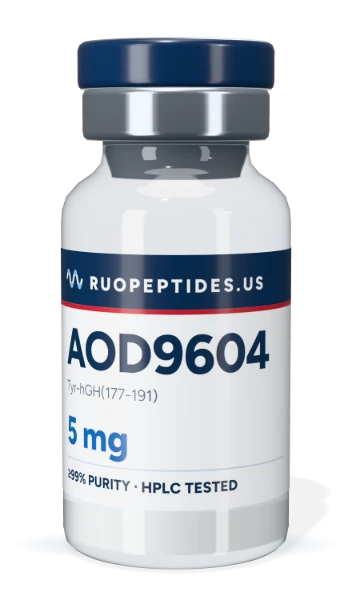
AOD9604
5 mg · $49.00/vial
Lyophilized AOD9604 storage
Lyophilized AOD9604 peptide should be stored in a dry place, protected from sunlight and moisture.
The following storage conditions are generally recommended:
- Room temperature (15-25 °C / 59-77 °F): Up to ~3-8 months
- Refrigerated (2-8 °C / 35.6-46.4 °F): Up to 6 months
- Frozen (-20 °C / -4 °F or below): 3-5 years
Prior reconstituting with a suitable solvent or Saline, allow the vial to reach room temperature after taking it out of the refrigerator or freezer.
Reconstituted AOD9604 storage
Once in solution, AOD9604 is generally less stable compared to their lyophilized (powdered) form and should be stored at cold temperatures when possible.
These storage conditions are generally recommended:
- Room temperature (15-25 °C / 59-77 °F): Avoid longer than 2-4 day storage
- Refrigerated (2-8 °C / 35.6-46.4 °F): Typically 4-8 weeks
- Frozen (-20 °C / -4 °F or below): Up to 3-4 months
However, to preserve peptide efficacy and amino-acid bonds, avoid repeatedly freezing and unfreezing the peptide.
AOD9604 delivery and shipping
AOD9604 ships from US stock to United States addresses only. Orders are packed and dispatched within 1-2 business days.
- Standard: $9.95, 1-2 business days after dispatch.
- Express: $24.95, next business day after dispatch.
Lyophilized AOD9604 ships in a sealed glass vial with protective packaging. The dry powder is stable at room temperature for the length of domestic transit, so no cold pack is needed. Move it to the storage conditions above when it arrives.
Follow your parcel any time on the Track Order page.
AOD9604 lab testing and COA
The certificate of analysis for AOD9604 is being uploaded. Ask support for the current report before you order if you need it now.
Every vial label has a lot number. Check it on the Verify page to confirm the vial is genuine. All reports are on the Lab Reports page.
For laboratory research use only. All products are sold for laboratory research use only. They are not drugs, foods, cosmetics or dietary supplements, and are not for human or veterinary use.
AOD9604 specifications
- Product
- AOD9604
- Also known as
- Tyr-hGH(177-191)
- Compound class
- Growth Factor Analogs
- Product type
- Peptide
- Form
- Lyophilized powder
- Amounts available
- 5 mg ($49.00), 10 mg ($89.00)
- Sequence
- Tyr-Leu-Arg-Ile-Val-Gln-Cys-Arg-Ser-Val-Glu-Gly-Ser-Cys-Gly-Phe
- Molecular weight
- 1,815.1 g/mol
- Molecular formula
- C₇₈H₁₂₃N₂₃O₂₃S₂
- CAS number
- 221231-10-3
- Storage as supplied
- Sealed, dry, dark; -20 °C for long-term storage
- Lab report
- COA on request
- Research areas
- Growth Factor Analogs
- Intended use
- Laboratory research only. Not for human or veterinary use.
Research overview
About AOD9604
Scientifically reviewed by John Johnson · Updated November 2026AOD9604 is a synthetic peptide fragment derived from the C-terminal region of human growth hormone (hGH), comprising amino acids 177-191 with an N-terminal tyrosine modification. [1] The peptide is intended solely for in vitro and analytical research use.
Its structural relationship to the C-terminal region of hGH has led to research investigating AOD9604 in areas such as lipid metabolism, lipolysis, adipose-tissue biology, and β3-adrenergic signaling in experimental models.
What Is AOD9604?
AOD9604 research peptide is a synthetic derivative of the C-terminal region of human growth hormone (hGH). It corresponds to amino acids 177-191 of the full-length hGH sequence and includes an additional tyrosine residue at the N-terminus to support structural stability.
Human growth hormone (hGH) consists of 191 amino acids and plays roles in growth, metabolism, and tissue-related processes. AOD9604 was developed from a specific C-terminal portion of hGH and has been examined separately in metabolic research. Its fragment-based structure distinguishes it from the parent hormone.
In scientific literature and commercial listings, AOD9604 may be identified by alternative names such as HGH fragment 176-191, hGH fragment, growth hormone fragment, and AOD-9604. Since these labels are not always used consistently, checking the exact sequence, modification profile, and CAS number can help confirm the identity of the compound being referenced.
AOD9604 Research Applications
AOD9604 peptide has been investigated in published experimental research covering several areas of metabolic and adipose-tissue biology. As a defined AOD9604 HGH fragment, it has been investigated in the following areas:
- Lipid-metabolism research: investigating the effects of AOD9604 on lipid metabolism and related metabolic pathways in experimental models. [2]
- Lipolysis research: investigating mobilization and breakdown of stored lipids within adipose-tissue experimental models.
- Adipose-tissue biology: studying metabolic activity and signaling pathways in white adipose tissue using experimental models.
- β3-adrenergic pathways: animal studies have investigated the relationship between AOD9604 and β3-adrenergic receptor (β3-AR) expression and lipolytic responses. Studies using obese and β3-AR knockout mice found associations with β3-AR expression, but the reported lipolytic effects were not attributed directly to β3-AR signaling. [3]
- Energy-metabolism research: experimental studies have investigated changes in energy expenditure and fat oxidation in animal models. [4]
- Growth-hormone-fragment research: examining biological properties associated with selected C-terminal hGH regions studied independently from the full-length hormone. [5]
All findings referenced reflect preclinical experimental literature and should not be extrapolated directly to human outcomes.
AOD9604 FAQ
Is AOD9604 a growth hormone fragment?
Yes. AOD9604 is a synthetic modified growth hormone fragment peptide derived from the C-terminal region of human growth hormone - specifically amino acids 177-191 with an N-terminal tyrosine modification incorporated to enhance structural stability.
Is AOD9604 the same as HGH?
No. Full-length hGH is a 191-amino-acid peptide hormone with broad biological functions. AOD9604 is a synthetic modified fragment derived from a specific C-terminal region of hGH and investigated separately for metabolic effects associated with that region; it is pharmacologically and structurally distinct from the parent hormone.
What is HGH fragment 176-191?
HGH fragment 176-191 is a common alternative designation encountered in published literature and commercial contexts for compounds derived from this C-terminal hGH region. AOD9604 corresponds to amino acids 177-191 with an N-terminal tyrosine modification - researchers should verify the exact sequence and modification profile when comparing products.
What is AOD9604 studied for?
Published research documents AOD9604 investigation across lipid metabolism, lipolysis, adipose-tissue biology, β3-adrenergic receptor pathways, energy expenditure, and growth-hormone-fragment research examining C-terminal hGH region properties independently from the full-length hormone.
Is AOD9604 studied for lipolysis?
Yes. Experimental studies have investigated AOD9604 in relation to lipolytic activity and lipid mobilization in adipose-tissue models. These findings reflect preclinical experimental literature and should not be directly extrapolated to human outcomes.
How is AOD9604 related to beta-3 adrenergic receptors?
Animal research has examined relationships between AOD9604 and β3-adrenergic receptor expression and lipolytic sensitivity. Notably, studies in obese and β3-AR knockout mice found associations with β3-AR expression, though the authors concluded AOD9604's lipolytic actions were not directly mediated through the β3-AR pathway.
Is AOD9604 the same as Adipotide?
No. Adipotide and AOD9604 are distinct research compounds with different structures, origins, and experimental mechanisms. AOD9604 is derived from the C-terminal region of hGH; Adipotide is a pro-apoptotic peptide investigated in relation to adipose vasculature in preclinical models. [6]
Is AOD9604 a GLP-1 receptor agonist?
No. AOD9604 is a modified hGH C-terminal fragment investigated primarily in lipid metabolism and adipose-tissue research. It is not a GLP-1 receptor agonist and should not be grouped with compounds such as Semaglutide or Tirzepatide, which act through entirely different receptor pathways. [7]
Scientific references
- [1]Detection and in vitro metabolism of AOD9604
- [2]Metabolic studies of a synthetic lipolytic domain (AOD9604) of human growth hormone
- [3]The effects of human GH and its lipolytic fragment (AOD9604) on lipid metabolism following chronic treatment in obese mice and beta(3)-AR knock-out mice
- [4]Increase of fat oxidation and weight loss in obese mice caused by chronic treatment with human growth hormone or a modified C-terminal fragment
- [5]Antilipogenic action of synthetic C-terminal sequence 177-191 of human growth hormone
- [6]A peptidomimetic targeting white fat causes weight loss and improved insulin resistance in obese monkeys
- [7]LY3298176, a novel dual GIP and GLP-1 receptor agonist for the treatment of type 2 diabetes mellitus: From discovery to clinical proof of concept
Buying AOD9604 for research in the USA
Price
From $49.00. 5 mg: $49.00, 10 mg: $89.00. Quantity discounts per size: 3% off 2 vials, 5% off 3-4 vials, 7% off 5+ vials.
Shipping
US addresses only. Orders are packed and dispatched within 1-2 business days. Standard from $9.95.
Proof it's genuine
Check the lot number on your vial on the Verify page.
Lab reports
COA and SDS documents are on the Lab Reports page.
Scientifically reviewed
Scientifically reviewed by John Johnson
Scientific reviewer · Last reviewed November 2026
John Johnson reviewed this AOD9604 page for scientific accuracy: the compound's identity and specifications, the summaries of published studies, and the references they cite. The page describes laboratory and preclinical research only. It is not medical advice and gives no usage guidance.
Research information on this page summarizes published laboratory and preclinical studies. It is not usage guidance.