For laboratory research use only. Not for human or veterinary use.
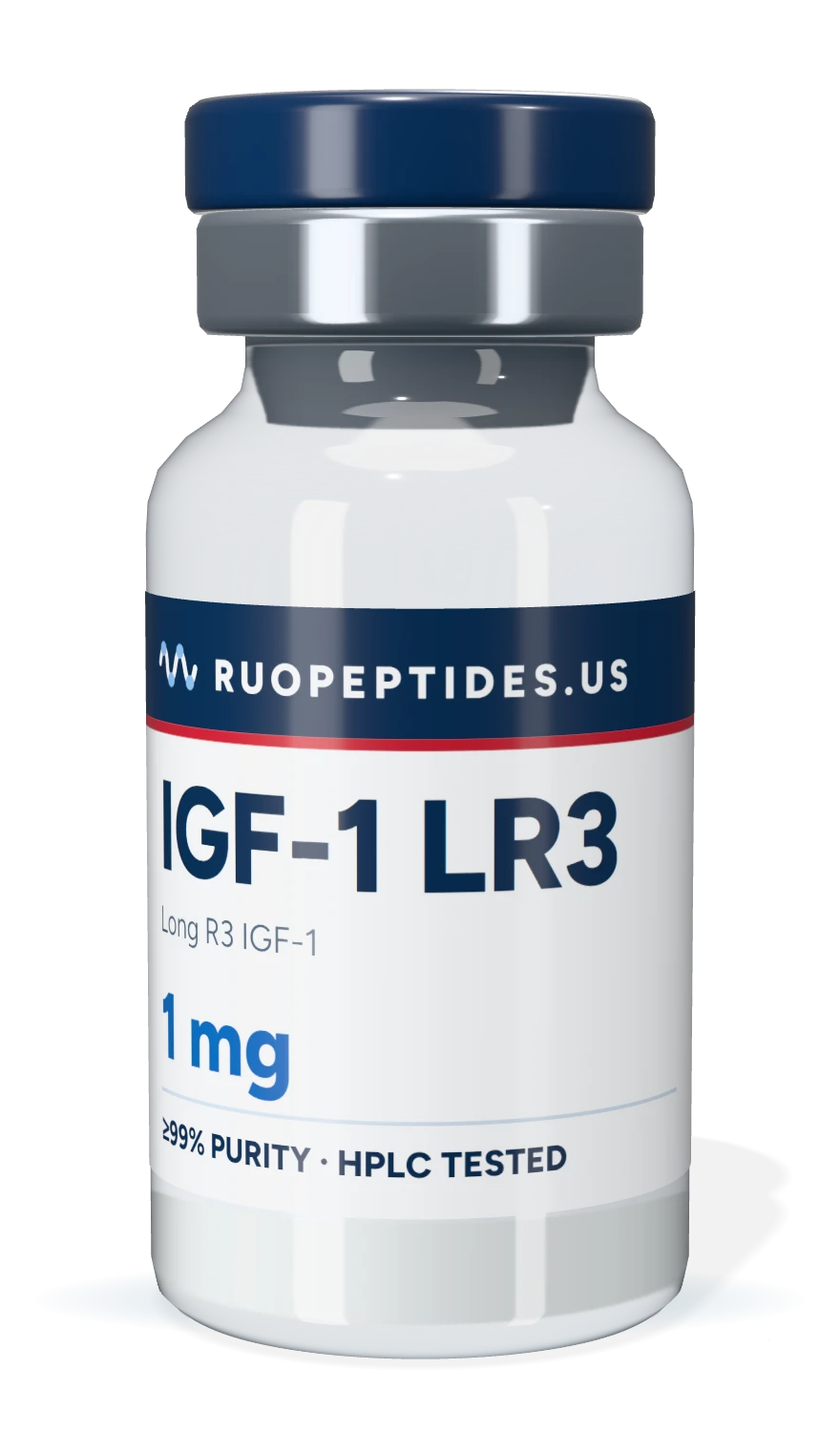
IGF-1 LR3
FOR RESEARCH USE ONLYNot for human or veterinary use of any kind
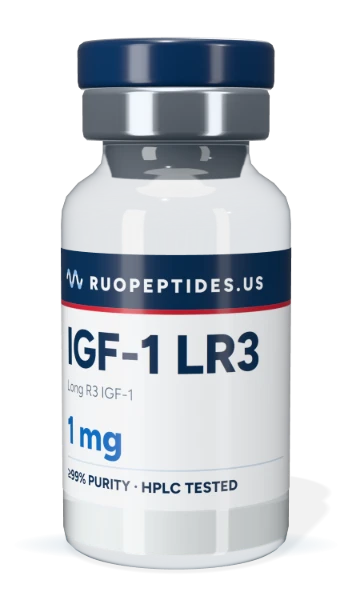
Full label. Lot number and expiry differ per batch and are printed on each vial.
IGF-1 LR3
Also known as: Long R3 IGF-1
Also known as Long R3 IGF-1 or Long IGF-I, IGF-1 LR3 differs from native IGF-1 through an arginine substitution at position 3 and a 13-amino-acid N-terminal extension.
- CAS
- 910463-68-2
- M.W.
- 4,113.64 g/mol
- Formula
- C₁₈₇H₂₉₁N₄₅O₅₉
- Form
- Lyophilized powder
$89.00per vial
Price shown per vial. Quantity discounts below.
In stock
Buy more, pay less per vial
Add 1 more vial to save 3%: $86.33 per vial.
- Safe credit card paymentVisa, Mastercard and American Express
- 30-day money-back guarantee
- Super-fast 1-2 day shippingTo all 50 states and DC
- Free shipping on orders over $200Applied automatically at checkout
IGF-1 LR3
1 mg · $89.00/vial
Lyophilized IGF-1 LR3 storage
Lyophilized IGF-1 LR3 peptide should be stored in a dry place, protected from sunlight and moisture.
The following storage conditions are generally recommended:
- Room temperature (15-25 °C / 59-77 °F): Up to ~3-8 months
- Refrigerated (2-8 °C / 35.6-46.4 °F): Up to 6 months
- Frozen (-20 °C / -4 °F or below): 3-5 years
Prior reconstituting with a suitable solvent or Saline, allow the vial to reach room temperature after taking it out of the refrigerator or freezer.
Reconstituted IGF-1 LR3 storage
Once in solution, IGF-1 LR3 is generally less stable compared to their lyophilized (powdered) form and should be stored at cold temperatures when possible.
These storage conditions are generally recommended:
- Room temperature (15-25 °C / 59-77 °F): Avoid longer than 2-4 day storage
- Refrigerated (2-8 °C / 35.6-46.4 °F): Typically 4-8 weeks
- Frozen (-20 °C / -4 °F or below): Up to 3-4 months
However, to preserve peptide efficacy and amino-acid bonds, avoid repeatedly freezing and unfreezing the peptide.
IGF-1 LR3 delivery and shipping
IGF-1 LR3 ships from US stock to United States addresses only. Orders are packed and dispatched within 1-2 business days.
- Standard: $9.95, 1-2 business days after dispatch.
- Express: $24.95, next business day after dispatch.
Lyophilized IGF-1 LR3 ships in a sealed glass vial with protective packaging. The dry powder is stable at room temperature for the length of domestic transit, so no cold pack is needed. Move it to the storage conditions above when it arrives.
Follow your parcel any time on the Track Order page.
IGF-1 LR3 lab testing and COA
The certificate of analysis for IGF-1 LR3 is being uploaded. Ask support for the current report before you order if you need it now.
Every vial label has a lot number. Check it on the Verify page to confirm the vial is genuine. All reports are on the Lab Reports page.
For laboratory research use only. All products are sold for laboratory research use only. They are not drugs, foods, cosmetics or dietary supplements, and are not for human or veterinary use.
IGF-1 LR3 specifications
- Product
- IGF-1 LR3
- Also known as
- Long R3 IGF-1
- Compound class
- Growth Factor Analogs
- Product type
- Peptide
- Form
- Lyophilized powder
- Amounts available
- 1 mg ($89.00), 2 mg ($159.00)
- Sequence
- His-Ala-Glu-Gly-Thr-Phe-Thr-Ser-Asp-Val-Ser-Ser-Tyr-Leu-Glu-Gly-Gln-Ala-Ala-Lys-Glu-Phe-Ile-Ala-Trp-Leu-Val-Lys-Gly-Gly-Gly-Pro-Ser-Ser-Gly-Ala-Pro-Pro-Pro-Ser-NH₂
- Molecular weight
- 4,113.64 g/mol
- Molecular formula
- C₁₈₇H₂₉₁N₄₅O₅₉
- CAS number
- 910463-68-2
- Storage as supplied
- Sealed, dry, dark; -20 °C for long-term storage
- Lab report
- COA on request
- Research areas
- Growth Factor Analogs
- Intended use
- Laboratory research only. Not for human or veterinary use.
Research overview
About IGF-1 LR3
Scientifically reviewed by John Johnson · Updated November 2026Also known as Long R3 IGF-1 or Long IGF-I, IGF-1 LR3 differs from native IGF-1 through an arginine substitution at position 3 and a 13-amino-acid N-terminal extension.
These modifications substantially reduce its binding affinity for endogenous IGF-binding proteins while maintaining activity at the type 1 IGF receptor (IGF-1R) [1].
What Is IGF-1 LR3?
Insulin-like growth factor 1 (IGF-1) is a peptide hormone involved in cellular growth, tissue differentiation, metabolic regulation, and development. In physiological systems, much of IGF-1's biological availability is regulated by a group of proteins known as insulin-like growth factor-binding proteins (IGFBPs). These proteins bind IGF-1 and influence its transport, availability, and interaction with cell-surface receptors.
Researchers have developed structural analogues of IGF-1 to investigate receptor signaling and the regulatory effects of IGFBPs under controlled experimental conditions. IGF-1 LR3 is one such analogue. Native human IGF-1 contains 70 amino acids, whereas IGF-1 LR3 contains 83 amino acids.
The modified structure incorporates two principal changes
- An arginine (R) substitution for glutamic acid (E) at position 3 of the native IGF-1 sequence.
- A 13-amino-acid extension at the N-terminus.
These modifications substantially reduce the analogue's affinity for several IGF-binding proteins while preserving activity at the type 1 IGF receptor [1]. This property makes IGF-1 LR3 useful in experimental systems where researchers want to examine IGF-1R signaling with reduced interference from endogenous IGFBP binding.
Importantly, reduced IGFBP affinity should not simply be interpreted as making IGF-1 LR3 universally "stronger" than native IGF-1. Its observed activity depends on the experimental model, the concentration used, the presence of binding proteins, and other biological conditions.
IGF-1 LR3 and IGF-Binding Proteins
The relationship between IGF-1 and IGFBPs is central to research involving Long R3 IGF-1. In cell-culture systems, endogenous IGFBPs can bind native IGF-1 and reduce the amount available to interact with cell-surface receptors. Because IGF-1 LR3 has substantially lower affinity for several IGFBPs, its activity can differ considerably from that of native IGF-1 in these experimental environments.
Research involving human fibroblasts demonstrated that Long R3 IGF-1 was approximately 20-fold more potent than native IGF-1 in an experimental assay measuring DNA synthesis and cellular proliferation [2]. In the experiment where exogenous IGFBP-3 was introduced into the culture system, the activity of endogenous IGF-1 was significantly inhibited but that of the Long R3 IGF-1 was not [2].
In another study carried out on postnatal lung fibroblasts, it was found that the activity of Long R3 IGF-1 was comparatively higher because of the inhibitory effect of IGFBPs in the conditioned media of the cultures [3]. These observations highlight the role that IGFBPs may play in regulating the biological effects of IGF-1.
The increased activity observed for LR3 in these assays therefore reflects the specific experimental environment rather than a general measure of potency applicable to humans. Its reduced interaction with IGFBPs is particularly useful when researchers need to distinguish direct IGF-1 receptor-mediated effects from binding-protein-mediated regulation.
IGF-1 LR3 in Cellular Growth and Signaling Research
Because IGF-1 LR3 has reduced affinity for IGFBPs, researchers can use it to investigate aspects of IGF-1 receptor signaling with less interference from endogenous binding proteins. Experimental studies have examined endpoints including DNA synthesis, cellular proliferation, IGFBP production, receptor activation, and downstream intracellular signaling pathways.
The IGF-1 receptor is a transmembrane receptor involved in transmitting signals from IGF-1 and related ligands into the cell. Following receptor activation, downstream pathways including Akt and MAPK signaling can influence cellular processes such as growth, metabolism, and proliferation.
Research in ovarian granulosa cells found Long R3 IGF-1 to be markedly more potent than native IGF-1 in stimulating the production of several IGF-binding proteins [4]. This finding provided experimental evidence that growth-factor signaling can itself influence the production of proteins that subsequently regulate IGF availability.
This relationship is important because IGFBPs are not simply passive carrier proteins. Their production and concentration can change in response to cellular signals, creating feedback mechanisms that influence the biological availability of IGF ligands.
More recent recombinant-expression research has also investigated the production of bioactive IGF-1 and LR3 IGF-1 using Pichia pastoris expression systems [5]. The study compared the resulting constructs and evaluated their biological activity in vitro, providing additional information about the production and characterization of recombinant LR3 IGF-1.
Together, these studies demonstrate why IGF-1 LR3 is useful as an experimental analogue for investigating IGF-1 receptor signaling and the relationship between growth-factor activity and IGFBP regulation.
IGF-1 LR3 in Growth and Tissue Research
Animal research has provided additional information about how Long R3 IGF-1 behaves when its interaction with IGFBPs is substantially reduced.
A study in guinea pigs compared Long R3 IGF-1 with native IGF-I and IGF-II following systemic administration [6]. Researchers observed changes in the fractional weights of several organs alongside reductions in circulating IGF-I, IGF-II, and IGF-binding protein concentrations [6].
Notably, overall body growth was not stimulated in the experimental animals [6]. This observation is relevant when interpreting the biological consequences of reduced IGFBP binding. Lower affinity for binding proteins does not automatically translate into increased whole-body growth.
Instead, changes in IGFBP interactions can affect the distribution, clearance, receptor exposure, and endocrine regulation of IGF-related molecules. The guinea-pig findings therefore demonstrate that the effects of Long R3 IGF-1 can vary between individual tissues and systemic physiological measures.
This research also highlights the importance of distinguishing tissue-specific experimental findings from broad claims about growth. The effects observed in animal models cannot automatically be extrapolated to human physiology.
Feedback Effects of Long R3 IGF-1 on the IGF/GH Axis
IGF-1 signaling is closely connected with the broader growth hormone (GH) and somatotropic endocrine axis. Manipulating IGF signaling can therefore produce feedback effects involving endogenous IGF-1, GH, insulin, and IGFBPs.
A study in pigs examined Long R3 IGF-1 administered alone and in combination with porcine growth hormone [7].
These findings demonstrate that modifying IGF-1 signaling can influence multiple components of endocrine homeostasis rather than producing an isolated receptor-level response. The study provides an example of how experimental manipulation of IGF signaling can affect feedback mechanisms throughout the somatotropic axis.
As with the other studies discussed here, these findings were obtained in specific animal or laboratory models and should be interpreted within those experimental contexts.
IGF-1 LR3 FAQ
What is IGF-1 LR3?
IGF-1 LR3 is a synthetic 83-amino-acid analogue of human insulin-like growth factor 1. It contains an arginine substitution at position 3 and a 13-amino-acid N-terminal extension. These modifications substantially reduce its affinity for IGF-binding proteins while maintaining activity at the type 1 IGF receptor.
What does LR3 mean in IGF-1 LR3?
LR3 refers to Long R3. "Long" describes the 13-amino-acid extension added to the N-terminus, while "R3" refers to the substitution of arginine (R) for glutamic acid (E) at position 3 of native IGF-1.
How is IGF-1 LR3 different from IGF-1?
Native human IGF-1 contains 70 amino acids, whereas IGF-1 LR3 contains 83. LR3 includes a 13-amino-acid N-terminal extension and an arginine-for-glutamic-acid substitution at position 3. These changes substantially reduce its affinity for several IGFBPs while retaining IGF-1 receptor activity.
How many amino acids are in IGF-1 LR3?
IGF-1 LR3 contains 83 amino acids. Native human IGF-1 contains 70 amino acids, while the LR3 analogue incorporates an additional 13 amino acids at the N-terminus along with the Arg3 substitution.
What are IGF-binding proteins?
IGF-binding proteins are a family of proteins that bind IGF molecules and regulate their biological availability. By interacting with IGF-1, IGFBPs can influence its transport, distribution, receptor access and activity in different experimental and physiological environments.
Does IGF-1 LR3 bind to IGF-1 receptors?
Yes. IGF-1 LR3 retains activity at the type 1 IGF receptor (IGF-1R) while having substantially reduced affinity for several IGF-binding proteins. This property makes it useful for studying IGF-1R-mediated signaling with less interference from IGFBP binding.
What is IGF-1 LR3 studied for?
In research settings, IGF-1 LR3 is studied to investigate IGF-1 receptor signaling, cellular proliferation, DNA synthesis, IGFBP regulation, and endocrine feedback mechanisms. Researchers have examined these effects in cultured cells and animal models, including fibroblasts, ovarian granulosa cells, guinea pigs and pigs.
Why does IGF-1 LR3 have reduced affinity for IGF-binding proteins?
The structural modifications in IGF-1 LR3 alter its interaction with IGFBPs. In particular, the Arg3 substitution and N-terminal extension substantially reduce binding affinity compared with native IGF-1. This allows researchers to investigate IGF-1 receptor activity in experimental systems with less influence from endogenous binding proteins.
Scientific references
- [1]Flint DJ, Tonner E, Beattie J, Allan GJ. “Several insulin-like growth factor-I analogues and complexes of insulin-like growth factors-I and -II with insulin-like growth factor-binding protein-3 fail to mimic the effect of growth hormone upon lactation in the rat.” Journal of Endocrinology. 1994;140(2):211-216.
- [2]Conover CA, Clarkson JT, Bale LK. “Cytokines modulate the sensitivity of human fibroblasts to stimulation with insulin-like growth factor-I (IGF-I) by altering endogenous IGF-binding protein production.” Journal of Cellular Physiology. 1993;154(2):429-440.
- [3]Price WA, Moats-Staats BM, Stiles AD. “Regulation of insulin-like growth factor (IGF)-binding protein expression by growth factors and cytokines alters IGF-mediated proliferation of postnatal lung fibroblasts.” Experimental Lung Research. 2004;30(3):195-210.
- [4]Adashi EY, Resnick CE, Hurwitz A, et al. “Insulin and insulin-like growth factors (IGFs) stimulate production of IGF-binding proteins by ovarian granulosa cells.” Endocrinology. 1992;131(6):2851-2858.
- [5]Zhang H, et al. “Recombinant expression of IGF-1 and LR3 IGF-1 fused with xylanase in Pichia pastoris.” Protein Expression and Purification. 2023;205:106240.
- [6]Conlon MA, Tomas FM, Owens PC, Wallace JC, Howarth GS, Ballard FJ. “Long R3 insulin-like growth factor-I (IGF-I) infusion stimulates organ growth but reduces plasma IGF-I, IGF-II and IGF binding protein concentrations in the guinea pig.” Journal of Endocrinology. 1995;146(2):247-258.
- [7]Dunaiski V, Dunshea FR, Walton PE, Goddard C. “Long insulin-like growth factor-I reduces growth, plasma growth hormone, IGF binding protein-3 and endogenous IGF-I concentrations in pigs.” Journal of Endocrinology. 1997;155(3):559-568.
Buying IGF-1 LR3 for research in the USA
Price
From $89.00. 1 mg: $89.00, 2 mg: $159.00. Quantity discounts per size: 3% off 2 vials, 5% off 3-4 vials, 7% off 5+ vials.
Shipping
US addresses only. Orders are packed and dispatched within 1-2 business days. Standard from $9.95.
Proof it's genuine
Check the lot number on your vial on the Verify page.
Lab reports
COA and SDS documents are on the Lab Reports page.
Scientifically reviewed
Scientifically reviewed by John Johnson
Scientific reviewer · Last reviewed November 2026
John Johnson reviewed this IGF-1 LR3 page for scientific accuracy: the compound's identity and specifications, the summaries of published studies, and the references they cite. The page describes laboratory and preclinical research only. It is not medical advice and gives no usage guidance.
Research information on this page summarizes published laboratory and preclinical studies. It is not usage guidance.