For laboratory research use only. Not for human or veterinary use.
PEG-MGF

FOR RESEARCH USE ONLYNot for human or veterinary use of any kind
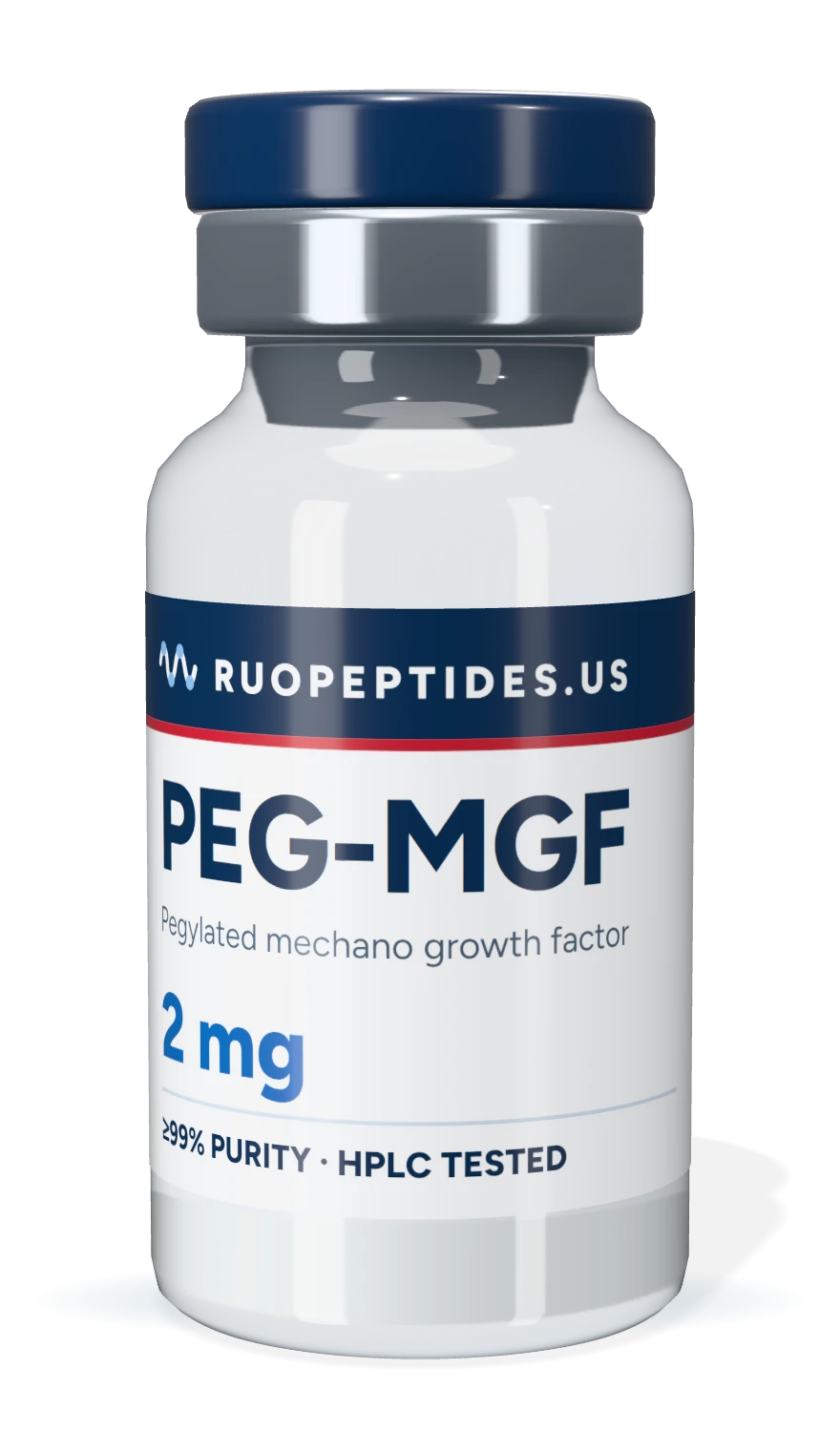
Full label. Lot number and expiry differ per batch and are printed on each vial.
PEG-MGF
Also known as: Pegylated mechano growth factor
PEG-MGF is Pegylated Mechano Growth Factor. MGF is the name attached to an IGF-1 splice variant associated with IGF-1Ec in humans, and the peptide sold under that name is a synthetic 24-residue piece of the variant's E-domain.
- CAS
- 0
- M.W.
- 2,888.16 g/mol
- Formula
- C₁₂₁H₂₀₀N₄₂O₃₉
- Form
- Lyophilized powder
$55.00per vial
Price shown per vial. Quantity discounts below.
In stock
Buy more, pay less per vial
Add 1 more vial to save 3%: $53.35 per vial.
- Safe credit card paymentVisa, Mastercard and American Express
- 30-day money-back guarantee
- Super-fast 1-2 day shippingTo all 50 states and DC
- Free shipping on orders over $200Applied automatically at checkout
PEG-MGF
2 mg · $55.00/vial
Lyophilized PEG-MGF storage
Lyophilized PEG-MGF peptide should be stored in a dry place, protected from sunlight and moisture.
The following storage conditions are generally recommended:
- Room temperature (15-25 °C / 59-77 °F): Up to ~3-8 months
- Refrigerated (2-8 °C / 35.6-46.4 °F): Up to 6 months
- Frozen (-20 °C / -4 °F or below): 3-5 years
Prior reconstituting with a suitable solvent or Saline, allow the vial to reach room temperature after taking it out of the refrigerator or freezer.
Reconstituted PEG-MGF storage
Once in solution, PEG-MGF is generally less stable compared to their lyophilized (powdered) form and should be stored at cold temperatures when possible.
These storage conditions are generally recommended:
- Room temperature (15-25 °C / 59-77 °F): Avoid longer than 2-4 day storage
- Refrigerated (2-8 °C / 35.6-46.4 °F): Typically 4-8 weeks
- Frozen (-20 °C / -4 °F or below): Up to 3-4 months
However, to preserve peptide efficacy and amino-acid bonds, avoid repeatedly freezing and unfreezing the peptide.
PEG-MGF delivery and shipping
PEG-MGF ships from US stock to United States addresses only. Orders are packed and dispatched within 1-2 business days.
- Standard: $9.95, 1-2 business days after dispatch.
- Express: $24.95, next business day after dispatch.
Lyophilized PEG-MGF ships in a sealed glass vial with protective packaging. The dry powder is stable at room temperature for the length of domestic transit, so no cold pack is needed. Move it to the storage conditions above when it arrives.
Follow your parcel any time on the Track Order page.
PEG-MGF lab testing and COA
The certificate of analysis for PEG-MGF is being uploaded. Ask support for the current report before you order if you need it now.
Every vial label has a lot number. Check it on the Verify page to confirm the vial is genuine. All reports are on the Lab Reports page.
For laboratory research use only. All products are sold for laboratory research use only. They are not drugs, foods, cosmetics or dietary supplements, and are not for human or veterinary use.
PEG-MGF specifications
- Product
- PEG-MGF
- Also known as
- Pegylated mechano growth factor
- Compound class
- Growth Factor Analogs
- Product type
- Peptide
- Form
- Lyophilized powder
- Amounts available
- 2 mg ($55.00), 4 mg ($99.00)
- Sequence
- Tyr-Gln-Pro-Pro-Ser-Thr-Asn-Lys-Asn-Thr-Lys-Ser-Gln-Arg-Arg-Lys-Gly-Ser-Thr-Phe-Glu-Glu-Arg-Lys
- Molecular weight
- 2,888.16 g/mol
- Molecular formula
- C₁₂₁H₂₀₀N₄₂O₃₉
- CAS number
- 0
- Storage as supplied
- Sealed, dry, dark; -20 °C for long-term storage
- Lab report
- COA on request
- Research areas
- Growth Factor Analogs
- Intended use
- Laboratory research only. Not for human or veterinary use.
Research overview
About PEG-MGF
Scientifically reviewed by John Johnson · Updated November 2026PEG-MGF is Pegylated Mechano Growth Factor. MGF is the name attached to an IGF-1 splice variant associated with IGF-1Ec in humans, and the peptide sold under that name is a synthetic 24-residue piece of the variant's E-domain.
The PEG half is polyethylene glycol, a chain bonded onto that peptide. Attaching one is routine practice in biotech for altering how a molecule behaves physically, its stability and pharmacokinetics included.
What is PEG-MGF?
Mechano Growth Factor is a nickname, not a formal designation. The formal name is IGF-1Ec, a splice variant of the IGF-1 gene in which exon 5 joins exon 6, the reading frame shifts, and the protein finishes on a different C-terminal tail. That tail is the E-domain. Muscle raises expression of this variant after mechanical loading or injury, which is where the mechano came from in the first place.
The peptide sold as MGF is that tail on its own, synthesized as 24 residues. PEG-MGF is the same 24 residues carrying a polyethylene glycol chain.
So the family tree has three branches: full-length IGF-1Ec, the free E-domain peptide, and the PEGylated peptide. They share an origin and they are not the same material. A study run on one of them is a study run on one of them.
PEG-MGF and MGF Research
The experimental record here belongs mostly to MGF, IGF-1Ec, and synthetic MGF E-domain peptide rather than to the PEGylated version. What's in it:
- Mechanical-Load Response: Hameed and colleagues biopsied eight men aged 25 to 36 and seven aged 70 to 82 after 10 sets of six knee extensions at 80% of one-rep max. MGF mRNA climbed in the younger group and stayed flat in the older one, while IGF-1Ea moved in neither. Loading switches the variant on. Age dampens the switch.
- Muscle Progenitor-Cell Biology: Kandalla and colleagues put MGF E peptide on human satellite cells and reported a longer proliferative life span in cells from younger donors, plus greater fusion potential at every age tested.
- Myoblast Response: Fornaro and colleagues ran concentrations up to 500 ng/ml against C2C12 cells and primary human myoblasts and recorded no increase in proliferation. Two competent labs, one peptide, findings pointing different ways. Read both before settling on controls.
- Tissue-Response Signaling: Stavropoulou and colleagues reported the E peptide acting on rat cardiomyocytes through ERK1/2 while leaving Akt phosphorylation untouched, and doing it without the IGF-1 receptor. For an IGF-1 fragment, a strange route.
- Cardiac Tissue Research: Peña and colleagues delivered MGF E-domain peptide into infarcted mouse hearts from polymeric microstructures, with improved cardiac function against controls.
Note how that group solved delivery. Microstructures, releasing the peptide slowly and in one place, because a free E-domain peptide doesn't hang around. Extending exposure is why PEGylated versions of this peptide exist.
PEG-MGF FAQ
Is PEG-MGF a peptide?
It's a peptide conjugate. The backbone is a 24-residue synthetic peptide taken from the MGF E-domain, carrying a polyethylene glycol chain. PEG itself isn't a peptide.
What purity is RUOPeptides PEG-MGF?
The published COA for lot 2026331 reports 97.2% (+/- 0.5), tested by Liquilabs s.r.o. in Czechia. The same document carries endotoxin, bioburden and elemental impurity results.
What does PEG-MGF stand for?
Pegylated Mechano Growth Factor. PEG is polyethylene glycol, the chain attached to the peptide. MGF is the working name for an IGF-1 splice variant associated with IGF-1Ec.
What is Mechano Growth Factor?
An IGF-1 splice variant expressed in muscle, associated with IGF-1Ec in humans. Expression rises after mechanical loading or tissue injury, which is where the name came from.
Is PEG-MGF the same as IGF-1?
No. Full-length IGF-1 is a 70-amino-acid protein. The PEG-MGF backbone is a 24-residue fragment of the E-domain of one IGF-1 splice variant, then PEGylated. Our IGF-1 and growth hormone peptides category carries IGF-1 LR3 separately.
What is IGF-1Ec?
A splice variant of the human IGF-1 gene. Exon 5 joins exon 6, the reading frame shifts, and the protein ends in an alternative C-terminal E-domain. MGF peptides are built from that domain.
Why is PEG added to peptides?
PEGylation increases a molecule's hydrodynamic size, which shields it from proteases and slows renal clearance. Several approved biologics use the same approach for exactly those reasons.
Does PEGylation make PEG-MGF longer-lasting than MGF?
That's the mechanistic rationale, and it's well established for PEGylated biologics generally. The specific half-life figures circulating for commercial PEG-MGF don't trace back to published work on the construct, so the mechanism is the solid part and the numbers are estimates.
What is PEG-MGF studied for?
The E-domain peptide underneath it appears in muscle repair, satellite-cell, bone and cardiac tissue research, largely in cell culture and animal models. Work naming the PEGylated construct is thinner on the ground.
Is PEG-MGF studied in muscle research?
The MGF E-domain peptide is. Reported effects include longer proliferative life span and greater fusion potential in human muscle progenitor cells, though a separate group testing myoblasts and primary muscle stem cells recorded no proliferation effect.
Buying PEG-MGF for research in the USA
Price
From $55.00. 2 mg: $55.00, 4 mg: $99.00. Quantity discounts per size: 3% off 2 vials, 5% off 3-4 vials, 7% off 5+ vials.
Shipping
US addresses only. Orders are packed and dispatched within 1-2 business days. Standard from $9.95.
Proof it's genuine
Check the lot number on your vial on the Verify page.
Lab reports
COA and SDS documents are on the Lab Reports page.
Scientifically reviewed
Scientifically reviewed by John Johnson
Scientific reviewer · Last reviewed November 2026
John Johnson reviewed this PEG-MGF page for scientific accuracy: the compound's identity and specifications, the summaries of published studies, and the references they cite. The page describes laboratory and preclinical research only. It is not medical advice and gives no usage guidance.
Research information on this page summarizes published laboratory and preclinical studies. It is not usage guidance.