For laboratory research use only. Not for human or veterinary use.
CAGRILINTIDE
FOR RESEARCH USE ONLYNot for human or veterinary use of any kind
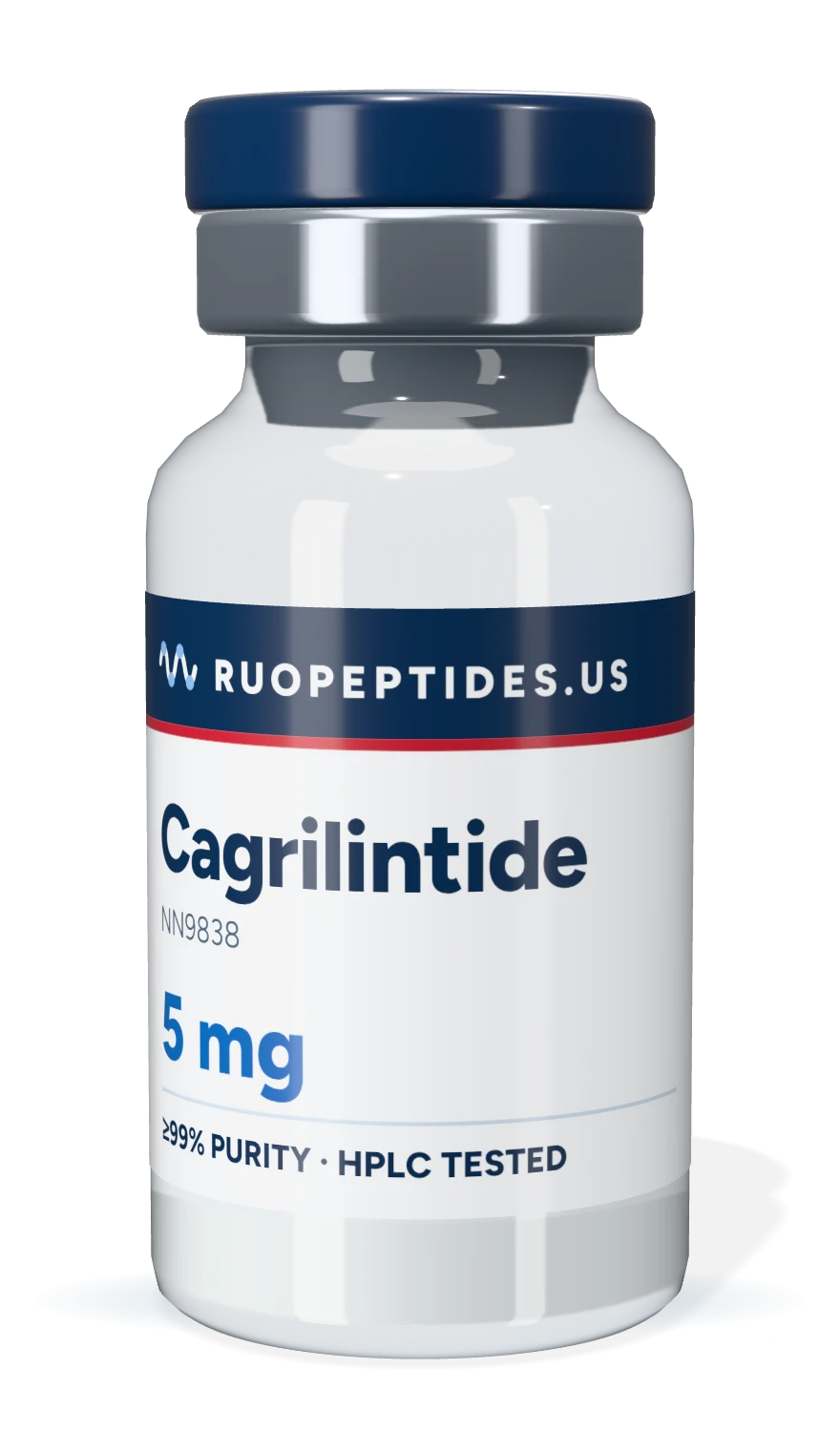
Full label. Lot number and expiry differ per batch and are printed on each vial.
Cagrilintide
Also known as: NN9838
Cagrilintide Peptide You can find Cagrilintide as a synthetic and long-acting amylin analogue here at RUOPeptides, where we offer it as a research option for use in laboratory settings.
- CAS
- 1417329-24-8
- M.W.
- 3900.6 g/mol
- Formula
- C179H304N56O51S2
- Form
- Lyophilized powder
$68.00per vial
Price shown per vial. Quantity discounts below.
In stock
Buy more, pay less per vial
Add 1 more vial to save 3%: $65.96 per vial.
- Safe credit card paymentVisa, Mastercard and American Express
- 30-day money-back guarantee
- Super-fast 1-2 day shippingTo all 50 states and DC
- Free shipping on orders over $200Applied automatically at checkout
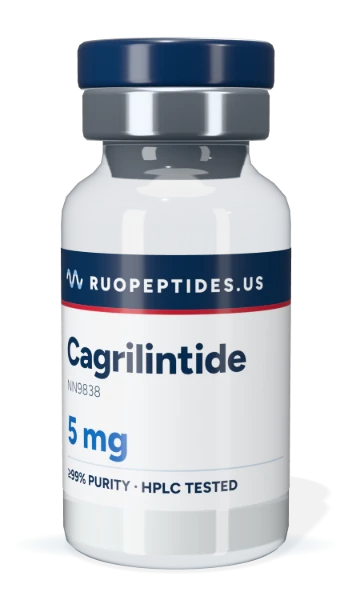
Cagrilintide
5 mg · $68.00/vial
Lyophilized Cagrilintide storage
Lyophilized Cagrilintide peptide should be stored in a dry place, protected from sunlight and moisture.
The following storage conditions are generally recommended:
- Room temperature (15-25 °C / 59-77 °F): Up to ~3-8 months
- Refrigerated (2-8 °C / 35.6-46.4 °F): Up to 6 months
- Frozen (-20 °C / -4 °F or below): 3-5 years
Prior reconstituting with a suitable solvent or Saline, allow the vial to reach room temperature after taking it out of the refrigerator or freezer.
Reconstituted Cagrilintide storage
Once in solution, Cagrilintide is generally less stable compared to their lyophilized (powdered) form and should be stored at cold temperatures when possible.
These storage conditions are generally recommended:
- Room temperature (15-25 °C / 59-77 °F): Avoid longer than 2-4 day storage
- Refrigerated (2-8 °C / 35.6-46.4 °F): Typically 4-8 weeks
- Frozen (-20 °C / -4 °F or below): Up to 3-4 months
However, to preserve peptide efficacy and amino-acid bonds, avoid repeatedly freezing and unfreezing the peptide.
Cagrilintide delivery and shipping
Cagrilintide ships from US stock to United States addresses only. Orders are packed and dispatched within 1-2 business days.
- Standard: $9.95, 1-2 business days after dispatch.
- Express: $24.95, next business day after dispatch.
Lyophilized Cagrilintide ships in a sealed glass vial with protective packaging. The dry powder is stable at room temperature for the length of domestic transit, so no cold pack is needed. Move it to the storage conditions above when it arrives.
Follow your parcel any time on the Track Order page.
Cagrilintide lab testing and COA
The certificate of analysis for Cagrilintide is being uploaded. Ask support for the current report before you order if you need it now.
Every vial label has a lot number. Check it on the Verify page to confirm the vial is genuine. All reports are on the Lab Reports page.
For laboratory research use only. All products are sold for laboratory research use only. They are not drugs, foods, cosmetics or dietary supplements, and are not for human or veterinary use.
Cagrilintide specifications
- Product
- Cagrilintide
- Also known as
- NN9838
- Compound class
- GLP-1s & Amylin Analogs
- Product type
- Peptide
- Form
- Lyophilized powder
- Amounts available
- 5 mg ($68.00), 10 mg ($119.00)
- Sequence
- KCNTATCATQRLANFLVHSSNNFGAILSSTNVGSNTY
- Molecular weight
- 3900.6 g/mol
- Molecular formula
- C179H304N56O51S2
- CAS number
- 1417329-24-8
- Storage as supplied
- Sealed, dry, dark; -20 °C for long-term storage
- Lab report
- COA on request
- Research areas
- GLP-1s & Amylin Analogs
- Intended use
- Laboratory research only. Not for human or veterinary use.
Research overview
About Cagrilintide
Scientifically reviewed by John Johnson · Updated November 2026You can find Cagrilintide as a synthetic and long-acting amylin analogue here at RUOPeptides, where we offer it as a research option for use in laboratory settings.
A pancreatic peptide hormone, amylin is involved in satiety and metabolic regulation, whereas Cagrilintide was engineered to prolong activity and improve stability compared with native amylin.
Cagrilintide 5 mg is listed here at RUOPeptides, and in development research, it’s been described as a lipidated and long-acting amylin analogue that’s selected for additional clinical investigation. [1]
What Is Cagrilintide?
Cagrilintide is a long-acting analogue of human amylin, with native amylin belonging to the calcitonin peptide family, holding quite a short biological half-life.
Its development origin is interesting, one that came through the optimization and limitation of structure-activity to provide better stability, solubility and duration of action.
There is newer pharmacology literature and it describes it as a dual amylin and calcitonin receptor agonist (DACRA) because it interacts with both amylin receptors and the calcitonin receptor. [2]
Amylin receptors are formed from the interactions between the calcitonin receptor and receptor-activity-modifying proteins or RAMPs.
Cagrilintide is not a GLP-1 agonist; it works via a distinct receptor family. To this day, it is still an investigational active ingredient: the FDA has not approved this as a standalone medicine, and have also made specific identification on marketed cagrilintide products offered for human use, describing them as unapproved new drugs.
Development of Cagrilintide as a Long-Acting Amylin Analogue
Native amylin has exhibited a tendency toward aggregation; this presents big challenges when it comes to developing stable amylin analogues.
The limitations were clear, and that led to medical chemistry research effectively utilizing structural modifications and lipidation. This structural optimization improved stability, solubility, receptor pharmacology, and also prolonged systemic exposure. Ultimately, this led to the logical selection of Cagrilintide for clinical development. [1]
Cagrilintide and Amylin/Calcitonin Receptor Activation
A structural study examined Cagrilintide bound to AMY1, AMY2, AMY3, and calcitonin receptors, and it showed an amylin-like binding mode that held distinct receptor-complex dynamics. [2]
Cagrilintide activates multiple amylin receptor subtypes while engaging the calcitonin receptor. This activity is partly dependent on the calcitonin receptor/RAMP configuration, which clarifies its classification as a dual amylin/calcitonin receptor agonist.
A separate 2025/2026 cryo-EM study characterized how Cagrilintide activates AMY1R and CTR; this one identified structural features that are associated with receptor binding and Gs signaling. [3]
Cagrilintide in Preclinical Food-Intake and Metabolic Research
Cagrilintide-like amylin agonism has been researched in preclinical settings to see how it impacts food intake, body weight, adiposity and metabolic parameters.
In 2025, a rodent study used 0839, which is a tool compound, one that shares high sequence homology with Cagrilintide, in order to compare its activity to the latter.
These two compounds both reduced food intake and body weight in diet-induced obesity models and (when studied alongside semaglutide) showed additive effects. [4]
We’d like to clarify that 0839 is a distinct preclinical tool (it isn’t Cagrilintide), and the findings shouldn’t be presented as results from the RUOPeptides product.
There is newer mouse work suggesting AMY1R and AMY3R make a significant contribution to Cagrilintide-related body-weight effects. [5]
Research on Cagrilintide Combined With Semaglutide
Cagrilintide targets the amylin/calcitonin receptor system, and on the other side, Semaglutide acts through the GLP-1 receptor. The combination of this pair enables the investigation of complementary metabolic pathways, not redundant mechanisms. A phase 1b study examined the pharmacokinetics, safety, and tolerability of concomitant Cagrilintide and Semaglutide administration. [7]
A phase 2 study was conducted on people with type 2 diabetes and analysed co-administered Cagrilintide and Semaglutide against each compound to assess HbA1c, body weight, fasting glucose, continuous glucose monitoring parameters and safety. [8]
CagriSema Phase 3 Research
Phase 3 research followed, including the 2026 REIMAGINE 2 publication, evaluating CagriSema against its individual components and placebo in adults that had type 2 diabetes. [10] It’s worth noting: CagriSema and Cagrilintide are not interchangeable terms. In December 2025, Novo Nordisk submitted CagriSema for FDA review in December 2025 and as of September 2026, its regulatory program is still ongoing.
Cagrilintide FAQ
Is Cagrilintide an amylin analogue?
Yes, Cagrilintide is a synthetic, long-acting analogue of human amylin. It is engineered through lipidation and structural optimization for stronger stability, as well as extended duration of action.
Is Cagrilintide a GLP-1 agonist?
No, Cagrilintide is not a GLP-1 receptor agonist; rather, it functions as a dual amylin and calcitonin receptor agonist (DACRA), targeting a distinct receptor family.
What is Cagrilintide studied for?
Cagrilintide is looked at in both preclinical and clinical studies for satiety regulation, food intake reduction, body weight management, and metabolic parameters. This is conducted both alone and alongside GLP-1 receptor agonists.
What is the difference between Cagrilintide and Semaglutide?
Cagrilintide targets the amylin and calcitonin receptors. Semaglutide on the other hand activates GLP-1 receptors. The two belong to different peptide classes.
Is Cagrilintide FDA approved?
No; the FDA has not approved standalone Cagrilintide as a commercial medicine. Please only use this product in the manner that it is designed to be: as an investigational research peptide.
Scientific references
- [1]Kruse T, Hansen JL, Dahl K, et al. Development of Cagrilintide, a Long-Acting Amylin Analogue. Journal of Medicinal Chemistry. 2021;64(15):11183-11194. Available at
- [2]Structural and dynamic features of cagrilintide binding to calcitonin and amylin receptors. Nature Communications. 2025. Available at
- [3]Structural and mechanistic insights into dual activation of cagrilintide in amylin and calcitonin receptors. Acta Pharmacologica Sinica. 2025/2026. Available at
- [4]Characterization of 0839 - A tool compound for pre-clinical mode-of-action studies of amylin analogues such as cagrilintide. PubMed study. 2025. Available at
- [5]Cagrilintide lowers bodyweight through brain amylin receptors 1 and 3. PubMed study. 2025. Available at
- [6]Lau DCW, Erichsen L, Francisco AM, et al. Once-weekly cagrilintide for weight management in people with overweight and obesity: a multicentre, randomised, double-blind, placebo-controlled and active-controlled, dose-finding phase 2 trial. The Lancet. 2021;398(10317):2160-2172. Available at
- [7]Enebo LB, Berthelsen KK, Kankam M, et al. Safety, tolerability, pharmacokinetics, and pharmacodynamics of concomitant administration of multiple doses of cagrilintide with semaglutide 2·4 mg for weight management: a randomised, controlled, phase 1b trial. The Lancet. 2021;397(10286):1736-1748. Available at
- [8]Frias JP, Deenadayalan S, Erichsen L, et al. Efficacy and safety of co-administered once-weekly cagrilintide 2.4 mg with once-weekly semaglutide 2.4 mg in type 2 diabetes: a multicentre, randomised, double-blind, active-controlled, phase 2 trial. The Lancet. 2023;402(10403):720-730. Available at
- [9]Coadministered Cagrilintide and Semaglutide in Adults with Overweight or Obesity. The New England Journal of Medicine. 2025. Available at
- [10]Cagrilintide-semaglutide versus semaglutide or cagrilintide in people with type 2 diabetes: REIMAGINE 2. PubMed study. 2026. Available at
Buying Cagrilintide for research in the USA
Price
From $68.00. 5 mg: $68.00, 10 mg: $119.00. Quantity discounts per size: 3% off 2 vials, 5% off 3-4 vials, 7% off 5+ vials.
Shipping
US addresses only. Orders are packed and dispatched within 1-2 business days. Standard from $9.95.
Proof it's genuine
Check the lot number on your vial on the Verify page.
Lab reports
COA and SDS documents are on the Lab Reports page.
Scientifically reviewed
Scientifically reviewed by John Johnson
Scientific reviewer · Last reviewed November 2026
John Johnson reviewed this Cagrilintide page for scientific accuracy: the compound's identity and specifications, the summaries of published studies, and the references they cite. The page describes laboratory and preclinical research only. It is not medical advice and gives no usage guidance.
Research information on this page summarizes published laboratory and preclinical studies. It is not usage guidance.