For laboratory research use only. Not for human or veterinary use.
RETATRUTIDE

FOR RESEARCH USE ONLYNot for human or veterinary use of any kind
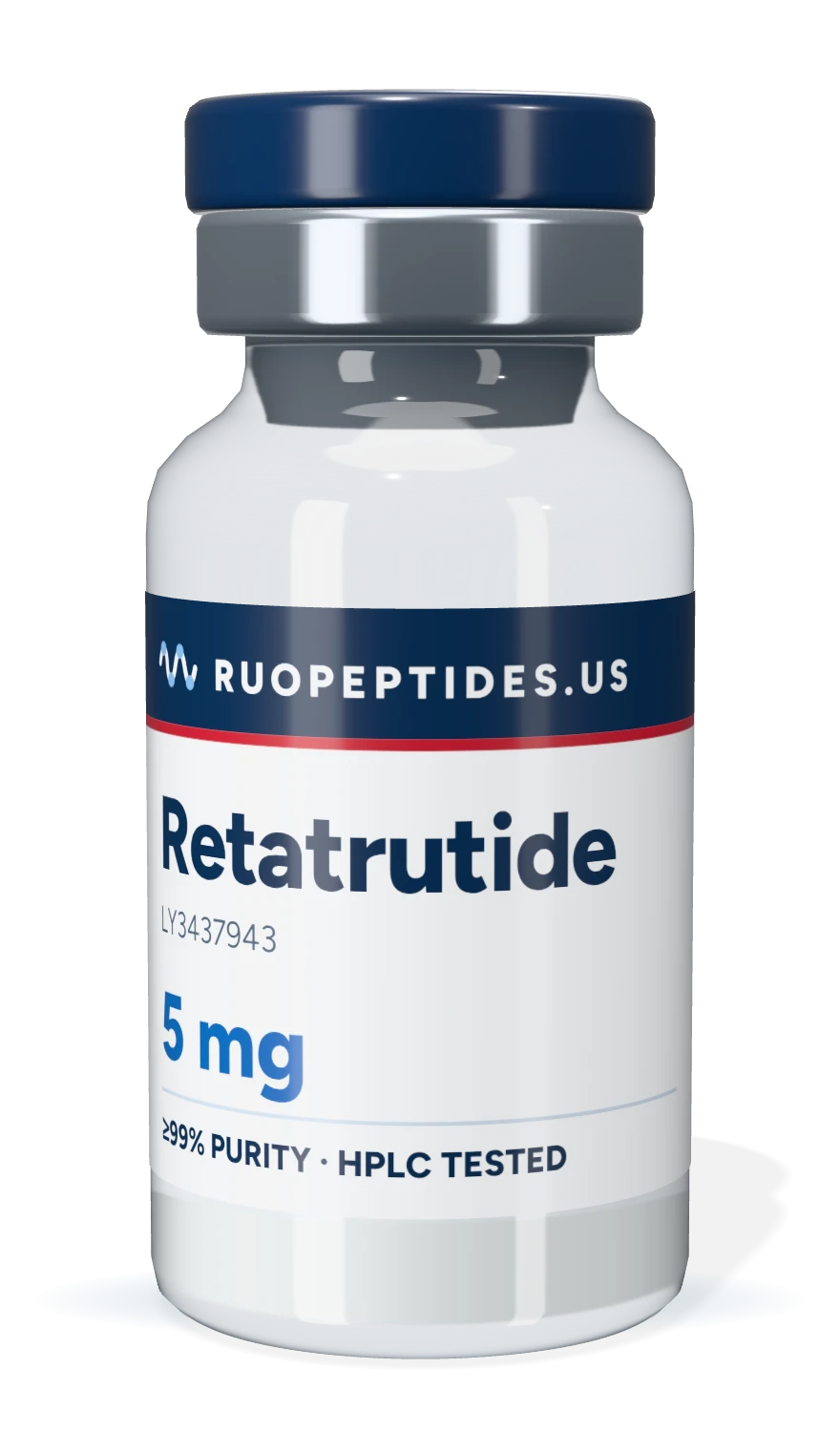
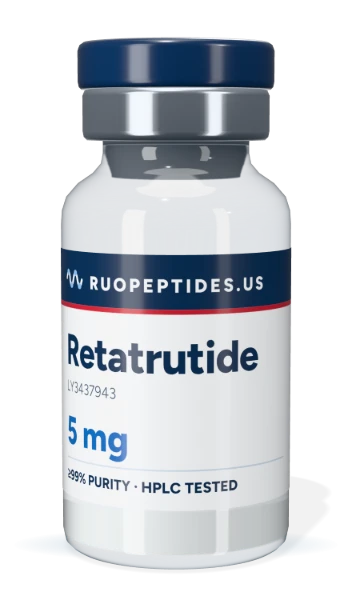
Full label. Lot number and expiry differ per batch and are printed on each vial.
Retatrutide
Also known as: LY3437943
Retatrutide is a triple agonist peptide that targets three different kinds of hormone receptors. These are glucose-dependent insulinotropic polypeptide (GIP), glucagon-like peptide-1 (GLP-1), and glucagon.
- CAS
- 2381089-83-2
- M.W.
- 4,731.33 g/mol
- Formula
- C₂₂₁H₃₄₂N₄₆O₆₈
- Form
- Lyophilized powder
$89.00per vial
Price shown per vial. Quantity discounts below.
In stock
Buy more, pay less per vial
Add 1 more vial to save 3%: $86.33 per vial.
- Safe credit card paymentVisa, Mastercard and American Express
- 30-day money-back guarantee
- Super-fast 1-2 day shippingTo all 50 states and DC
- Free shipping on orders over $200Applied automatically at checkout
Retatrutide
5 mg · $89.00/vial
Lyophilized Retatrutide storage
Reconstituted Retatrutide storage
Retatrutide delivery and shipping
Retatrutide ships from US stock to United States addresses only. Orders are packed and dispatched within 1-2 business days.
- Standard: $9.95, 1-2 business days after dispatch.
- Express: $24.95, next business day after dispatch.
Lyophilized Retatrutide ships in a sealed glass vial with protective packaging. The dry powder is stable at room temperature for the length of domestic transit, so no cold pack is needed. Move it to the storage conditions above when it arrives.
Follow your parcel any time on the Track Order page.
Retatrutide lab testing and COA
The certificate of analysis for Retatrutide is being uploaded. Ask support for the current report before you order if you need it now.
Every vial label has a lot number. Check it on the Verify page to confirm the vial is genuine. All reports are on the Lab Reports page.
For laboratory research use only. All products are sold for laboratory research use only. They are not drugs, foods, cosmetics or dietary supplements, and are not for human or veterinary use.
Retatrutide specifications
- Product
- Retatrutide
- Also known as
- LY3437943
- Compound class
- GLP-1s & Amylin Analogs
- Product type
- Peptide
- Form
- Lyophilized powder
- Amounts available
- 5 mg ($89.00), 10 mg ($169.00), 20 mg ($299.00)
- Sequence
- Tyr-Aib-Gln-Gly-Thr-Phe-Thr-Ser-Asp-Tyr-Ser-Ile-α-MeLeu-Leu-Asp-Lys-Lys(PEG2-γ-Glu-Eicosanedioic acid)-Ala-Gln-Aib-Ala-Phe-Ile-Glu-Tyr-Leu-Leu-Glu-Gly-Gly-Pro-Ser-Ser-Gly-Ala-Pro-Pro-Pro-Ser-NH₂
- Molecular weight
- 4,731.33 g/mol
- Molecular formula
- C₂₂₁H₃₄₂N₄₆O₆₈
- CAS number
- 2381089-83-2
- Storage as supplied
- Sealed, dry, dark; -20 °C for long-term storage
- Lab report
- COA on request
- Research areas
- GLP-1s & Amylin Analogs
- Intended use
- Laboratory research only. Not for human or veterinary use.
Research overview
About Retatrutide
Scientifically reviewed by John Johnson · Updated November 2026Retatrutide is a triple agonist peptide that targets three different kinds of hormone receptors. These are glucose-dependent insulinotropic polypeptide (GIP), glucagon-like peptide-1 (GLP-1), and glucagon. This distinguishes it from other agonists that target just one or two receptors and forms the basis of research into its pharmacological properties. [1]
This topic is important in metabolic and cardiometabolic research, as it activates all three receptor systems. Studies are being conducted to understand how the signaling systems of the three receptors may help analyze the processes associated with energy balance and metabolic control.
Other areas of research include lipid metabolism and liver-related metabolic pathways. Ongoing research also examines the GIP, GLP-1, and glucagon receptor systems to better understand how these metabolic pathways interact and contribute to the regulation of energy balance and metabolic homeostasis.
What Is Retatrutide?
Retatrutide is a single molecule designed to simultaneously activate three hormone receptors: GIP, GLP-1 and Glucagon. Each of these receptors participates in different metabolically relevant signalling pathways.
For example, GIP is associated with the incretin signalling system and glucose-dependent pathways. GLP-1 is linked to the incretin, insulin, glucagon, gastric, and energy-balance signalling, while Glucagon is linked to hepatic glucose control and energy expenditure pathways. [3]
The activation of all three receptor systems in a single molecule makes Retatrutide interesting in the field of exploring integrated metabolic signaling and interaction among several hormone pathways. Instead, Retatrutide remains investigational in clinical development across different metabolic and obesity-related areas.
What are Retatrutide's Research Applications
Retatrutide is being investigated across several metabolic and obesity-associated research areas. As a retatrutide research peptide, it is studied for its activity across multiple receptor pathways and its potential relevance to metabolic research:
- Triple-receptor signaling: Investigation into simultaneous activation of GIP, GLP-1, and glucagon receptors.
- Glucose metabolism: Understanding effects on glycemic regulation and incretin-related pathways. [4]
- Energy-balance pathways: Investigation of appetite, food consumption, and energy expenditure.
- Lipid and liver metabolism: Research involving lipid regulation, metabolic processes, and hepatic pathways. [5]
- Cardiometabolic physiology: Investigation of cardiovascular and metabolic markers. [6]
- Broader obesity-associated mechanisms: Clinical research looking into conditions related to obesity and metabolic complications. [7]
In addition, the retatrutide peptide has also progressed in Phase 3 trials, including the 2026 data from trials in obesity [8] and type 2 diabetes [9]. These findings represent clinical trials, and they should not be taken as performance results or effect statements for any product. Current research continues to examine metabolic and body-weight outcomes across multiple study populations.
Retatrutide FAQ
Is RUOPeptides Retatrutide third-party tested?
Yes. Retatrutide is independently verified by external analytical laboratories, with purity and identity confirmed through HPLC and mass spectrometry analysis, supporting quality assurance across orders.
Is Retatrutide a peptide?
Yes. Retatrutide is a synthetic peptide engineered to activate GIP, GLP-1, and glucagon receptors simultaneously, making it a GIP GLP-1 glucagon research peptide of interest across metabolic and incretin research applications.
Is Retatrutide a GLP-1 peptide?
Retatrutide activates the GLP-1 receptor, but its activity extends further. As a triple agonist, it also engages GIP and glucagon receptors, distinguishing it from single-receptor GLP-1 analogues used in comparable research.
Is Retatrutide a GLP-3?
No. GLP-3 is not a recognized receptor classification in current incretin research. Retatrutide is classified as a triple hormone receptor agonist targeting GIP, GLP-1, and glucagon receptors specifically.
Why is Retatrutide called a triple agonist?
Retatrutide is termed a triple agonist because it selectively binds to and activates three distinct hormone receptors, GIP, GLP-1, and glucagon, rather than one or two, distinguishing it from earlier incretin-based compounds.
What is Retatrutide studied for?
Published research documents retatrutide use in investigations examining triple-receptor signaling, glucose- and insulin-related pathways, energy-balance mechanisms, lipid and liver metabolism, and broader cardiometabolic research applications. [10]
Is Retatrutide available as a prescription medication?
No. Retatrutide is not FDA-approved and is not available as a prescription medication. RUOPeptides retatrutide is a research-grade peptide supplied exclusively for in vitro and analytical laboratory use.
Can RUOPeptides Retatrutide be used for weight loss?
No. RUOPeptides retatrutide is supplied solely for laboratory research purposes. It is not an approved therapeutic agent for any condition and is not intended for human or animal consumption.
Scientific references
- [1]LY3437943, a novel triple glucagon, GIP, and GLP-1 receptor agonist for glycemic control and weight loss: From discovery to clinical proof of concept
- [2]Structural insights into the triple agonism at GLP-1R, GIPR and GCGR manifested by retatrutide
- [3]Glucagon-like peptide-1, glucose-dependent insulinotropic polypeptide, and glucagon receptor poly-agonists: a new era in obesity pharmacotherapy
- [4]Retatrutide, a GIP, GLP-1 and glucagon receptor agonist, for people with type 2 diabetes: a randomised, double-blind, placebo and active-controlled, parallel-group, phase 2 trial conducted in the USA
- [5]Triple hormone receptor agonist retatrutide for metabolic dysfunction-associated steatotic liver disease: a randomized phase 2a trial
- [6]Retatrutide-Associated Improvements in Cardiovascular Risk Biomarkers in Adults With Obesity With or Without Type 2 Diabetes
- [7]Triple-Hormone-Receptor Agonist Retatrutide for Obesity - A Phase 2 Trial
- [8]The First Phase 3 Obesity Study of Retatrutide, a GIP, GLP-1, and Glucagon Receptor Agonist, in People with Obesity (TRIUMPH-1)
- [9]Efficacy and safety of retatrutide, a GIP, GLP-1, and glucagon receptor agonist, in people with type 2 diabetes and inadequate glycaemic control with diet and exercise (TRANSCEND-T2D-1): a double-blind, randomised, phase 3 trial
- [10]Retatrutide in type 2 diabetes mellitus and obesity: an overview
Buying Retatrutide for research in the USA
Price
From $89.00. 5 mg: $89.00, 10 mg: $169.00, 20 mg: $299.00. Quantity discounts per size: 3% off 2 vials, 5% off 3-4 vials, 7% off 5+ vials.
Shipping
US addresses only. Orders are packed and dispatched within 1-2 business days. Standard from $9.95.
Proof it's genuine
Check the lot number on your vial on the Verify page.
Lab reports
COA and SDS documents are on the Lab Reports page.
Scientifically reviewed
Scientifically reviewed by John Johnson
Scientific reviewer · Last reviewed November 2026
John Johnson reviewed this Retatrutide page for scientific accuracy: the compound's identity and specifications, the summaries of published studies, and the references they cite. The page describes laboratory and preclinical research only. It is not medical advice and gives no usage guidance.
Research information on this page summarizes published laboratory and preclinical studies. It is not usage guidance.