For laboratory research use only. Not for human or veterinary use.
SEMAGLUTIDE
FOR RESEARCH USE ONLYNot for human or veterinary use of any kind
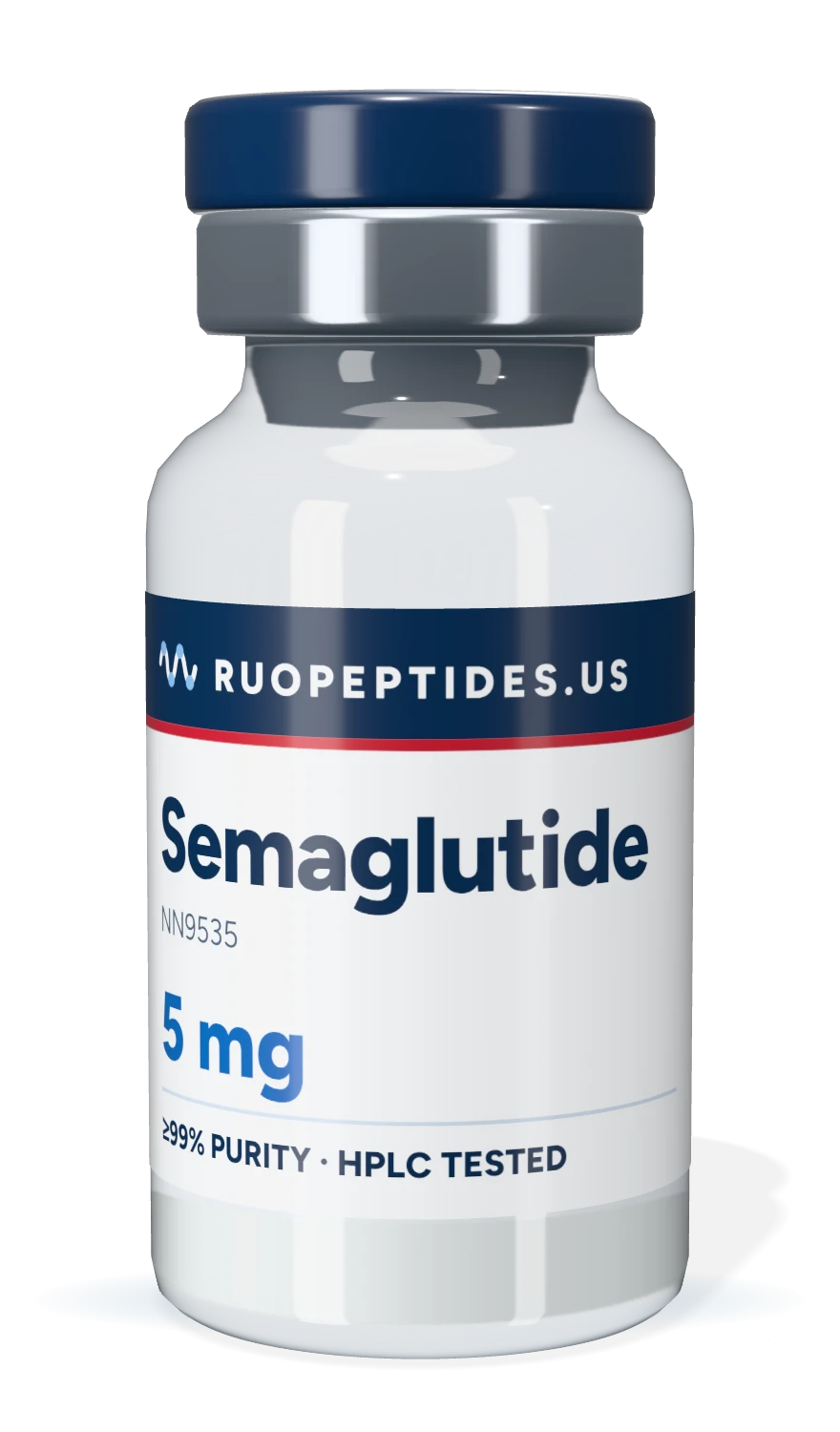
Full label. Lot number and expiry differ per batch and are printed on each vial.
Semaglutide
Also known as: NN9535
Semaglutide is a synthetic analog of glucagon-like peptide-1 (GLP-1) built for a long circulating half-life.
- CAS
- 910463-68-2
- M.W.
- 4,113.64 g/mol
- Formula
- C₁₈₇H₂₉₁N₄₅O₅₉
- Form
- Lyophilized powder
$65.00per vial
Price shown per vial. Quantity discounts below.
In stock
Buy more, pay less per vial
Add 1 more vial to save 3%: $63.05 per vial.
- Safe credit card paymentVisa, Mastercard and American Express
- 30-day money-back guarantee
- Super-fast 1-2 day shippingTo all 50 states and DC
- Free shipping on orders over $200Applied automatically at checkout
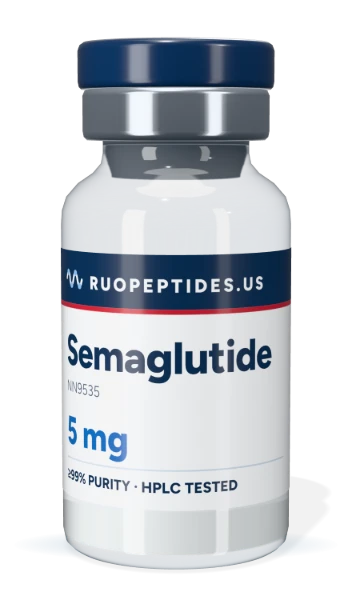
Semaglutide
5 mg · $65.00/vial
Lyophilized Semaglutide storage
Store lyophilized material sealed, dry and protected from light. Refrigerate (2-8 °C) for short-term storage; freeze (−20 °C or below) for long-term storage.
Reconstituted Semaglutide storage
Material in solution is less stable than the lyophilized form. Keep refrigerated (2-8 °C), protect from light, and avoid repeated freeze-thaw cycles.
Semaglutide delivery and shipping
Semaglutide ships from US stock to United States addresses only. Orders are packed and dispatched within 1-2 business days.
- Standard: $9.95, 1-2 business days after dispatch.
- Express: $24.95, next business day after dispatch.
Lyophilized Semaglutide ships in a sealed glass vial with protective packaging. The dry powder is stable at room temperature for the length of domestic transit, so no cold pack is needed. Move it to the storage conditions above when it arrives.
Follow your parcel any time on the Track Order page.
Semaglutide lab testing and COA
The certificate of analysis for Semaglutide is being uploaded. Ask support for the current report before you order if you need it now.
Every vial label has a lot number. Check it on the Verify page to confirm the vial is genuine. All reports are on the Lab Reports page.
For laboratory research use only. All products are sold for laboratory research use only. They are not drugs, foods, cosmetics or dietary supplements, and are not for human or veterinary use.
Semaglutide specifications
- Product
- Semaglutide
- Also known as
- NN9535
- Compound class
- GLP-1s & Amylin Analogs
- Product type
- Peptide
- Form
- Lyophilized powder
- Amounts available
- 5 mg ($65.00), 10 mg ($109.00)
- Sequence
- H-His-Aib-Glu-Gly-Thr-Phe-Thr-Ser-Asp-Val-Ser-Ser-Tyr-Leu-Glu-Gly-Gln-Ala-Ala-Lys(γGlu-2xOEG-C18 diacid)-Glu-Phe-Ile-Ala-Trp-Leu-Val-Arg-Gly-Arg-Gly-OH
- Molecular weight
- 4,113.64 g/mol
- Molecular formula
- C₁₈₇H₂₉₁N₄₅O₅₉
- CAS number
- 910463-68-2
- Storage as supplied
- Sealed, dry, dark; -20 °C for long-term storage
- Lab report
- COA on request
- Research areas
- GLP-1s & Amylin Analogs
- Intended use
- Laboratory research only. Not for human or veterinary use.
Research overview
About Semaglutide
Scientifically reviewed by John Johnson · Updated November 2026Semaglutide is a synthetic analog of glucagon-like peptide-1 (GLP-1) built for a long circulating half-life. Its backbone carries two amino acid substitutions and a fatty acid side chain that binds serum albumin, and it is one of the most studied compounds in GLP-1 receptor research. [1][2] RUOPeptides supplies semaglutide in 5 mg vials for laboratory research.
What Is Semaglutide?
Native GLP-1 is an incretin hormone released by intestinal L-cells after nutrient intake. In circulation it lasts only minutes, because the enzyme dipeptidyl peptidase-4 (DPP-4) cleaves its N-terminus and the kidneys clear the small peptide quickly. [3] That short life makes the native hormone hard to use in longer experiments.
Semaglutide was designed around that problem. It is a 31-amino-acid peptide with about 94% sequence identity to human GLP-1(7-37). Aib (α-aminoisobutyric acid) at position 8 blocks DPP-4 cleavage, and arginine at position 34 leaves a single lysine, Lys26, for the side chain. That side chain is a C18 fatty diacid joined through a γ-glutamic acid and two OEG spacers. It binds albumin strongly, which slows clearance and gives semaglutide a far longer half-life than native GLP-1. [1]
The same molecule is the active ingredient in approved prescription medicines. Research-grade semaglutide is not a drug product: it is supplied as a lyophilized peptide for in vitro and preclinical work only.
Overview of Published Semaglutide Research
Published semaglutide research covers receptor pharmacology, peptide engineering, central nervous system pathways and vascular biology. Much of the mechanistic work comes from cell assays and rodent models. Results from approved drug products and clinical programs describe those formulations and study conditions, and they do not carry over to research-grade material.
GLP-1 Receptor Signaling and Glucose-Dependent Insulin Secretion
The GLP-1 receptor is a class B G-protein-coupled receptor found on pancreatic β-cells and in the gut, heart, kidney and brain. Binding activates Gαs, raises intracellular cAMP and engages PKA and Epac2 signaling. [3]
In β-cell studies, this signaling increases insulin secretion only when glucose is elevated. That glucose dependence is a central topic in incretin research, along with suppression of glucagon release from α-cells. Semaglutide is used in these assays as a long-acting, single-receptor reference agonist. [2][3]
Central GLP-1 Receptor Pathways
GLP-1 receptors are expressed in the hypothalamus and brainstem, regions that process signals about energy balance. Gabery and colleagues used fluorescently labeled semaglutide in mice and rats to map where the peptide goes in the brain. It reached circumventricular organs and areas close to the circulation, such as the arcuate nucleus, and changed activity in connected neural pathways. [4]
These rodent findings help explain how a large, albumin-bound peptide can act on central circuits. They describe distribution and signaling in animal models.
Gastric Emptying Research
GLP-1 receptor activation slows gastric emptying, an effect studied with native GLP-1 and its analogs. The effect on emptying weakens with sustained receptor activation, which makes long-acting agonists such as semaglutide useful for studying receptor and pathway tolerance. [3]
Vascular and Inflammation Research
Rakipovski and colleagues compared semaglutide and liraglutide in ApoE-/- and LDLr-/- mice, two standard models of atherosclerosis. Both analogs reduced plaque development, and gene expression analysis of the aorta pointed to changes in inflammatory pathways that were partly independent of body weight and cholesterol. [5]
This work places semaglutide in vascular inflammation research. Mouse plaque data do not establish effects in other species or settings.
Neuronal GLP-1 Receptor Research
GLP-1 receptor signaling has also been studied in neuron survival models. In the chronic MPTP mouse model, which damages dopaminergic neurons, Zhang and colleagues reported that semaglutide was associated with preserved tyrosine hydroxylase, lower α-synuclein accumulation and fewer inflammation markers compared with untreated MPTP mice. [6]
These are rodent model findings. They support further study of neuronal GLP-1 receptor signaling and do not establish any effect outside that model.
Semaglutide vs Tirzepatide vs Retatrutide: What's the Difference?
All three are long-acting incretin-based peptides with fatty acid side chains, but they activate different sets of receptors. That difference is the main reason researchers compare them.
| Feature | Semaglutide | Tirzepatide | Retatrutide |
|---|---|---|---|
| Receptor targets | GLP-1R | GIPR and GLP-1R | GIPR, GLP-1R and glucagon receptor |
| Agonist type | Single | Dual | Triple |
| Peptide length | 31 amino acids | 39 amino acids | 39 amino acids |
| Backbone | Based on GLP-1(7-37) | Based on GIP | Based on GIP |
| Fatty acid side chain | C18 diacid | C20 diacid | C20 diacid |
| Development code | NN9535 | LY3298176 | LY3437943 |
See the Tirzepatide and Retatrutide pages for those compounds.
Semaglutide FAQ
What is semaglutide?
A synthetic GLP-1 receptor agonist: a 31-amino-acid analog of human GLP-1 with a fatty acid side chain that binds albumin. It is used in GLP-1 receptor pharmacology and long-acting peptide research.
Is research-grade semaglutide the same as semaglutide medicines?
It is the same molecule but not the same product. Approved medicines are finished drug formulations made and tested under pharmaceutical regulations. Research-grade semaglutide is a lyophilized peptide sold only for laboratory research, and it is not for human or veterinary use.
How is semaglutide different from native GLP-1?
Native GLP-1 is cleaved by DPP-4 and cleared within minutes. Semaglutide has Aib at position 8, arginine at position 34 and a C18 fatty diacid on Lys26, which together protect it from DPP-4 and slow its clearance through albumin binding.
What makes semaglutide resistant to DPP-4?
The alanine at position 8 of native GLP-1 is replaced with α-aminoisobutyric acid (Aib), which blocks cleavage by DPP-4.
How does semaglutide bind albumin?
Through a C18 fatty diacid attached to lysine 26 by a γ-glutamic acid and two OEG spacer units.
What is semaglutide studied for?
GLP-1 receptor signaling, glucose-dependent insulin secretion in β-cell models, central GLP-1 receptor pathways in rodents, gastric emptying, and vascular inflammation in mouse atherosclerosis models. It is also a reference compound for dual and triple incretin agonists.
Scientific references
- [1]Lau J, et al. J Med Chem. 2015. Discovery of the Once-Weekly Glucagon-Like Peptide-1 (GLP-1) Analogue Semaglutide.
- [2]Knudsen LB, Lau J. Front Endocrinol. 2019. The Discovery and Development of Liraglutide and Semaglutide.
- [3]Drucker DJ. Cell Metab. 2018. Mechanisms of Action and Therapeutic Application of Glucagon-like Peptide-1.
- [4]Gabery S, et al. JCI Insight. 2020. Semaglutide lowers body weight in rodents via distributed neural pathways.
- [5]Rakipovski G, et al. JACC Basic Transl Sci. 2018. The GLP-1 Analogs Liraglutide and Semaglutide Reduce Atherosclerosis in ApoE-/- and LDLr-/- Mice by a Mechanism That Includes Inflammatory Pathways.
- [6]Zhang L, et al. J Parkinsons Dis. 2019. Semaglutide is Neuroprotective and Reduces α-Synuclein Levels in the Chronic MPTP Mouse Model of Parkinson's Disease.
Buying Semaglutide for research in the USA
Price
From $65.00. 5 mg: $65.00, 10 mg: $109.00. Quantity discounts per size: 3% off 2 vials, 5% off 3-4 vials, 7% off 5+ vials.
Shipping
US addresses only. Orders are packed and dispatched within 1-2 business days. Standard from $9.95.
Proof it's genuine
Check the lot number on your vial on the Verify page.
Lab reports
COA and SDS documents are on the Lab Reports page.
Scientifically reviewed
Scientifically reviewed by John Johnson
Scientific reviewer · Last reviewed November 2026
John Johnson reviewed this Semaglutide page for scientific accuracy: the compound's identity and specifications, the summaries of published studies, and the references they cite. The page describes laboratory and preclinical research only. It is not medical advice and gives no usage guidance.
Research information on this page summarizes published laboratory and preclinical studies. It is not usage guidance.