For laboratory research use only. Not for human or veterinary use.
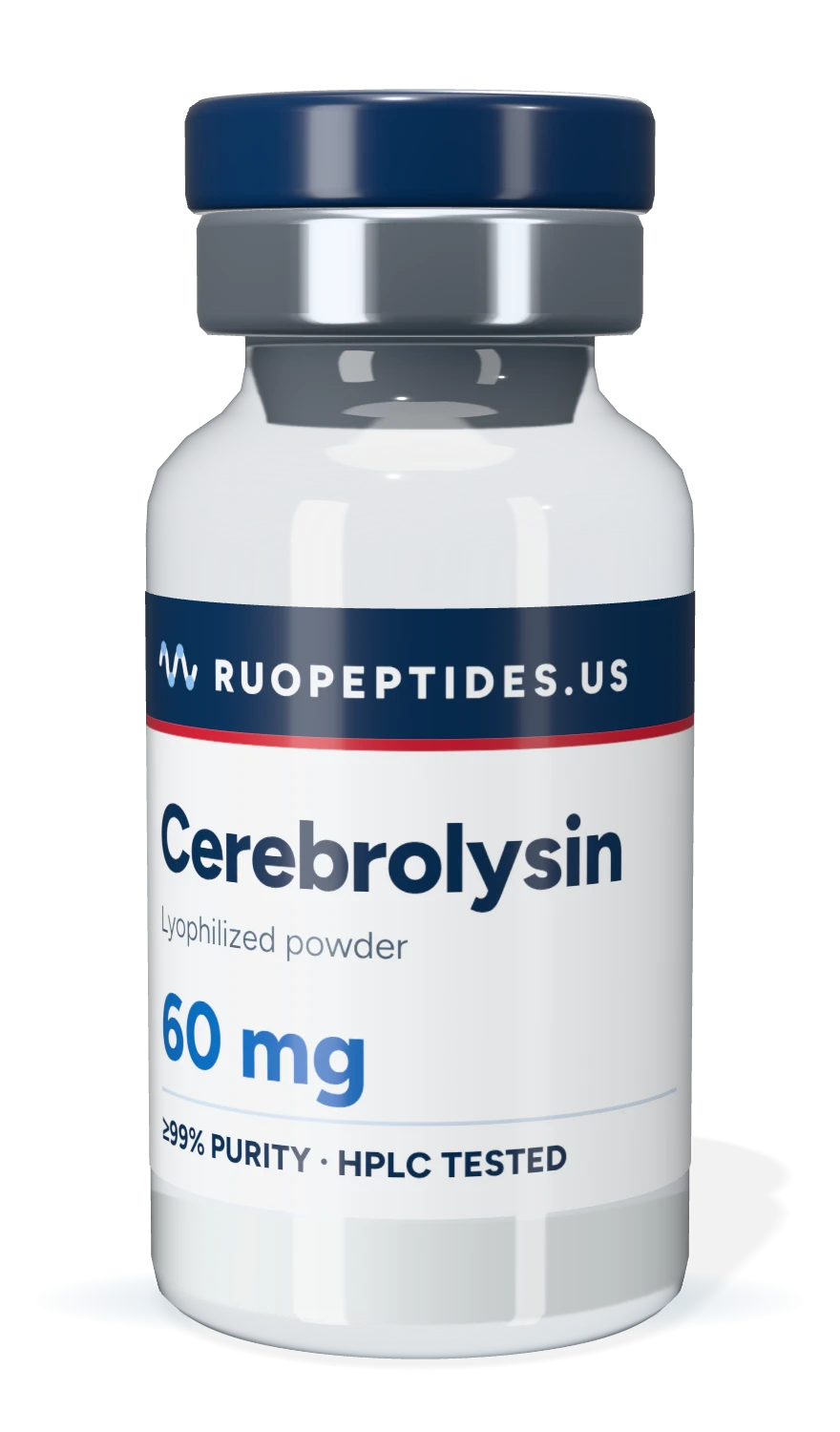
CEREBROLYSIN
FOR RESEARCH USE ONLYNot for human or veterinary use of any kind
Full label. Lot number and expiry differ per batch and are printed on each vial.
Cerebrolysin
RUOPeptides supplies Cerebrolysin as a 60mg lyophilized vial for laboratory and scientific research. It's a peptide preparation rather than a single peptide, and that distinction matters more than it sounds.
- CAS
- 12656-61-0
- Form
- Lyophilized powder
$79.00per vial
Price shown per vial. Quantity discounts below.
In stock
Buy more, pay less per vial
Add 1 more vial to save 3%: $76.63 per vial.
- Safe credit card paymentVisa, Mastercard and American Express
- 30-day money-back guarantee
- Super-fast 1-2 day shippingTo all 50 states and DC
- Free shipping on orders over $200Applied automatically at checkout
Cerebrolysin
60 mg · $79.00/vial
Lyophilized Cerebrolysin storage
Lyophilized Cerebrolysin peptide should be stored in a dry place, protected from sunlight and moisture.
The following storage conditions are generally recommended:
- Room temperature (15-25 °C / 59-77 °F): Up to ~3-8 months
- Refrigerated (2-8 °C / 35.6-46.4 °F): Up to 6 months
- Frozen (-20 °C / -4 °F or below): 3-5 years
Prior reconstituting with a suitable solvent or Saline, allow the vial to reach room temperature after taking it out of the refrigerator or freezer.
Reconstituted Cerebrolysin storage
Once in solution, Cerebrolysin is generally less stable compared to their lyophilized (powdered) form and should be stored at cold temperatures when possible.
These storage conditions are generally recommended:
- Room temperature (15-25 °C / 59-77 °F): Avoid longer than 2-4 day storage
- Refrigerated (2-8 °C / 35.6-46.4 °F): Typically 4-8 weeks
- Frozen (-20 °C / -4 °F or below or below): Up to 3-4 months
However, to preserve peptide efficacy and amino-acid bonds, avoid repeatedly freezing and unfreezing the peptide.
Cerebrolysin delivery and shipping
Cerebrolysin ships from US stock to United States addresses only. Orders are packed and dispatched within 1-2 business days.
- Standard: $9.95, 1-2 business days after dispatch.
- Express: $24.95, next business day after dispatch.
Lyophilized Cerebrolysin ships in a sealed glass vial with protective packaging. The dry powder is stable at room temperature for the length of domestic transit, so no cold pack is needed. Move it to the storage conditions above when it arrives.
Follow your parcel any time on the Track Order page.
Cerebrolysin lab testing and COA
The certificate of analysis for Cerebrolysin is being uploaded. Ask support for the current report before you order if you need it now.
Every vial label has a lot number. Check it on the Verify page to confirm the vial is genuine. All reports are on the Lab Reports page.
For laboratory research use only. All products are sold for laboratory research use only. They are not drugs, foods, cosmetics or dietary supplements, and are not for human or veterinary use.
Cerebrolysin specifications
- Product
- Cerebrolysin
- Compound class
- Neuropeptides
- Product type
- Preparation
- Form
- Lyophilized powder
- Amounts available
- 60 mg ($79.00), 120 mg ($139.00)
- Preparation type
- Peptide preparation, not a single synthetic peptide
- Source
- Porcine brain tissue, enzymatically processed
- Composition
- Low-molecular-weight peptides with free amino acids
- Peptide size
- Below 10,000 daltons
- CAS number
- 12656-61-0
- Product format
- Lyophilized powder, single sealed vial
- Storage as supplied
- Sealed, dry, dark; -20 °C for long-term storage
- Lab report
- COA on request
- Research areas
- Neuropeptides
- Intended use
- Laboratory research only. Not for human or veterinary use.
Research overview
About Cerebrolysin
Scientifically reviewed by John Johnson · Updated November 2026RUOPeptides supplies Cerebrolysin as a 60mg lyophilized vial for laboratory and scientific research. It's a peptide preparation rather than a single peptide, and that distinction matters more than it sounds.
The material is a complex mixture of low-molecular-weight peptides, investigated across neurological and neurotrophic-factor research for decades. nanoLC-MS work published in 2023 has since resolved that mixture into a set of identified peptide sequences.
What is Cerebrolysin?
Cerebrolysin is made by enzymatically breaking porcine brain tissue down into low-molecular-weight fragments. What comes out the other end is a mixture: peptides below roughly 10,000 daltons, alongside free amino acids. There's no parent molecule to point at.
Hold onto that. Every other product in this catalogue has a sequence you can read and a weight you can verify. This one has a composition instead, and a composition is a property of the process that produced it.
Its standing in neuroscience research follows from the same fact. A 2023 review in Medicinal Research Reviews describes Cerebrolysin as carrying activities that resemble those of endogenous neurotrophic factors, and works through how the preparation interacts with neurotrophic signaling rather than engaging one named receptor. Multiple peptides, multiple points of contact. That's a harder thing to study than a single ligand, and it's why the literature reads the way it does.
Cerebrolysin Research Applications
Mechanistic investigation and clinical investigation belong in separate columns here.
- Neurotrophic Signaling: Research examining interactions with pathways associated with endogenous neurotrophic factors.
- Neuroplasticity: Investigation of mechanisms involved in neuronal adaptation and synaptic plasticity.
- Neurogenesis: Experimental work on processes associated with neuronal development and regeneration.
- Neuroprotection Research: Cellular responses to neuronal stress and injury in experimental models.
- Angiogenesis and Vascular Signaling: Vascular responses studied inside neurological models rather than in isolation.
- Neuroinflammatory Pathways: Signaling associated with inflammation in nervous tissue.
- Neurological Injury Models: Cerebrolysin has been investigated in preclinical and clinical research involving stroke and traumatic brain injury. The clinical picture is contested. A 2023 Cochrane review of seven randomized trials covering 1,773 participants concluded that adding it to standard stroke therapy probably has no beneficial effect on all-cause death, at moderate certainty, and reported an increase in non-fatal serious adverse events.
- Neurodegeneration Research: Published work extends into dementia and other neurodegenerative contexts.
The gap between the mechanistic literature and the clinical trial record is itself part of the research picture, and it's where most of the open questions in this area currently live.
Cerebrolysin FAQ
Is Cerebrolysin a single peptide?
No. It's a preparation containing many low-molecular-weight peptides plus free amino acids. No single sequence, molecular weight or formula describes it, which is why those fields are absent from the specifications above.
What is Cerebrolysin made from?
Porcine brain tissue, broken down enzymatically into low-molecular-weight fragments. The resulting mixture contains peptides below roughly 10,000 daltons together with free amino acids.
What is Cerebrolysin studied for?
Mechanistically, neurotrophic signaling, neuroplasticity, neurogenesis, angiogenesis and neuroinflammation. Clinically, it has been investigated in stroke, traumatic brain injury and dementia research, with results that remain under debate.
What type of peptides are found in Cerebrolysin?
Low-molecular-weight peptides below roughly 10,000 daltons, generated by enzymatic breakdown rather than synthesis. Mass spectrometry work has identified specific sequences within the mixture.
Has Cerebrolysin been studied in dementia research?
Yes, dementia and other neurodegenerative contexts appear in the published literature alongside stroke and traumatic brain injury. Findings across that body of work are not uniform and remain actively discussed.
Is Cerebrolysin studied in neuroplasticity research?
It is. Neuroplasticity sits among the mechanistic research areas, alongside neurogenesis and neurotrophic-factor signaling, and it's the area where the mechanistic literature is most developed.
Is Cerebrolysin the same as a nootropic?
No. Nootropic is a colloquial consumer category rather than a scientific classification. Cerebrolysin is a peptide preparation studied in neurological research contexts, and it isn't supplied here for cognitive enhancement of any kind.
Buying Cerebrolysin for research in the USA
Price
From $79.00. 60 mg: $79.00, 120 mg: $139.00. Quantity discounts per size: 3% off 2 vials, 5% off 3-4 vials, 7% off 5+ vials.
Shipping
US addresses only. Orders are packed and dispatched within 1-2 business days. Standard from $9.95.
Proof it's genuine
Check the lot number on your vial on the Verify page.
Lab reports
COA and SDS documents are on the Lab Reports page.
Scientifically reviewed
Scientifically reviewed by John Johnson
Scientific reviewer · Last reviewed November 2026
John Johnson reviewed this Cerebrolysin page for scientific accuracy: the compound's identity and specifications, the summaries of published studies, and the references they cite. The page describes laboratory and preclinical research only. It is not medical advice and gives no usage guidance.
Research information on this page summarizes published laboratory and preclinical studies. It is not usage guidance.