For laboratory research use only. Not for human or veterinary use.
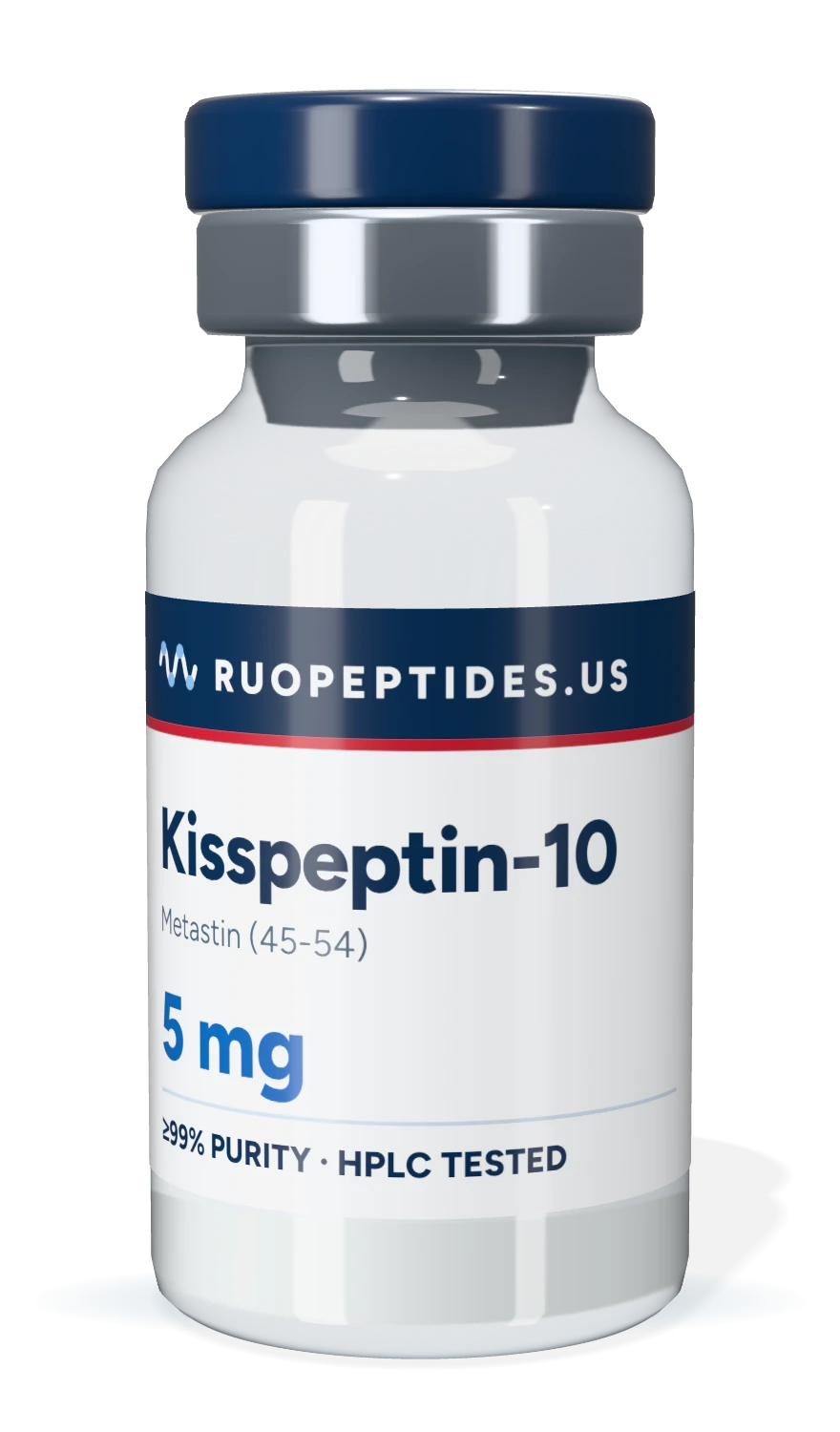
KISSPEPTIN-10

FOR RESEARCH USE ONLYNot for human or veterinary use of any kind
Full label. Lot number and expiry differ per batch and are printed on each vial.
Kisspeptin-10
Also known as: Metastin (45-54)
Kisspeptin-10 (KP-10) is a biologically active 10-amino-acid peptide derived from KISS1 and an endogenous agonist of KISS1R (formerly GPR54).
- CAS
- 374675-21-5
- M.W.
- 1302.4 g/mol
- Formula
- C₆₃H₈₃N₁₇O₁₄
- Form
- Lyophilized powder
$39.00per vial
Price shown per vial. Quantity discounts below.
In stock
Buy more, pay less per vial
Add 1 more vial to save 3%: $37.83 per vial.
- Safe credit card paymentVisa, Mastercard and American Express
- 30-day money-back guarantee
- Super-fast 1-2 day shippingTo all 50 states and DC
- Free shipping on orders over $200Applied automatically at checkout
Kisspeptin-10
5 mg · $39.00/vial
Lyophilized Kisspeptin-10 storage
Store lyophilized material sealed, dry and protected from light. Refrigerate (2-8 °C) for short-term storage; freeze (−20 °C or below) for long-term storage.
Reconstituted Kisspeptin-10 storage
Material in solution is less stable than the lyophilized form. Keep refrigerated (2-8 °C), protect from light, and avoid repeated freeze-thaw cycles.
Kisspeptin-10 delivery and shipping
Kisspeptin-10 ships from US stock to United States addresses only. Orders are packed and dispatched within 1-2 business days.
- Standard: $9.95, 1-2 business days after dispatch.
- Express: $24.95, next business day after dispatch.
Lyophilized Kisspeptin-10 ships in a sealed glass vial with protective packaging. The dry powder is stable at room temperature for the length of domestic transit, so no cold pack is needed. Move it to the storage conditions above when it arrives.
Follow your parcel any time on the Track Order page.
Kisspeptin-10 lab testing and COA
The certificate of analysis for Kisspeptin-10 is being uploaded. Ask support for the current report before you order if you need it now.
Every vial label has a lot number. Check it on the Verify page to confirm the vial is genuine. All reports are on the Lab Reports page.
For laboratory research use only. All products are sold for laboratory research use only. They are not drugs, foods, cosmetics or dietary supplements, and are not for human or veterinary use.
Kisspeptin-10 specifications
- Product
- Kisspeptin-10
- Also known as
- Metastin (45-54)
- Compound class
- Neuropeptides
- Product type
- Peptide
- Form
- Lyophilized powder
- Amounts available
- 5 mg ($39.00), 10 mg ($69.00)
- Sequence
- Tyr-Asn-Trp-Asn-Ser-Phe-Gly-Leu-Arg-Phe-NH₂
- Molecular weight
- 1302.4 g/mol
- Molecular formula
- C₆₃H₈₃N₁₇O₁₄
- CAS number
- 374675-21-5
- Storage as supplied
- Sealed, dry, dark; -20 °C for long-term storage
- Lab report
- COA on request
- Research areas
- Neuropeptides
- Intended use
- Laboratory research only. Not for human or veterinary use.
Research overview
About Kisspeptin-10
Scientifically reviewed by John Johnson · Updated November 2026Kisspeptin-10 (KP-10) is a biologically active 10-amino-acid peptide derived from KISS1 and an endogenous agonist of KISS1R (formerly GPR54). Kisspeptin signaling regulates the hypothalamic-pituitary-gonadal axis through gonadotropin-releasing hormone (GnRH), which controls luteinizing hormone (LH) and follicle-stimulating hormone (FSH) secretion. Human studies have directly investigated these endocrine responses in men and women. [1][2] RUOPeptides supplies Kisspeptin-10 in 5 mg vials for laboratory research.
What Is Kisspeptin-10?
Kisspeptins are signaling peptides encoded by the KISS1 gene. Its precursor produces several active fragments, including kisspeptin-54, -14, -13 and -10. These fragments share a conserved C-terminal sequence that is important for receptor activation. Kisspeptin-10 is the shortest fragment that keeps full intrinsic activity at KISS1R, formerly called GPR54. [3]
Kisspeptin/KISS1R signaling acts upstream of GnRH neurons, influencing LH and FSH secretion. This places Kisspeptin-10 within studies of puberty and reproductive endocrine regulation. [1][2]
The KISS1 gene was first identified in metastasis-suppression research, which explains the historical name metastin, particularly associated with kisspeptin-54. Today, reproductive hormone signaling is the main research focus for Kisspeptin-10.
Overview of Published Kisspeptin-10 Research
Published kisspeptin research has focused on how Kisspeptin-10 influences hormonal signaling within the hypothalamic-pituitary-gonadal (HPG) axis. Studies with healthy volunteers and people with altered endocrine function have examined changes in gonadotropin secretion, hormone feedback and LH pulse patterns. The findings consistently show why the biological setting matters: responses to KP-10 can differ by sex, reproductive status and experimental conditions. The studies are valuable for characterizing signaling pathways, but measured hormone changes are not automatically evidence of lasting clinical effects.
Kisspeptin-10 and KISS1R/GnRH Signaling
Kisspeptin-10 binds KISS1R, a G-protein-coupled receptor formerly called GPR54. As a naturally occurring KISS1R agonist, it activates receptor-associated signaling that helps regulate GnRH neurons. GnRH then stimulates the pituitary to secrete LH and FSH, which influence gonadal activity. [4]
This makes the Kisspeptin-10 and GnRH relationship important for investigating the HPG axis. Because the pathway is involved in puberty, reproductive maturation and feedback from sex hormones, researchers can examine how specific experimental exposures affect hormone release.
GnRH is normally released in pulses, so the timing of upstream signals matters. Mechanistic studies have identified Gq/11-linked signaling downstream of KISS1R, and have explored receptor desensitization, internalization and recovery, all of which may influence responses to repeated or sustained stimulation. [4]
The older term GPR54 agonist describes the same receptor interaction, not a different target. Receptor activation does not guarantee an identical hormone response in every participant: sex, hormonal status, administration pattern and feedback mechanisms can all alter measured outcomes.
Kisspeptin-10 and LH Secretion in Men
George and colleagues studied Kisspeptin-10 directly in healthy men, using intravenous administration and frequent blood sampling to assess reproductive hormone responses. Their experiments provide human evidence for KP-10 itself rather than a different kisspeptin fragment or analog. [1]
The investigators observed a rapid, dose-dependent rise in LH after single administrations. In separate infusion experiments, lower-rate exposure increased LH pulse frequency and the amount of LH released per pulse. These findings support the interpretation that KP-10 influences upstream GnRH activity in humans. Because GnRH cannot readily be measured in routine peripheral blood samples, LH pulse measurements offer an indirect way to study hypothalamic signaling.
The LH response was not simply proportional at every exposure level. In the study, a higher bolus produced less LH stimulation than the level associated with the maximum response, which shows why experimental conditions matter when interpreting endocrine results.
During a longer infusion, the researchers also measured higher testosterone alongside LH. These were acute observations in small groups under controlled research conditions. They do not demonstrate sustained testosterone increases, clinical benefits or an established use for research-grade peptide products.
Kisspeptin-10 and Female Reproductive Hormone Signaling
Human investigations have shown that the response to KP-10 differs with menstrual-cycle stage and prevailing sex-steroid levels.
Jayasena and colleagues compared reproductive hormone responses in healthy men and women. KP-10 increased LH and FSH in men and in women studied during the preovulatory phase. Under the tested protocols, women in the follicular phase did not show comparable gonadotropin increases. [2]
These results showed differences between male and female responses and the importance of menstrual-cycle context. A response observed in one hormonal state should not automatically be expected in another, and differences in timing, exposure and study methods may also contribute to variation between experiments.
Later research examined sex-steroid feedback more directly. George and colleagues found that KP-10 increased LH secretion in women during the early follicular phase, with particularly strong LH and FSH responses in postmenopausal women. Responses were suppressed in participants taking combined hormonal contraceptives, while some response remained in those using progestogen implants. [5]
Statistically significant FSH stimulation occurred only in the postmenopausal group. Taken together, the studies suggest that endogenous and administered sex steroids influence how the HPG axis responds to kisspeptin stimulation.
These observations make KP-10 useful for investigating reproductive endocrine feedback. They should not be read as evidence that it reliably induces ovulation, enhances fertility or produces predictable hormonal changes outside a research setting.
Kisspeptin-10 in Reproductive Endocrine Disorder Research
Because kisspeptin signaling sits upstream of GnRH, researchers have investigated KP-10 in conditions involving disrupted gonadotropin secretion.
One exploratory study involved two women with chronic amenorrhea associated with hyperprolactinemia. During controlled KP-10 infusion, researchers observed increased LH and FSH secretion, more frequent LH pulses, and changes in estradiol, testosterone and inhibin B. [6]
These findings suggest that kisspeptin-related signaling may remain responsive in particular forms of reproductive endocrine disruption. The study involved only two participants, so it cannot establish treatment effectiveness.
Research has also investigated interactions between kisspeptin and neurokinin B in women with polycystic ovary syndrome (PCOS). One study found that blocking neurokinin 3 receptors reduced LH pulse frequency, while the LH response to KP-10 remained measurable. [7]
This work explores how interconnected signaling pathways regulate GnRH and gonadotropin release in PCOS. It also shows why an observed LH response cannot, by itself, indicate normalization of a complex endocrine disorder. These relatively small clinical studies need cautious interpretation and further investigation.
Overall, Kisspeptin-10 remains an experimental tool for studying endocrine mechanisms. These findings do not demonstrate that RUOPeptides Kisspeptin-10 treats amenorrhea, infertility, PCOS or any other reproductive disorder.
Kisspeptin-10 vs Kisspeptin-54: What's the Difference?
Both belong to the kisspeptin family and activate KISS1R (formerly GPR54). They differ in structure and pharmacokinetics, which makes them distinct research compounds.
| Feature | Kisspeptin-10 | Kisspeptin-54 |
|---|---|---|
| Abbreviation | KP-10 / Kp-10 | KP-54 / Kp-54 |
| Length | 10 amino acids | 54 amino acids |
| Origin | C-terminal active kisspeptin fragment | Longer KISS1-derived peptide |
| Receptor | KISS1R / GPR54 | KISS1R / GPR54 |
| Biological activity | Shortest fragment with full intrinsic KISS1R activity | Biologically active endogenous kisspeptin |
| Older terminology | Kisspeptin fragment | Metastin |
These differences affect experimental timing, peptide clearance and measured hormone responses. Kisspeptin-10 is not simply a short name for kisspeptin-54, and neither peptide is universally stronger or better: outcomes depend on the research conditions. [4]
Kisspeptin-10 FAQ
What is Kisspeptin-10 studied for?
Kisspeptin-10 is studied for its role in reproductive hormone regulation, especially within the hypothalamic-pituitary-gonadal axis. Human investigations have measured changes in LH, FSH and LH pulse frequency, and researchers have examined responses across different hormonal states and in selected reproductive endocrine disorders. These investigations assess physiological responses, not established benefits from research-grade products.
How does Kisspeptin-10 interact with KISS1R?
Kisspeptin-10 binds KISS1R, a G-protein-coupled receptor, and activates intracellular signaling associated with GnRH neurons. This can influence downstream pituitary hormone secretion. The size of the response varies with biological sex, hormonal environment and experimental exposure, and receptor activation does not guarantee a particular reproductive outcome.
Is KISS1R the same as GPR54?
Yes. KISS1R is the current name for the receptor previously called GPR54. Both terms describe the same target of active kisspeptin peptides, including Kisspeptin-10. Older papers may use GPR54, while current reproductive endocrinology literature generally uses KISS1R.
How is Kisspeptin-10 related to GnRH?
Kisspeptin-10 acts upstream of GnRH by stimulating KISS1R on the relevant neurons. GnRH then promotes pituitary release of LH and FSH. Controlled human studies have examined LH secretion and pulse patterns after Kisspeptin-10 administration to investigate how this pathway operates.
Is Kisspeptin-10 the same as Kisspeptin-54?
No. Kisspeptin-10 has ten amino acids and Kisspeptin-54 has 54. Both come from the KISS1 precursor and activate KISS1R, but they differ in structure, circulation time and exposure characteristics. Results obtained with one fragment cannot automatically be assumed for the other.
What is the difference between kisspeptin and metastin?
Kisspeptin is the collective name for active peptides derived from the KISS1 precursor, including Kisspeptin-10 and Kisspeptin-54. Metastin is an older name, commonly associated with Kisspeptin-54, because KISS1 was first studied in connection with metastasis suppression. Kisspeptin terminology is now standard in reproductive endocrine and receptor research.
Scientific references
- [1]George JT, et al. J Clin Endocrinol Metab. 2011. Kisspeptin-10 is a potent stimulator of LH and increases pulse frequency in men.
- [2]Jayasena CN, et al. J Clin Endocrinol Metab. 2011. The effects of kisspeptin-10 on reproductive hormone release show sexual dimorphism in humans.
- [3]Kirby HR, et al. Pharmacol Rev. 2010. International Union of Basic and Clinical Pharmacology. LXXVII. Kisspeptin receptor nomenclature, distribution, and function.
- [4]Millar RP, Newton CL. Neuroendocrinology. 2015. KISS1R: Hallmarks of an Effective Regulator of the Neuroendocrine Axis.
- [5]George JT, Anderson RA, Millar RP. Hum Reprod. 2012. Kisspeptin-10 stimulation of gonadotrophin secretion in women is modulated by sex steroid feedback.
- [6]Millar RP, et al. J Endocr Soc. 2017. Hypothalamic-Pituitary-Ovarian Axis Reactivation by Kisspeptin-10 in Hyperprolactinemic Women With Chronic Amenorrhea.
- [7]Skorupskaite K, et al. Hum Reprod. 2020. Kisspeptin and neurokinin B interactions in modulating gonadotropin secretion in women with polycystic ovary syndrome.
Buying Kisspeptin-10 for research in the USA
Price
From $39.00. 5 mg: $39.00, 10 mg: $69.00. Quantity discounts per size: 3% off 2 vials, 5% off 3-4 vials, 7% off 5+ vials.
Shipping
US addresses only. Orders are packed and dispatched within 1-2 business days. Standard from $9.95.
Proof it's genuine
Check the lot number on your vial on the Verify page.
Lab reports
COA and SDS documents are on the Lab Reports page.
Scientifically reviewed
Scientifically reviewed by John Johnson
Scientific reviewer · Last reviewed November 2026
John Johnson reviewed this Kisspeptin-10 page for scientific accuracy: the compound's identity and specifications, the summaries of published studies, and the references they cite. The page describes laboratory and preclinical research only. It is not medical advice and gives no usage guidance.
Research information on this page summarizes published laboratory and preclinical studies. It is not usage guidance.