For laboratory research use only. Not for human or veterinary use.
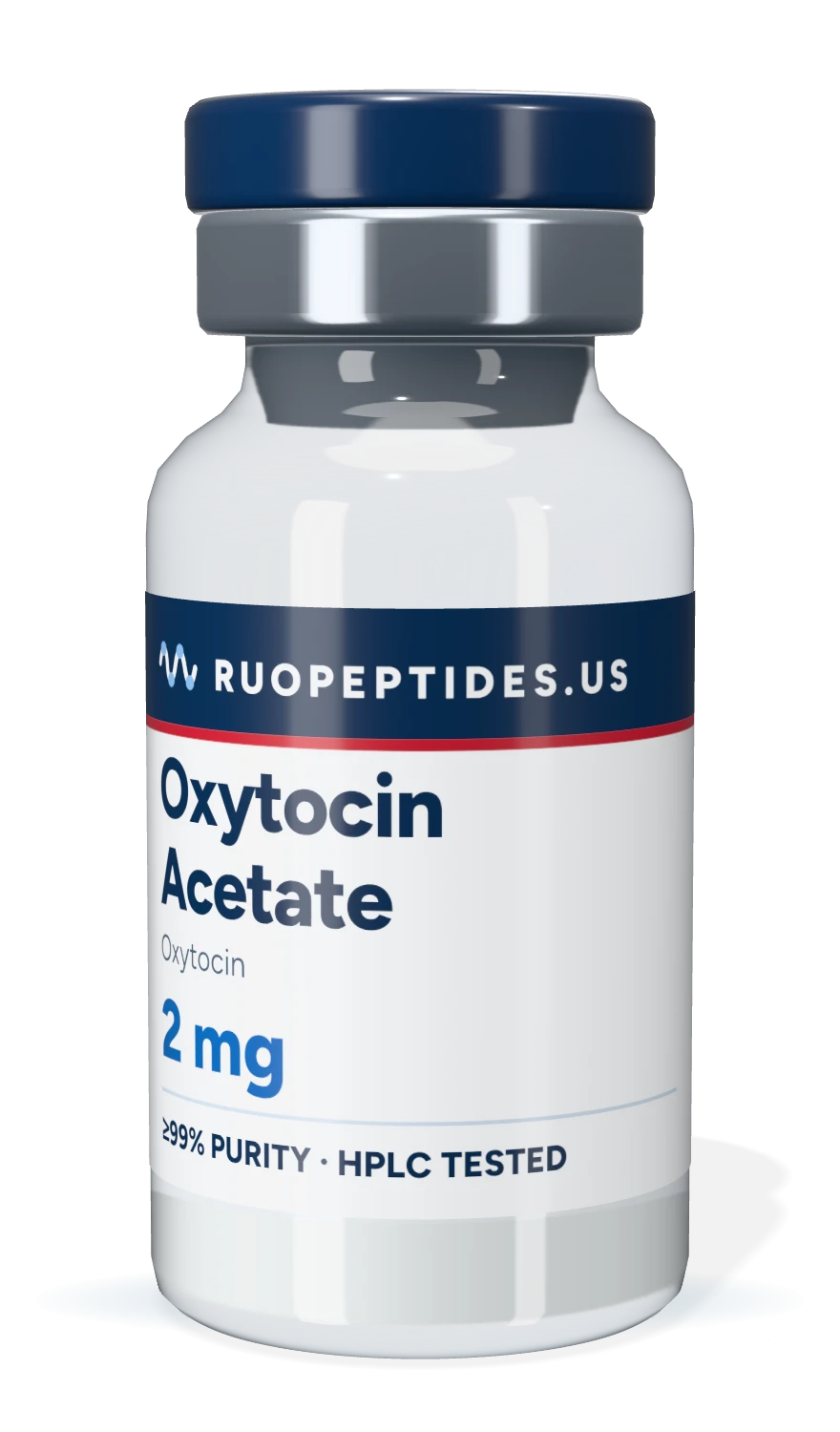
OXYTOCIN ACETATE
FOR RESEARCH USE ONLYNot for human or veterinary use of any kind
Full label. Lot number and expiry differ per batch and are printed on each vial.
Oxytocin Acetate
Also known as: Oxytocin
Oxytocin is a nine-amino-acid neuropeptide made in the hypothalamus and released from the posterior pituitary. Oxytocin acetate is the same peptide supplied as an acetate salt, the usual form for synthetic material.
- CAS
- 50-56-6
- M.W.
- 1,007.19 g/mol
- Formula
- C₄₃H₆₆N₁₂O₁₂S₂
- Form
- Lyophilized powder
$35.00per vial
Price shown per vial. Quantity discounts below.
In stock
Buy more, pay less per vial
Add 1 more vial to save 3%: $33.95 per vial.
- Safe credit card paymentVisa, Mastercard and American Express
- 30-day money-back guarantee
- Super-fast 1-2 day shippingTo all 50 states and DC
- Free shipping on orders over $200Applied automatically at checkout
Oxytocin Acetate
2 mg · $35.00/vial
Lyophilized Oxytocin Acetate storage
Store lyophilized material sealed, dry and protected from light. Refrigerate (2-8 °C) for short-term storage; freeze (−20 °C or below) for long-term storage.
Reconstituted Oxytocin Acetate storage
Material in solution is less stable than the lyophilized form. Keep refrigerated (2-8 °C), protect from light, and avoid repeated freeze-thaw cycles.
Oxytocin Acetate delivery and shipping
Oxytocin Acetate ships from US stock to United States addresses only. Orders are packed and dispatched within 1-2 business days.
- Standard: $9.95, 1-2 business days after dispatch.
- Express: $24.95, next business day after dispatch.
Lyophilized Oxytocin Acetate ships in a sealed glass vial with protective packaging. The dry powder is stable at room temperature for the length of domestic transit, so no cold pack is needed. Move it to the storage conditions above when it arrives.
Follow your parcel any time on the Track Order page.
Oxytocin Acetate lab testing and COA
The certificate of analysis for Oxytocin Acetate is being uploaded. Ask support for the current report before you order if you need it now.
Every vial label has a lot number. Check it on the Verify page to confirm the vial is genuine. All reports are on the Lab Reports page.
For laboratory research use only. All products are sold for laboratory research use only. They are not drugs, foods, cosmetics or dietary supplements, and are not for human or veterinary use.
Oxytocin Acetate specifications
- Product
- Oxytocin Acetate
- Also known as
- Oxytocin
- Compound class
- Neuropeptides
- Product type
- Peptide
- Form
- Lyophilized powder
- Amounts available
- 2 mg ($35.00), 4 mg ($59.00)
- Sequence
- Cys-Tyr-Ile-Gln-Asn-Cys-Pro-Leu-Gly-NH₂
- Molecular weight
- 1,007.19 g/mol
- Molecular formula
- C₄₃H₆₆N₁₂O₁₂S₂
- CAS number
- 50-56-6
- Storage as supplied
- Sealed, dry, dark; -20 °C for long-term storage
- Lab report
- COA on request
- Research areas
- Neuropeptides
- Intended use
- Laboratory research only. Not for human or veterinary use.
Research overview
About Oxytocin Acetate
Scientifically reviewed by John Johnson · Updated November 2026Oxytocin is a nine-amino-acid neuropeptide made in the hypothalamus and released from the posterior pituitary. Oxytocin acetate is the same peptide supplied as an acetate salt, the usual form for synthetic material. It is studied in receptor pharmacology, neuroendocrinology and behavioral neuroscience. [1] RUOPeptides supplies oxytocin acetate in 2 mg vials for laboratory research.
What Is Oxytocin Acetate?
Oxytocin has the sequence Cys-Tyr-Ile-Gln-Asn-Cys-Pro-Leu-Gly-NH₂. A disulfide bond between the two cysteines closes a six-residue ring, and a three-residue tail ends in a C-terminal amide. The peptide's molecular weight is about 1007.2 g/mol.
In oxytocin acetate, acetate is the counter-ion paired with the peptide's basic groups after purification. The peptide itself is identical to native oxytocin. Specifications such as molecular weight refer to the peptide, so the net peptide content of a vial can differ slightly from its gross weight.
Oxytocin is made by magnocellular neurons in the paraventricular and supraoptic nuclei of the hypothalamus, whose axons run to the posterior pituitary. Smaller parvocellular neurons project within the brain and spinal cord, which is why oxytocin is studied both as a circulating hormone and as a neuromodulator. [1][4]
Overview of Published Oxytocin Research
Oxytocin research spans more than a century, from its classic roles in uterine contraction and milk ejection to its receptor pharmacology and actions in the central nervous system. Much of the current mechanistic work uses rodent models and isolated tissues. Behavioral findings in animals depend heavily on species, sex, brain region and experimental design.
Oxytocin Receptor Signaling
The oxytocin receptor (OXTR) is a class A G-protein-coupled receptor. It couples mainly to Gq/11, activating phospholipase C, inositol trisphosphate and calcium release, with further signaling through MAPK pathways. Receptor expression changes with hormonal state, one reason uterine tissue has long served as a model for studying receptor regulation. [1]
The same signaling explains oxytocin's classic physiological actions: contraction of uterine smooth muscle and of the myoepithelial cells around mammary alveoli. These tissue preparations remain standard assays for oxytocin receptor activity.
Social Behavior and Stress-Axis Research
Oxytocin is one of the most studied neuropeptides in behavioral neuroscience. Work in prairie voles linked oxytocin receptor distribution in the nucleus accumbens and prefrontal cortex to partner preference formation, a laboratory model of pair bonding. [2]
A second line of research looks at stress physiology. In rodent studies, brain oxytocin release during stress has been linked to dampened activity of the hypothalamic-pituitary-adrenal (HPA) axis and to changes in anxiety-related behavior. [3] These findings describe neuroendocrine mechanisms in animal models and underpin much of the wider interest in oxytocin.
Nociception Research
Oxytocin also acts in pain pathways. Eliava and colleagues identified a small group of parvocellular oxytocin neurons in the rat hypothalamus that project both to magnocellular neurons and to the spinal cord. Activating these neurons reduced responses to inflammatory pain stimuli in rats, showing that central and peripheral oxytocin release can be coordinated. [4]
Wound Healing Models
Oxytocin's links to the social environment have also been studied in wound biology. Vitalo and colleagues found that isolation-reared rats healed experimental wounds more slowly than socially housed rats, and that both nesting material and oxytocin were associated with faster healing in the isolated animals. [5]
Feeding and Metabolic Research
Oxytocin neurons interact with hypothalamic circuits that regulate food intake. Rodent studies have examined how central oxytocin signaling affects meal size, intake of sweet solutions and glucose handling, work reviewed by Leng and Sabatier. [6] Open questions remain about how peripheral and central oxytocin signals relate to each other.
Oxytocin vs Vasopressin: What's the Difference?
Oxytocin and arginine vasopressin (AVP) are both cyclic nonapeptides made in the hypothalamus and released from the posterior pituitary. They differ at only two positions but act on different receptor families.
| Feature | Oxytocin | Arginine vasopressin |
|---|---|---|
| Residues that differ | Ile at position 3, Leu at position 8 | Phe at position 3, Arg at position 8 |
| Ring structure | Cys1-Cys6 disulfide | Cys1-Cys6 disulfide |
| Main receptors | OXTR | V1a, V1b, V2 |
| Main signaling | Gq/11, calcium | V1 receptors: Gq/11; V2: Gs, cAMP |
| Classic research areas | Uterine and mammary contraction, social behavior | Water balance, vascular tone, ACTH release |
Because the two structures are so close, oxytocin can activate vasopressin receptors at higher concentrations, and the reverse is also true. Receptor selectivity is worth planning for when designing experiments. [1]
Oxytocin Acetate FAQ
What is the difference between oxytocin and oxytocin acetate?
None in the peptide itself. Oxytocin acetate is oxytocin paired with acetate as the counter-ion, which is how synthetic oxytocin is usually supplied after purification. Molecular weight and formula in the specifications refer to the peptide.
What receptor does oxytocin act on?
The oxytocin receptor (OXTR), a G-protein-coupled receptor that signals mainly through Gq/11 and calcium. At higher concentrations oxytocin can also activate vasopressin receptors.
Why is oxytocin called a nonapeptide?
Because it has nine amino acids: a six-residue ring closed by a disulfide bond, plus a three-residue tail with a C-terminal amide.
How is oxytocin related to vasopressin?
Both are cyclic nonapeptides from the hypothalamus and posterior pituitary. They differ only at positions 3 and 8, but they act mainly on different receptors and are studied in different physiological systems.
What is oxytocin studied for?
Receptor pharmacology, uterine and mammary tissue models, social behavior and stress-axis research in rodents, nociception, wound healing models and the regulation of food intake in animal studies.
Scientific references
- [1]Gimpl G, Fahrenholz F. Physiol Rev. 2001. The oxytocin receptor system: structure, function, and regulation.
- [2]Young LJ, Wang Z. Nat Neurosci. 2004. The neurobiology of pair bonding.
- [3]Neumann ID. Prog Brain Res. 2002. Involvement of the brain oxytocin system in stress coping: interactions with the hypothalamo-pituitary-adrenal axis.
- [4]Eliava M, et al. Neuron. 2016. A New Population of Parvocellular Oxytocin Neurons Controlling Magnocellular Neuron Activity and Inflammatory Pain Processing.
- [5]Vitalo A, et al. PLoS One. 2009. Nest making and oxytocin comparably promote wound healing in isolation reared rats.
- [6]Leng G, Sabatier N. Trends Endocrinol Metab. 2017. Oxytocin - The Sweet Hormone?
Buying Oxytocin Acetate for research in the USA
Price
From $35.00. 2 mg: $35.00, 4 mg: $59.00. Quantity discounts per size: 3% off 2 vials, 5% off 3-4 vials, 7% off 5+ vials.
Shipping
US addresses only. Orders are packed and dispatched within 1-2 business days. Standard from $9.95.
Proof it's genuine
Check the lot number on your vial on the Verify page.
Lab reports
COA and SDS documents are on the Lab Reports page.
Scientifically reviewed
Scientifically reviewed by John Johnson
Scientific reviewer · Last reviewed November 2026
John Johnson reviewed this Oxytocin Acetate page for scientific accuracy: the compound's identity and specifications, the summaries of published studies, and the references they cite. The page describes laboratory and preclinical research only. It is not medical advice and gives no usage guidance.
Research information on this page summarizes published laboratory and preclinical studies. It is not usage guidance.