For laboratory research use only. Not for human or veterinary use.
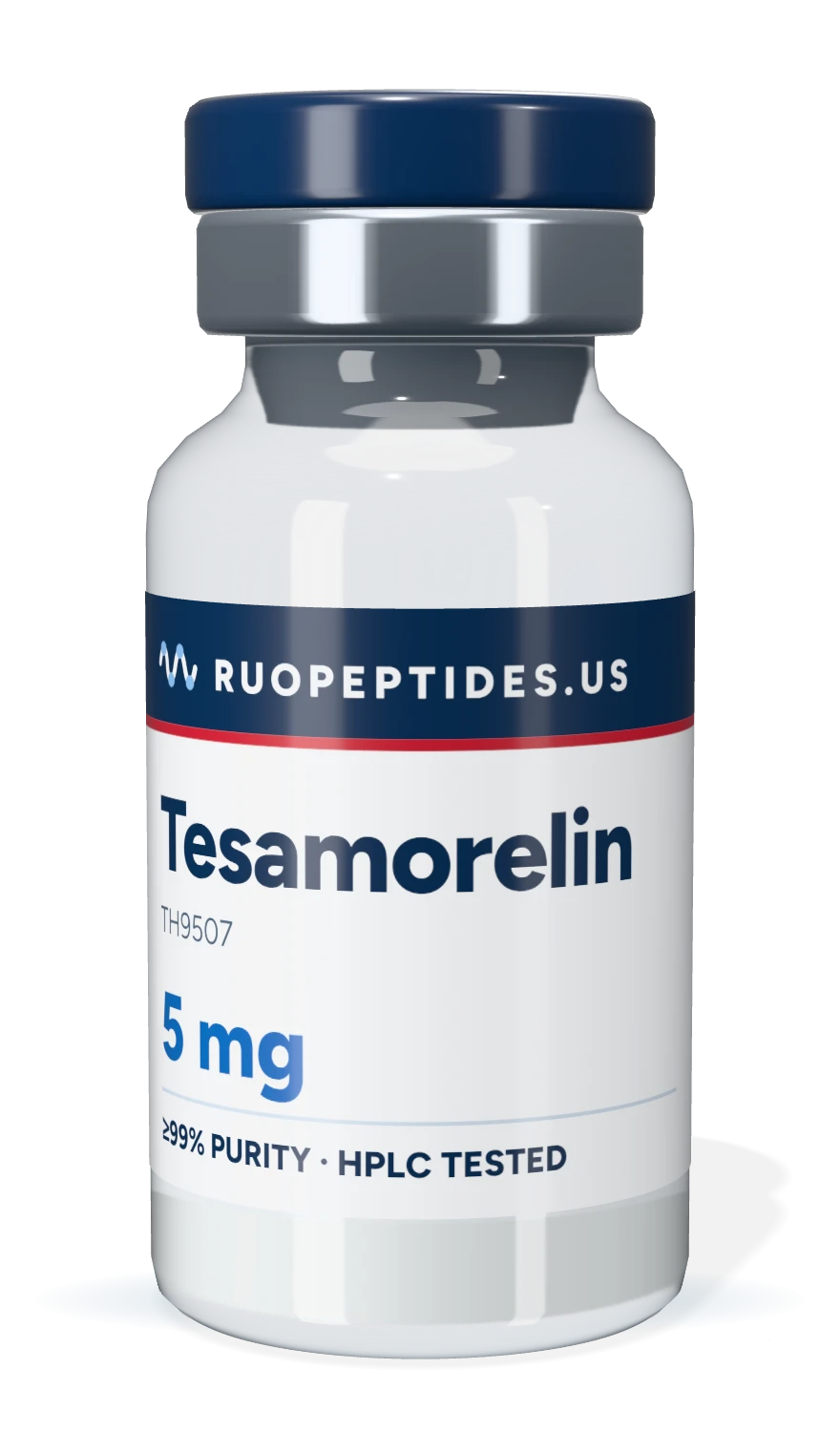
TESAMORELIN
FOR RESEARCH USE ONLYNot for human or veterinary use of any kind
Full label. Lot number and expiry differ per batch and are printed on each vial.
GHRH Analogs & GH SecretagoguesPopular Research Peptides
Tesamorelin
Also known as: TH9507
Tesamorelin, also known as TH9507 in research literature, is a synthetic GHRH analogue supplied solely for in vitro and analytical applications.
- CAS
- 218949-48-5
- M.W.
- 5135.9 g/mol
- Formula
- C221H366N72O67S
- Form
- Lyophilized powder
$55.00per vial
Price shown per vial. Quantity discounts below.
In stock
Buy more, pay less per vial
Add 1 more vial to save 3%: $53.35 per vial.
- Safe credit card paymentVisa, Mastercard and American Express
- 30-day money-back guarantee
- Super-fast 1-2 day shippingTo all 50 states and DC
- Free shipping on orders over $200Applied automatically at checkout
Tesamorelin
5 mg · $55.00/vial
Lyophilized Tesamorelin storage
Lyophilized Tesamorelin peptide should be stored in a dry place, protected from sunlight and moisture.
The following storage conditions are generally recommended:
- Room temperature (15-25 °C / 59-77 °F): Up to ~3-8 months
- Refrigerated (2-8 °C / 35.6-46.4 °F): Up to 6 months
- Frozen (-20 °C / -4 °F or below): 3-5 years
Prior reconstituting with a suitable solvent or Saline, allow the vial to reach room temperature after taking it out of the refrigerator or freezer.
Reconstituted Tesamorelin storage
Once in solution, Tesamorelin is generally less stable compared to their lyophilized (powdered) form and should be stored at cold temperatures when possible.
These storage conditions are generally recommended:
- Room temperature (15-25 °C / 59-77 °F): Avoid longer than 2-4 day storage
- Refrigerated (2-8 °C / 35.6-46.4 °F): Typically 4-8 weeks
- Frozen (-20 °C / -4 °F or below): Up to 3-4 months
However, to preserve peptide efficacy and amino-acid bonds, avoid repeatedly freezing and unfreezing the peptide.
Tesamorelin delivery and shipping
Tesamorelin ships from US stock to United States addresses only. Orders are packed and dispatched within 1-2 business days.
- Standard: $9.95, 1-2 business days after dispatch.
- Express: $24.95, next business day after dispatch.
Lyophilized Tesamorelin ships in a sealed glass vial with protective packaging. The dry powder is stable at room temperature for the length of domestic transit, so no cold pack is needed. Move it to the storage conditions above when it arrives.
Follow your parcel any time on the Track Order page.
Tesamorelin lab testing and COA
The certificate of analysis for Tesamorelin is being uploaded. Ask support for the current report before you order if you need it now.
Every vial label has a lot number. Check it on the Verify page to confirm the vial is genuine. All reports are on the Lab Reports page.
For laboratory research use only. All products are sold for laboratory research use only. They are not drugs, foods, cosmetics or dietary supplements, and are not for human or veterinary use.
Tesamorelin specifications
- Product
- Tesamorelin
- Also known as
- TH9507
- Compound class
- GHRH Analogs & GH Secretagogues
- Product type
- Peptide
- Form
- Lyophilized powder
- Amounts available
- 5 mg ($55.00), 10 mg ($89.00), 20 mg ($159.00)
- Sequence
- Tyr-D-Ala-Asp-Ala-Ile-Phe-Thr-Asn-Ser-Tyr-Arg-Lys-Val-Leu-Ala-Gln-Leu-Ser-Ala-Arg-Lys-Leu-Leu-Gln-Asp-Ile-Met-Ser-Arg-Gly-OH
- Molecular weight
- 5135.9 g/mol
- Molecular formula
- C221H366N72O67S
- CAS number
- 218949-48-5
- Storage as supplied
- Sealed, dry, dark; -20 °C for long-term storage
- Lab report
- COA on request
- Research areas
- GHRH Analogs & GH Secretagogues, Popular Research Peptides
- Intended use
- Laboratory research only. Not for human or veterinary use.
Research overview
About Tesamorelin
Scientifically reviewed by John Johnson · Updated November 2026Tesamorelin, also known as TH9507 in research literature, is a synthetic GHRH analogue supplied solely for in vitro and analytical applications.
Tesamorelin has been investigated in studies examining GHRH receptor signaling, growth hormone secretion, the GH/IGF-1 axis, body-composition biology, and broader metabolic pathways. Its extended stability profile has also contributed to its use in experimental research.
What Is Tesamorelin?
Tesamorelin peptide is a synthetic analogue of human growth hormone-releasing hormone (GHRH), consisting of the full 44-amino-acid GHRH sequence with a trans-3-hexenoyl group modification at the N-terminus. [1] This structural modification differentiates Tesamorelin from native GHRH while retaining GHRH receptor binding activity and improving resistance to enzymatic degradation.
Tesamorelin peptide is a synthetic GHRH analogue based on the full 44-amino-acid sequence of human growth hormone-releasing hormone. It incorporates a trans-3-hexenoyl group at the N-terminus, a modification that distinguishes it from native GHRH while retaining GHRH receptor binding activity and increasing resistance to enzymatic degradation.
Tesamorelin follows the established GHRH signaling pathway. As a GHRH analogue, it interacts with GHRH receptors in the pituitary gland, promoting growth hormone release and subsequent IGF-1 signaling in the liver.
When comparing GHRH peptide research, it is important to distinguish the mechanisms and structures of these compounds. Tesamorelin is a modified, full-length GHRH analogue, whereas sermorelin is based on the shorter GHRH(1-29) sequence and acts at the same receptor. Ipamorelin and Hexarelin belong to a different class, acting through the ghrelin/growth hormone secretagogue receptor instead.
Tesamorelin Research Applications
Tesamorelin research peptide, also identified as TH9507 in earlier literature, has been investigated across several areas of experimental and clinical research. These include the following, several of which have been evaluated in human clinical studies:
- GHRH receptor research: examining how GHRH receptors are activated and how this interaction triggers downstream intracellular signaling pathways.
- Growth hormone regulation: examining how GHRH signaling influences pituitary growth hormone secretion and related endocrine responses in experimental models. [2]
- GH/IGF-1 axis research: exploring the connection between pituitary GH secretion following GHRH stimulation and hepatic IGF-1 production. [3]
- Adipose-tissue biology: clinical research has investigated Tesamorelin in relation to visceral adipose tissue and body-composition measures across studied populations. [4]
- Lipid-metabolism research: examining metabolic processes and lipid-related outcomes associated with signaling through the GHRH/GH axis. [5]
- Neuroendocrine research: studying regulation of the hypothalamic-pituitary growth hormone axis and associated neuroendocrine feedback mechanisms.
- Metabolic research: investigating relationships between GH-axis signaling, insulin sensitivity, and broader metabolic parameters in published research models. [6] [7]
Tesamorelin FAQ
Is Tesamorelin a peptide?
Yes. Tesamorelin is a synthetic peptide. It is specifically a 44-amino-acid analogue of human growth hormone-releasing hormone (GHRH), modified at the N-terminus with a trans-3-hexenoyl group to improve stability while retaining GHRH receptor activity.
How many amino acids are in Tesamorelin?
Tesamorelin consists of 44 amino acids, the complete human GHRH sequence with an N-terminal trans-3-hexenoyl modification. Its molecular weight is 5135.9 g/mol and molecular formula C₂₂₁H₃₆₆N₇₂O₆₇S, CAS 218949-48-5.
What does TH9507 mean?
TH9507 is the research and development designation assigned to Tesamorelin during its original development. It appears in earlier published literature and clinical research documents and refers to the same compound as Tesamorelin.
Is Tesamorelin a GHRH analogue?
Yes. Tesamorelin is a synthetic analogue of human growth hormone-releasing hormone (GHRH). It retains the full 44-amino-acid GHRH sequence with an N-terminal structural modification that improves resistance to enzymatic degradation while maintaining GHRH receptor binding activity.
What is Tesamorelin studied for?
Published research documents Tesamorelin investigation across GHRH receptor signaling, pituitary GH secretion, GH/IGF-1 axis biology, adipose-tissue composition, lipid metabolism, neuroendocrine regulation, and broader metabolic research. Clinical studies have examined specific documented populations with published findings.
Is Tesamorelin studied in GH and IGF-1 research?
Yes. Tesamorelin's GHRH receptor activity stimulates pituitary GH secretion, which drives downstream hepatic IGF-1 production. The GH/IGF-1 axis is one of the primary areas of investigation in published Tesamorelin research literature.
Is Tesamorelin studied in adipose-tissue research?
Yes. Published clinical studies have examined Tesamorelin in relation to visceral adipose tissue and body-composition parameters in documented research populations. These findings are attributable to the cited clinical studies, not to the RUOPeptides research product.
What is the difference between Tesamorelin and Sermorelin?
Both are GHRH-receptor agonists, but structurally distinct. Tesamorelin is a full 44-amino-acid GHRH analogue with an N-terminal modification; Sermorelin is a shorter GHRH(1-29)-based analogue. Both stimulate pituitary GH release through the GHRH receptor but differ in sequence length and modification profile.
Is Tesamorelin the same as Ipamorelin?
No. They act through entirely different receptors. Tesamorelin is a GHRH-receptor agonist; Ipamorelin is a ghrelin/growth hormone secretagogue receptor (GHSR) agonist. Both stimulate pituitary GH release but through pharmacologically distinct receptor pathways and represent different peptide classes.
Scientific references
- [1]Metabolic effects of a growth hormone-releasing factor in patients with HIV
- [2]Effects of a growth hormone-releasing hormone analog on endogenous GH pulsatility and insulin sensitivity in healthy men
- [3]Population pharmacokinetic and pharmacodynamic analysis of tesamorelin in HIV-infected patients and healthy subjects
- [4]Effects of tesamorelin, a growth hormone-releasing factor, in HIV-infected patients with abdominal fat accumulation: a randomized placebo-controlled trial with a safety extension
- [5]Effect of tesamorelin on visceral fat and liver fat in HIV-infected patients with abdominal fat accumulation: a randomized clinical trial
- [6]Safety and metabolic effects of tesamorelin, a growth hormone-releasing factor analogue, in patients with type 2 diabetes: A randomized, placebo-controlled trial
- [7]Metabolic effects of a growth hormone-releasing factor in obese subjects with reduced growth hormone secretion: a randomized controlled trial
Buying Tesamorelin for research in the USA
Price
From $55.00. 5 mg: $55.00, 10 mg: $89.00, 20 mg: $159.00. Quantity discounts per size: 3% off 2 vials, 5% off 3-4 vials, 7% off 5+ vials.
Shipping
US addresses only. Orders are packed and dispatched within 1-2 business days. Standard from $9.95.
Proof it's genuine
Check the lot number on your vial on the Verify page.
Lab reports
COA and SDS documents are on the Lab Reports page.
Scientifically reviewed
Scientifically reviewed by John Johnson
Scientific reviewer · Last reviewed November 2026
John Johnson reviewed this Tesamorelin page for scientific accuracy: the compound's identity and specifications, the summaries of published studies, and the references they cite. The page describes laboratory and preclinical research only. It is not medical advice and gives no usage guidance.
Research information on this page summarizes published laboratory and preclinical studies. It is not usage guidance.