For laboratory research use only. Not for human or veterinary use.
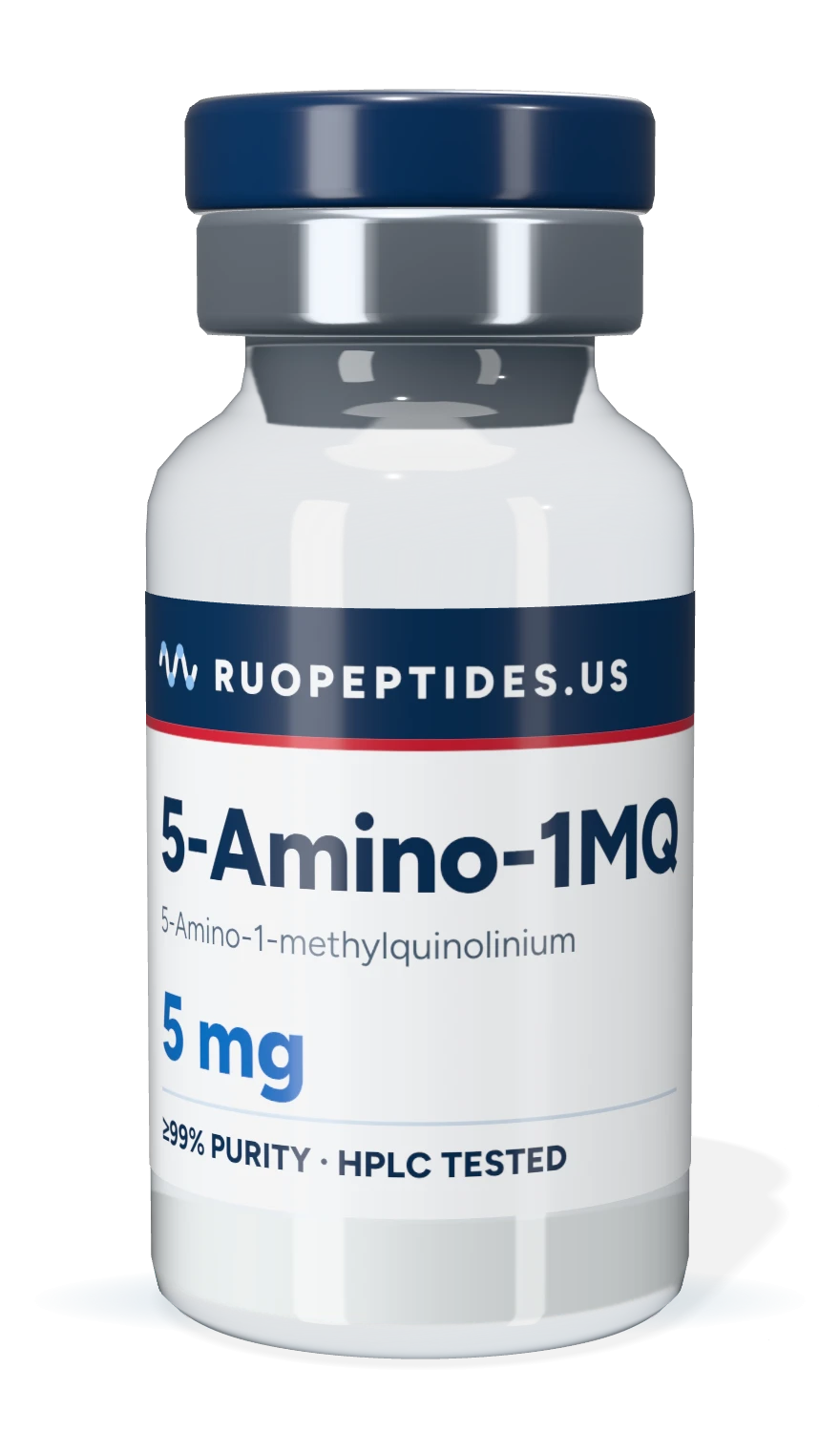
5-AMINO-1MQ
FOR RESEARCH USE ONLYNot for human or veterinary use of any kind
Full label. Lot number and expiry differ per batch and are printed on each vial.
Mitochondrial & Metabolic ResearchSmall Molecules & Coenzymes
5-Amino-1MQ
Also known as: 5-Amino-1-methylquinolinium
5-Amino-1MQ (5-amino-1-methylquinolinium) is a synthetic small-molecule inhibitor of nicotinamide N-methyltransferase (NNMT); notably, it is not a peptide despite being available from peptide-research suppliers.
- CAS
- 42464-96-0
- M.W.
- 286.11 g/mol
- Formula
- C₁₀H₁₁IN₂
- Form
- Lyophilized powder
$79.00per vial
Price shown per vial. Quantity discounts below.
In stock
Buy more, pay less per vial
Add 1 more vial to save 3%: $76.63 per vial.
- Safe credit card paymentVisa, Mastercard and American Express
- 30-day money-back guarantee
- Super-fast 1-2 day shippingTo all 50 states and DC
- Free shipping on orders over $200Applied automatically at checkout
5-Amino-1MQ
5 mg · $79.00/vial
Lyophilized 5-Amino-1MQ storage
Lyophilized 5-Amino-1MQ peptide should be stored in a dry place, protected from sunlight and moisture.
The following storage conditions are generally recommended:
- Room temperature (15-25 °C / 59-77 °F): Up to ~3-8 months
- Refrigerated (2-8 °C / 35.6-46.4 °F): Up to 6 months
- Frozen (-20 °C / -4 °F or below): 3-5 years
Prior reconstituting with a suitable solvent or Saline, allow the vial to reach room temperature after taking it out of the refrigerator or freezer.
Reconstituted 5-Amino-1MQ storage
Once in solution, 5-Amino-1MQ is generally less stable compared to their lyophilized (powdered) form and should be stored at cold temperatures when possible.
These storage conditions are generally recommended:
- Room temperature (15-25 °C / 59-77 °F): Avoid longer than 2-4 day storage
- Refrigerated (2-8 °C / 35.6-46.4 °F): Typically 4-8 weeks
- Frozen (-20 °C / -4 °F or below): Up to 3-4 months
However, to preserve peptide efficacy and amino-acid bonds, avoid repeatedly freezing and unfreezing the peptide.
5-Amino-1MQ delivery and shipping
5-Amino-1MQ ships from US stock to United States addresses only. Orders are packed and dispatched within 1-2 business days.
- Standard: $9.95, 1-2 business days after dispatch.
- Express: $24.95, next business day after dispatch.
Lyophilized 5-Amino-1MQ ships in a sealed glass vial with protective packaging. The dry powder is stable at room temperature for the length of domestic transit, so no cold pack is needed. Move it to the storage conditions above when it arrives.
Follow your parcel any time on the Track Order page.
5-Amino-1MQ lab testing and COA
The certificate of analysis for 5-Amino-1MQ is being uploaded. Ask support for the current report before you order if you need it now.
Every vial label has a lot number. Check it on the Verify page to confirm the vial is genuine. All reports are on the Lab Reports page.
For laboratory research use only. All products are sold for laboratory research use only. They are not drugs, foods, cosmetics or dietary supplements, and are not for human or veterinary use.
5-Amino-1MQ specifications
- Product
- 5-Amino-1MQ
- Also known as
- 5-Amino-1-methylquinolinium
- Compound class
- Mitochondrial & Metabolic Research
- Product type
- Small molecule
- Form
- Lyophilized powder
- Amounts available
- 5 mg ($79.00)
- Molecular Structure
- Quinolinium core (benzopyridinium), N1-methyl (quaternized N), 5-amino (-NH₂) on the aromatic ring; overall +1 on the ring nitrogen with iodide (I⁻) as the counter-ion.
- Molecular weight
- 286.11 g/mol
- Molecular formula
- C₁₀H₁₁IN₂
- CAS number
- 42464-96-0
- Storage as supplied
- Sealed, dry, dark; -20 °C for long-term storage
- Lab report
- COA on request
- Research areas
- Mitochondrial & Metabolic Research, Small Molecules & Coenzymes
- Intended use
- Laboratory research only. Not for human or veterinary use.
Research overview
About 5-Amino-1MQ
Scientifically reviewed by John Johnson · Updated November 20265-Amino-1MQ (5-amino-1-methylquinolinium) is a synthetic small-molecule inhibitor of nicotinamide N-methyltransferase (NNMT); notably, it is not a peptide despite being available from peptide-research suppliers. NNMT participates in nicotinamide metabolism by methylating nicotinamide using S-adenosylmethionine (SAM). Experimental research has focused on NNMT inhibition, adipose-tissue metabolism, energy expenditure, and metabolic regulation[1].
What Is 5-Amino-1MQ?
5-Amino-1MQ, full name 5-amino-1-methylquinolinium, is a synthetic small-molecule NNMT inhibitor rather than a peptide. Its primary research target is nicotinamide N-methyltransferase (NNMT), an enzyme that catalyzes the methylation of nicotinamide to produce 1-methylnicotinamide (1-MNA), using S-adenosylmethionine (SAM) as the methyl donor in this reaction.
NNMT is expressed across several tissues and has been investigated in relation to cellular energy metabolism, NAD+ biology, methyl-donor availability, adipose-tissue biology, and metabolic disease research. Its biological functions are broad and context-dependent, making it a subject of active investigation across multiple metabolic research areas rather than a single-pathway target.
As a nicotinamide N-methyltransferase inhibitor, this 5-Amino-1MQ research compound was identified as a selective, membrane-permeable inhibitor of NNMT and subsequently evaluated across cellular and animal models examining NNMT-related metabolic pathways [1].
For a detailed breakdown of mechanisms, published research, and investigated applications, researchers can explore current NNMT inhibitor literature through published metabolic research databases.
NNMT Inhibition and Cellular Metabolism
Foundational NNMT metabolism research began with efforts to develop selective small-molecule inhibitors capable of suppressing NNMT activity in cellular and adipose-tissue models. The goal was to investigate how inhibiting this enzyme affects downstream nicotinamide metabolism, methyl-donor availability, and cellular energy regulation.
The foundational study characterizing 5-amino-1-methylquinolinium identified it as a selective, membrane-permeable NNMT inhibitor suitable for use in cellular models. In cultured adipocytes, NNMT inhibition with 5A-1MQ was associated with increased intracellular NAD+ and SAM concentrations, establishing a mechanistic link between NNMT activity, nicotinamide metabolism, and methyl-donor balance within the cell [1].
This finding provides an important mechanistic framework for 5-Amino-1MQ research: by suppressing NNMT-catalyzed methylation of nicotinamide, inhibition alters the balance between nicotinamide, NAD+ precursor availability, and SAM consumption within the cell.
Researchers should note that this mechanism is distinct from direct NAD+ supplementation approaches such as NMN or NR. NNMT inhibition and NAD+ supplementation represent different research strategies targeting related but non-identical aspects of nicotinamide metabolism.
5-Amino-1MQ in Adipose Tissue and Diet-Induced Obesity Models
The same foundational study extended its investigation of 5 amino 1MQ into in vivo animal models, examining diet-induced obese mice treated with the compound over an experimental period. This represents the most widely cited preclinical evidence associated with 5-Amino-1MQ research in metabolic biology.
In diet-induced obese mouse models, researchers investigated associations between 5A-1MQ administration and body weight, white adipose-tissue mass, adipocyte size, food intake, and plasma cholesterol parameters. The study reported reductions in body weight and white adipose-tissue measures in treated animals without corresponding reductions in food intake, suggesting that observed effects were not attributable to appetite suppression [1].
The authors linked these observations to NNMT's documented role in adipose-tissue energy metabolism, positioning NNMT inhibition as a metabolic research target distinct from caloric restriction or appetite-regulatory pathways. These findings are derived exclusively from diet-induced obese mouse experiments and reflect preclinical animal-model data.
The foundational study also examined plasma lipid parameters alongside body-composition measures, reporting changes in cholesterol levels in treated animals. Researchers further noted differences in adipocyte morphology, including reduced adipocyte size in white adipose tissue of treated mice compared with controls.
These observations contributed to broader interest in NNMT as a regulator of adipose-tissue biology and cellular energy balance in preclinical models.
NNMT Inhibition, Diet, and Metabolic Adaptation
Subsequent NNMT metabolism research extended investigation of 5-amino-1MQ beyond isolated NNMT inhibition to examine interactions between dietary intervention and NNMT suppression in preclinical models.
A later study investigated how a reduced-calorie dietary protocol combined with 5A-1MQ administration influenced body weight, fat mass, metabolic parameters, and gut microbiome composition in diet-induced obese mice. Researchers found that dietary restriction and NNMT inhibition produced distinct and partially independent effects on metabolic outcomes and microbial community composition, rather than simply additive results [2].
This study is notable for introducing gut microbiome composition as a variable in 5-Amino-1MQ research, reflecting growing interest in interactions between metabolic enzyme inhibition, host metabolism, and intestinal microbial communities in experimental models. The findings characterize relationships between these variables in a controlled animal setting and do not establish therapeutic effects in human metabolic disease.
5-Amino-1MQ in Emerging NNMT Research
More recent published literature has begun examining NNMT inhibition in research contexts beyond adipose-tissue and obesity models, reflecting broader interest in NNMT as a metabolic regulator across different tissue environments.
A 2024 bladder-cancer study employed 5-amino-1-methylquinolinium iodide to investigate NNMT inhibition in cancer-associated fibroblast research. Researchers reported effects on tumor growth parameters and responses to PD-L1 blockade in mouse models, situating NNMT inhibition within tumor microenvironment metabolism research [3].
A recent review additionally discusses 5A-1MQ among experimental NNMT-inhibition strategies being investigated in cardiovascular and broader metabolic research contexts, highlighting ongoing interest in NNMT as a target across multiple disease-relevant biological environments [4].
These emerging research areas illustrate that NNMT is a metabolic research target with relevance beyond adipose biology. They do not position 5-Amino-1MQ research as a cancer therapeutic or cardiovascular treatment, and findings remain at the preclinical and experimental stage.
How Does 5-Amino-1MQ Inhibit NNMT?
NNMT normally catalyzes the following reaction: nicotinamide + SAM produces 1-methylnicotinamide (1-MNA) + S-adenosylhomocysteine (SAH). This reaction consumes both nicotinamide and SAM, connecting NNMT activity directly to nicotinamide metabolism and cellular methyl-donor availability.
5-Amino-1MQ inhibits NNMT activity, allowing researchers engaged in NNMT metabolism research to investigate how reduced nicotinamide methylation affects the following downstream variables in experimental models:
- Intracellular nicotinamide metabolism: examining shifts in nicotinamide availability following NNMT suppression.
- NAD+ availability: investigating changes in NAD+ precursor flux within the cell.
- SAM and methyl-donor balance: studying effects on cellular methylation capacity.
- Adipocyte energy metabolism: examining metabolic responses in adipose-tissue models.
- Downstream metabolic pathways: investigating broader metabolic consequences of NNMT inhibition [1].
Researchers also use 5-Amino-1MQ to investigate how NNMT inhibition influences the broader relationship between nicotinamide metabolism and one-carbon metabolism pathways. Because SAM serves as the universal methyl donor across numerous cellular methylation reactions, NNMT inhibition has implications beyond nicotinamide metabolism alone.
Experimental models applying 5-Amino-1MQ therefore provide a tool for studying how shifts in methyl-donor availability ripple across interconnected metabolic networks, without requiring genetic manipulation of NNMT expression.
5-Amino-1MQ is an NNMT inhibitor, not an NAD+ precursor, and should not be grouped with compounds such as NMN or NR in research contexts.
5-Amino-1MQ FAQ
Is 5-Amino-1MQ a peptide?
No. 5-Amino-1MQ (5-amino-1-methylquinolinium) is a synthetic small-molecule compound, not a peptide. It is available from research-peptide suppliers due to its relevance to metabolic and cellular research, but it belongs to a different compound class entirely.
What does 5-Amino-1MQ inhibit?
5-Amino-1MQ is a selective, membrane-permeable inhibitor of nicotinamide N-methyltransferase (NNMT), an enzyme that catalyzes the methylation of nicotinamide to produce 1-methylnicotinamide (1-MNA) using S-adenosylmethionine (SAM) as the methyl donor.
What is NNMT?
Nicotinamide N-methyltransferase (NNMT) is an enzyme expressed across multiple tissues that participates in nicotinamide metabolism. It has been investigated in relation to cellular energy metabolism, NAD+ biology, methyl-donor balance, adipose-tissue function, and metabolic disease research.
How does 5-Amino-1MQ affect NAD+ metabolism?
By inhibiting NNMT, 5-Amino-1MQ reduces nicotinamide methylation, which has been associated with increased intracellular NAD+ and SAM concentrations in cultured adipocyte models. This provides a mechanistic link between NNMT activity and nicotinamide metabolism, though it is distinct from direct NAD+ supplementation approaches.
Is 5-Amino-1MQ the same as NAD+?
No. 5-Amino-1MQ is an NNMT inhibitor that indirectly influences nicotinamide metabolism pathways. NAD+ is a coenzyme involved in cellular redox reactions and signaling. They are chemically and mechanistically distinct compounds and should not be treated as interchangeable in research contexts.
What is 5-Amino-1MQ studied for?
5-Amino-1MQ 5mg is the current RUOPeptides research format for laboratory and analytical investigations.
Scientific references
- [1]Neelakantan H, Vance V, Wetzel MD, et al. "Selective and membrane-permeable small molecule inhibitors of nicotinamide N-methyltransferase reverse high-fat diet-induced obesity in mice." Biochemical Pharmacology. 2018.
- [2]Hong S et al. "Reduced calorie diet combined with NNMT inhibition establishes a distinct microbiome in DIO mice." Scientific Reports. 2022.
- [3]Yeh CS et al. "NAD+ metabolism enzyme NNMT in cancer-associated fibroblasts drives tumor progression and resistance to immunotherapy by modulating macrophages in urothelial bladder cancer." 2024.
- [4]"Nicotinamide N-Methyltransferase in Cardiovascular Diseases: Metabolic Regulator and Emerging Therapeutic Target." 2025.
Buying 5-Amino-1MQ for research in the USA
Price
$79.00 per vial. 5 mg: $79.00. Quantity discounts per size: 3% off 2 vials, 5% off 3-4 vials, 7% off 5+ vials.
Shipping
US addresses only. Orders are packed and dispatched within 1-2 business days. Standard from $9.95.
Proof it's genuine
Check the lot number on your vial on the Verify page.
Lab reports
COA and SDS documents are on the Lab Reports page.
Scientifically reviewed
Scientifically reviewed by John Johnson
Scientific reviewer · Last reviewed November 2026
John Johnson reviewed this 5-Amino-1MQ page for scientific accuracy: the compound's identity and specifications, the summaries of published studies, and the references they cite. The page describes laboratory and preclinical research only. It is not medical advice and gives no usage guidance.
Research information on this page summarizes published laboratory and preclinical studies. It is not usage guidance.