For laboratory research use only. Not for human or veterinary use.
MOTS-C

FOR RESEARCH USE ONLYNot for human or veterinary use of any kind
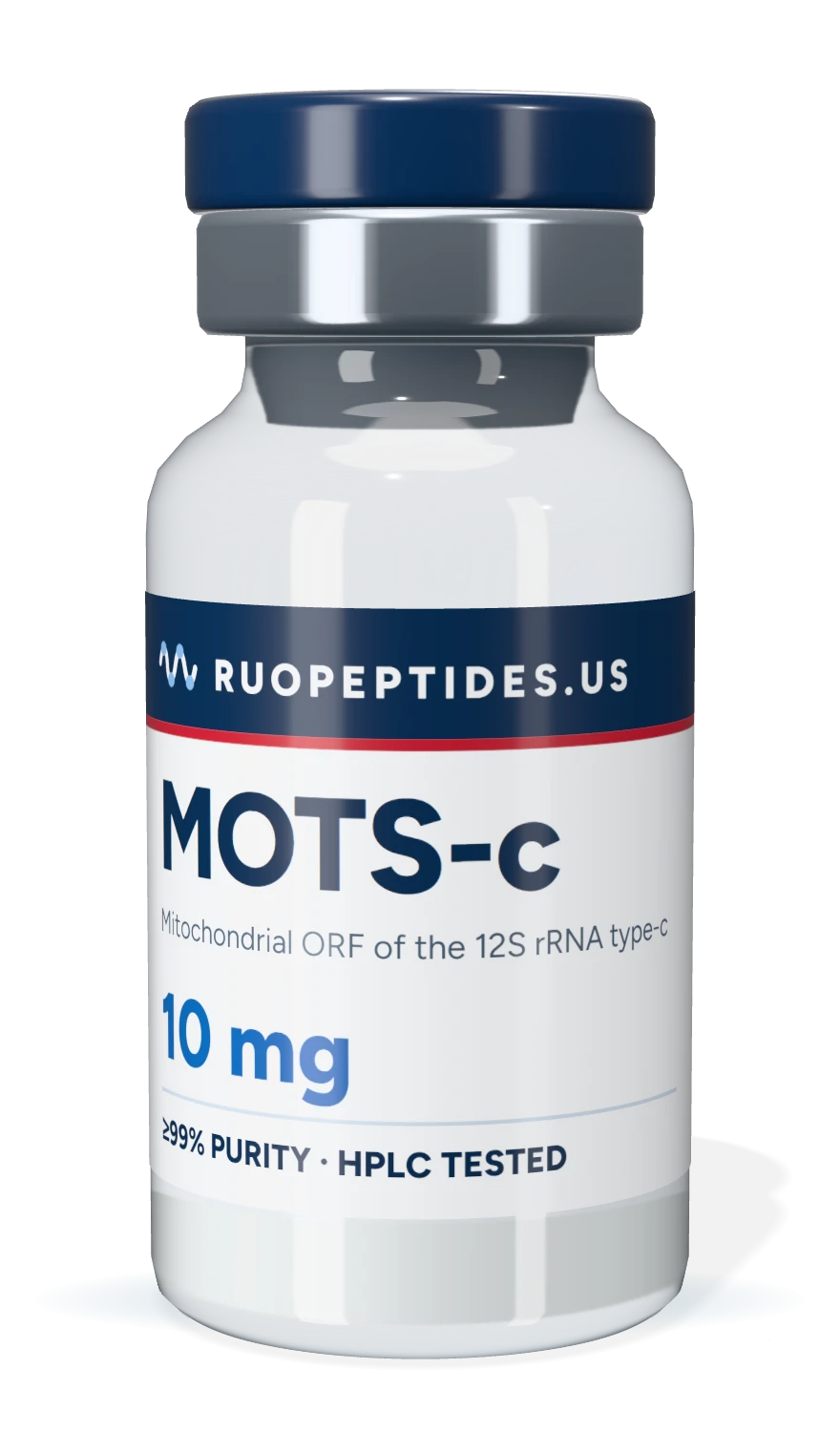
Full label. Lot number and expiry differ per batch and are printed on each vial.
Mitochondrial & Metabolic ResearchCellular Aging ResearchPopular Research Peptides
MOTS-c
Also known as: Mitochondrial ORF of the 12S rRNA type-c
MOTS-C is a 16-amino-acid mitochondrial-derived peptide (MDP) associated with the mitochondrial 12S rRNA region [ 1 ] and is supplied strictly for in vitro and analytical research.
- CAS
- 1627580-64-6
- Form
- Lyophilized powder
$59.00per vial
Price shown per vial. Quantity discounts below.
In stock
Buy more, pay less per vial
Add 1 more vial to save 3%: $57.23 per vial.
- Safe credit card paymentVisa, Mastercard and American Express
- 30-day money-back guarantee
- Super-fast 1-2 day shippingTo all 50 states and DC
- Free shipping on orders over $200Applied automatically at checkout
MOTS-c
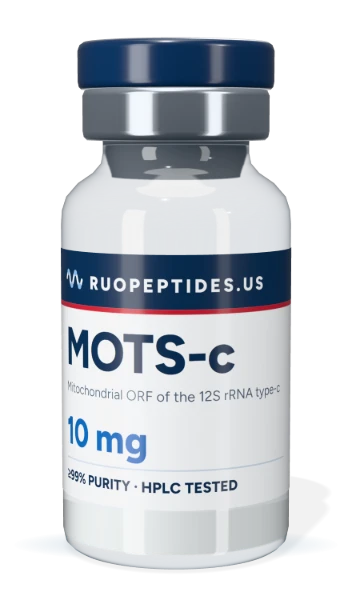
10 mg · $59.00/vial
Lyophilized MOTS-c storage
Lyophilized MOTS-C peptide should be stored in a dry place, protected from sunlight and moisture.
Reconstituted MOTS-c storage
Once in solution, MOTS-C is generally less stable compared to their lyophilized (powdered) form and should be stored at cold temperatures when possible.
These storage conditions are generally recommended:
- Room temperature (15-25 °C / 59-77 °F): Avoid longer than 2-4 day storage
- Refrigerated (2-8 °C / 35.6-46.4 °F): Typically 4-8 weeks
- Frozen (-20 °C / -4 °F or below or below): Up to 3-4 months
However, to preserve peptide efficacy and amino-acid bonds, avoid repeatedly freezing and unfreezing the peptide.
MOTS-c delivery and shipping
MOTS-c ships from US stock to United States addresses only. Orders are packed and dispatched within 1-2 business days.
- Standard: $9.95, 1-2 business days after dispatch.
- Express: $24.95, next business day after dispatch.
Lyophilized MOTS-c ships in a sealed glass vial with protective packaging. The dry powder is stable at room temperature for the length of domestic transit, so no cold pack is needed. Move it to the storage conditions above when it arrives.
Follow your parcel any time on the Track Order page.
MOTS-c lab testing and COA
The certificate of analysis for MOTS-c is being uploaded. Ask support for the current report before you order if you need it now.
Every vial label has a lot number. Check it on the Verify page to confirm the vial is genuine. All reports are on the Lab Reports page.
For laboratory research use only. All products are sold for laboratory research use only. They are not drugs, foods, cosmetics or dietary supplements, and are not for human or veterinary use.
MOTS-c specifications
- Product
- MOTS-c
- Also known as
- Mitochondrial ORF of the 12S rRNA type-c
- Compound class
- Mitochondrial & Metabolic Research
- Product type
- Peptide
- Form
- Lyophilized powder
- Amounts available
- 10 mg ($59.00), 20 mg ($99.00)
- CAS number
- 1627580-64-6
- Peptide Type
- Mitochondrial-derived peptide (MDP)
- Length
- 16 amino acids
- Genetic Origin
- Mitochondrial 12S rRNA region
- Form
- White to off-white lyophilized powder
- Storage as supplied
- Sealed, dry, dark; -20 °C for long-term storage
- Lab report
- COA on request
- Research areas
- Mitochondrial & Metabolic Research, Cellular Aging Research, Popular Research Peptides
- Intended use
- Laboratory research only. Not for human or veterinary use.
Research overview
About MOTS-c
Scientifically reviewed by John Johnson · Updated November 2026MOTS-C is a 16-amino-acid mitochondrial-derived peptide (MDP) associated with the mitochondrial 12S rRNA region [1] and is supplied strictly for in vitro and analytical research.
Due to its mitochondrial origin and role in cellular signaling, MOTS-C continues to be studied for its potential role in pathways related to cellular stress, mitochondrial function, and metabolic processes in experimental models.
What Is MOTS-C?
MOTS-C belongs to the mitochondrial-derived peptide family and consists of 16 amino acids encoded by a short open reading frame within mitochondrial DNA. The abbreviation refers to the mitochondrial open reading frame of the 12S rRNA type-c. First reported in 2015, MOTS-C was among the early MDPs identified and subsequently characterized as part of this emerging area of mitochondrial peptide research.
What distinguishes the MOTS-C peptide in research is its documented involvement in mitochondria-to-nucleus retrograde signaling. Under conditions of metabolic stress, published research indicates MOTS-C can translocate from the mitochondria to the nucleus and has been investigated for its influence on gene expression pathways associated with cellular stress adaptation. [2] Research has also explored its connection with the folate-AICAR-AMPK pathway and broader mechanisms of metabolic regulation.
These characteristics position MOTS-C as a compound of active interest in mitochondrial biology and cellular stress research.
MOTS-C Research Applications
Research-grade MOTS-C is used in scientific investigation across multiple areas of mitochondrial biology, metabolic signaling, and cellular response to stress. As a well-characterized MOTS-C research peptide, it is examined across several areas in published scientific literature:
- Mitochondrial signaling: researching how mitochondrial-derived peptides may support retrograde communication between mitochondria and the nucleus through signaling pathways.
- Cellular energy metabolism: exploring how cells regulate energy production and metabolic balance across different physiological conditions.
- AMPK signaling: studying how MOTS-C has been linked to AMPK activation and signaling pathways involved in the cellular response to metabolic stress. [3]
- Glucose metabolism: examining glucose utilization, insulin signaling, and metabolic regulation in experimental models. [4]
- Cellular stress adaptation: investigating nuclear translocation of MOTS-C and its influence on stress-responsive gene expression.
- Exercise physiology: examining documented relationships between endogenous MOTS-C levels, skeletal muscle metabolism, and exercise-associated metabolic adaptation. [5]
- Age-related biology: investigating changes in MOTS-C signaling and mitochondrial homeostasis observed across ageing research models.
Additional published literature has explored MOTS-C in relation to inflammation, cardiovascular biology, and skeletal metabolism. [6] [7] [8] These remain active areas of investigation rather than established applications.
MOTS-c FAQ
What purity is RUOPeptides MOTS-C?
RUOPeptides MOTS-C is supplied at ≥99% purity, independently verified by third-party analytical laboratories using high-performance liquid chromatography prior to dispatch. Certificates of analysis are available for researcher review.
What does MOTS-C stand for?
MOTS-C stands for mitochondrial open reading frame of the 12S rRNA type-c. The name reflects its genetic origin, a short open reading frame encoded within the mitochondrial 12S rRNA region of mitochondrial DNA.
Is MOTS-C a peptide?
Yes. MOTS-C is a 16-amino-acid peptide belonging to the mitochondrial-derived peptide family, a class of bioactive peptides encoded by short open reading frames within mitochondrial DNA rather than the nuclear genome.
Is MOTS-C a mitochondrial peptide?
Yes. MOTS-C is categorized as a mitochondrial-derived peptide (MDP) encoded within the mitochondrial 12S rRNA region. Since its identification in 2015, it has been studied as part of the broader MDP family in published scientific literature.
Is MOTS-C naturally occurring?
Yes. MOTS-C is an endogenous peptide produced within human cells. Published research has examined how endogenous MOTS-C levels vary in response to metabolic stress, physical activity, and ageing in experimental models.
When was MOTS-C discovered?
MOTS-C was first reported in 2015, when it was identified as a mitochondrial-derived peptide with roles in metabolic regulation and cellular stress signaling. It remains an active subject of investigation in mitochondrial biology research.
What is MOTS-C studied for?
Published research documents MOTS-C investigation across mitochondrial signaling, cellular energy metabolism, AMPK pathway activation, glucose metabolism, cellular stress adaptation, exercise physiology, and age-related changes in mitochondrial homeostasis and signaling.
Scientific references
- [1]The mitochondrial-derived peptide MOTS-c promotes metabolic homeostasis and reduces obesity and insulin resistance
- [2]The Mitochondrial-Encoded Peptide MOTS-c Translocates to the Nucleus to Regulate Nuclear Gene Expression in Response to Metabolic Stress
- [3]MOTS-c interacts synergistically with exercise intervention to regulate PGC-1α expression, attenuate insulin resistance and enhance glucose metabolism in mice via AMPK signaling pathway
- [4]Plasma MOTS-c levels are associated with insulin sensitivity in lean but not in obese individuals
- [5]MOTS-c is an exercise-induced mitochondrial-encoded regulator of age-dependent physical decline and muscle homeostasis
- [6]Mitochondrial-encoded MOTS-c prevents pancreatic islet destruction in autoimmune diabetes
- [7]Downregulation of circulating MOTS-c levels in patients with coronary endothelial dysfunction
- [8]MOTS-c improves osteoporosis by promoting osteogenic differentiation of bone marrow mesenchymal stem cells via TGF-β/Smad pathway
Buying MOTS-c for research in the USA
Price
From $59.00. 10 mg: $59.00, 20 mg: $99.00. Quantity discounts per size: 3% off 2 vials, 5% off 3-4 vials, 7% off 5+ vials.
Shipping
US addresses only. Orders are packed and dispatched within 1-2 business days. Standard from $9.95.
Proof it's genuine
Check the lot number on your vial on the Verify page.
Lab reports
COA and SDS documents are on the Lab Reports page.
Scientifically reviewed
Scientifically reviewed by John Johnson
Scientific reviewer · Last reviewed November 2026
John Johnson reviewed this MOTS-c page for scientific accuracy: the compound's identity and specifications, the summaries of published studies, and the references they cite. The page describes laboratory and preclinical research only. It is not medical advice and gives no usage guidance.
Research information on this page summarizes published laboratory and preclinical studies. It is not usage guidance.