For laboratory research use only. Not for human or veterinary use.
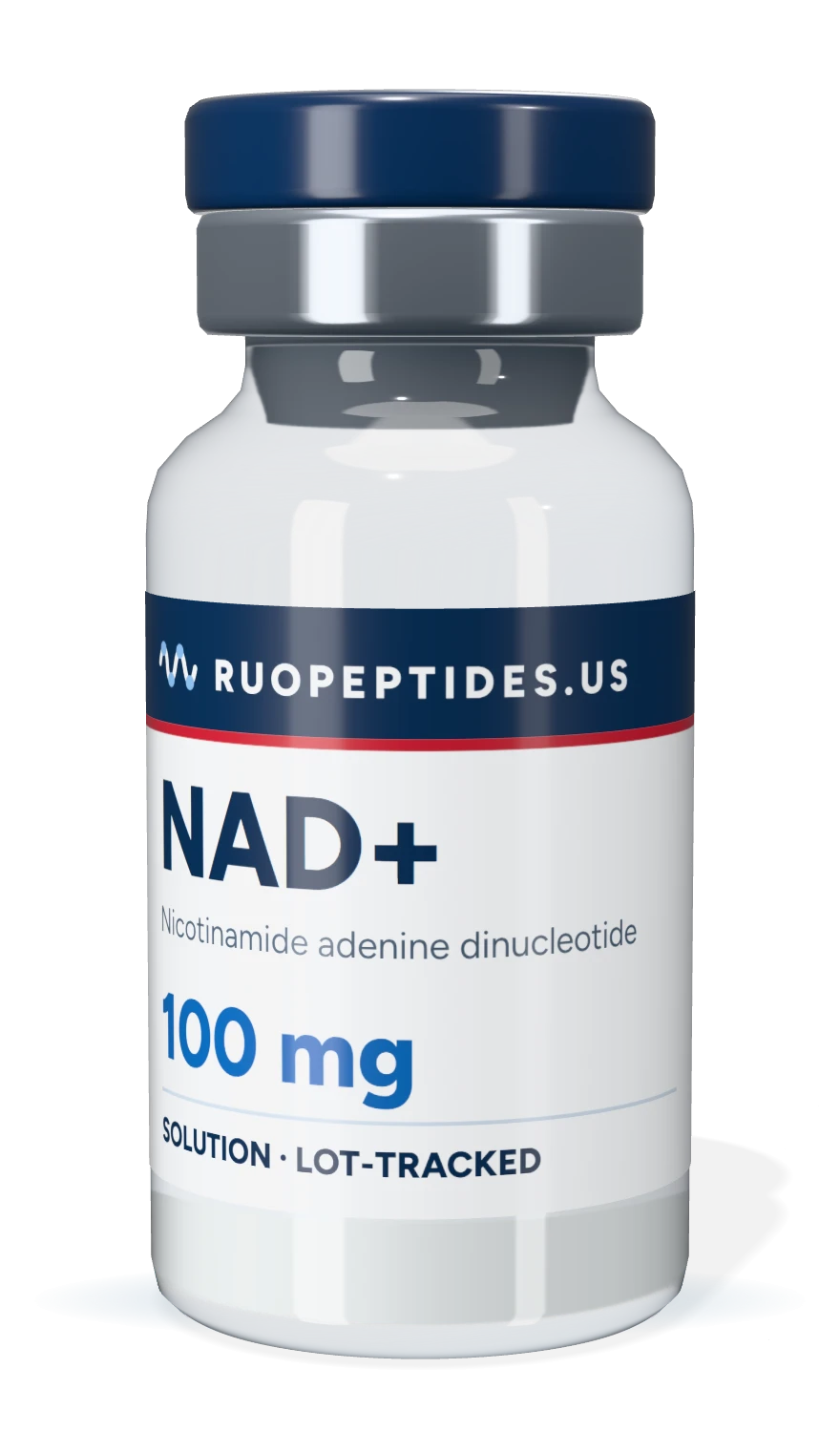
NAD+
FOR RESEARCH USE ONLYNot for human or veterinary use of any kind
Full label. Lot number and expiry differ per batch and are printed on each vial.
Mitochondrial & Metabolic ResearchSmall Molecules & CoenzymesCellular Aging Research
NAD+
Also known as: Nicotinamide adenine dinucleotide, β-NAD
NAD+ (nicotinamide adenine dinucleotide) is a coenzyme found in every living cell.
- CAS
- 53-84-9
- M.W.
- 663.43 g/mol
- Formula
- C₂₁H₂₇N₇O₁₄P₂
- Form
- Solution
$49.00per vial
Price shown per vial. Quantity discounts below.
In stock
Buy more, pay less per vial
Add 1 more vial to save 3%: $47.53 per vial.
- Safe credit card paymentVisa, Mastercard and American Express
- 30-day money-back guarantee
- Super-fast 1-2 day shippingTo all 50 states and DC
- Free shipping on orders over $200Applied automatically at checkout
NAD+
100 mg · $49.00/vial
NAD+ storage
Store refrigerated (2-8 °C) and protected from light. Avoid repeated freeze-thaw cycles.
NAD+ delivery and shipping
NAD+ ships from US stock to United States addresses only. Orders are packed and dispatched within 1-2 business days.
- Standard: $9.95, 1-2 business days after dispatch.
- Express: $24.95, next business day after dispatch.
Solutions ship sealed and upright in protective packaging.
Follow your parcel any time on the Track Order page.
NAD+ lab testing and COA
The certificate of analysis for NAD+ is being uploaded. Ask support for the current report before you order if you need it now.
Every vial label has a lot number. Check it on the Verify page to confirm the vial is genuine. All reports are on the Lab Reports page.
For laboratory research use only. All products are sold for laboratory research use only. They are not drugs, foods, cosmetics or dietary supplements, and are not for human or veterinary use.
NAD+ specifications
- Product
- NAD+
- Also known as
- Nicotinamide adenine dinucleotide, β-NAD
- Compound class
- Mitochondrial & Metabolic Research
- Product type
- Solution
- Form
- Solution
- Amounts available
- 100 mg ($49.00), 500 mg ($127.00)
- Molecular weight
- 663.43 g/mol
- Molecular formula
- C₂₁H₂₇N₇O₁₄P₂
- CAS number
- 53-84-9
- Format
- Solution, 10 mL vial
- Storage as supplied
- Sealed, protected from light
- Lab report
- COA on request
- Research areas
- Mitochondrial & Metabolic Research, Small Molecules & Coenzymes, Cellular Aging Research, Popular Research Peptides
- Intended use
- Laboratory research only. Not for human or veterinary use.
Research overview
About NAD+
Scientifically reviewed by John Johnson · Updated November 2026NAD+ (nicotinamide adenine dinucleotide) is a coenzyme found in every living cell. It carries electrons in redox reactions and is consumed by enzymes that regulate gene expression, DNA repair and cell signaling, which makes it a central molecule in metabolism and aging research. [1][2] RUOPeptides supplies NAD+ in solution, in 100 mg and 500 mg vials, for laboratory research.
What Is NAD+?
NAD+ was first identified in 1906, when Arthur Harden and William Young described a heat-stable factor needed for yeast fermentation. Chemically it is a dinucleotide: one nucleotide carrying adenine and one carrying nicotinamide, joined through their phosphate groups. Its formula is C₂₁H₂₇N₇O₁₄P₂ and its molecular weight is about 663.4 g/mol.
The nicotinamide ring is the reactive part. In the oxidized form, NAD+, it accepts a hydride ion and becomes NADH. NADH then passes those electrons on, for example to complex I of the mitochondrial electron transport chain. The NAD+/NADH ratio is widely used as a readout of a cell's redox state. [2]
Cells make NAD+ by three routes: de novo synthesis from tryptophan, the Preiss-Handler pathway from nicotinic acid, and the salvage pathway, which recycles nicotinamide through the enzyme NAMPT. Nicotinamide mononucleotide (NMN) and nicotinamide riboside (NR) are salvage-pathway intermediates used widely in research. [5]
Overview of Published NAD+ Research
NAD+ research covers basic redox metabolism, NAD+-consuming signaling enzymes, and the drop in NAD+ levels seen in aging tissue. Most mechanistic findings come from cell culture and mouse models, and many studies use NAD+ precursors rather than NAD+ itself.
Redox Metabolism and Mitochondrial Function
NAD+ accepts electrons in glycolysis, the TCA cycle and fatty acid oxidation, and NADH feeds them into oxidative phosphorylation. Cells keep separate NAD+ pools in the cytosol, mitochondria and nucleus, and the balance between them affects how these pathways respond to changes in nutrient supply. [2]
Mouse models of diet-induced metabolic stress have been used to measure NAD+ in liver, muscle and fat, and to study how raising NAD+ with precursors changes mitochondrial function in those tissues. [2]
Sirtuin and PARP Signaling
Beyond its coenzyme role, NAD+ is a substrate that some enzymes break down. Sirtuins (SIRT1 to SIRT7) use NAD+ to remove acetyl and other acyl groups from proteins, linking cellular energy status to gene regulation and mitochondrial function. PARP enzymes, especially PARP1, use NAD+ to build poly(ADP-ribose) chains at sites of DNA damage, and CD38 is a major NAD+-degrading enzyme in many tissues. [1][2]
Because these enzymes draw on the same NAD+ supply, heavy PARP activation can limit sirtuin activity. This competition is a recurring theme in NAD+ research.
NAD+ Decline in Aging Models
NAD+ levels fall with age in several mouse tissues. Gomes and colleagues reported that declining NAD+ in aging mouse muscle reduced SIRT1 activity and produced a pseudohypoxic state, in which HIF-1α builds up despite normal oxygen, disrupting communication between the nucleus and mitochondria. Raising NAD+ with the precursor NMN restored several of these mitochondrial markers in older mice. [3]
Reviews of the field describe NAD+ decline as one of several linked changes in aging cells, alongside rising CD38 expression and lower NAMPT activity. [5] Mouse findings do not establish the same effects in other species.
Axon Degeneration and SARM1
NAD+ is also central to neuron research. Gerdts and colleagues showed that activating SARM1, a protein found in axons, triggers rapid local NAD+ destruction and axon degeneration in cultured neurons. [4] Later work showed that SARM1 itself cleaves NAD+, and these findings made NAD+ maintenance a key topic in axon biology.
NAD+ vs NADH vs NMN vs NR: What's the Difference?
These four molecules are often named together, but they play different parts in the NAD+ system.
| Molecule | What it is | Role in the NAD+ system |
|---|---|---|
| NAD+ | Oxidized coenzyme | Accepts electrons; substrate for sirtuins, PARPs and CD38 |
| NADH | Reduced coenzyme | Donates electrons, mainly to mitochondrial complex I |
| NMN | Nicotinamide mononucleotide | Salvage-pathway intermediate, converted to NAD+ by NMNAT enzymes |
| NR | Nicotinamide riboside | Precursor, phosphorylated to NMN by NRK1 and NRK2 |
Studies that use NMN or NR measure how cells and tissues respond to a larger NAD+ supply. Those results describe the precursor studied, under that study's conditions. [5]
NAD+ FAQ
What does NAD+ do in cells?
Two things. It carries electrons in redox reactions as the NAD+/NADH pair, and it is consumed as a substrate by sirtuins, PARPs and CD38, which link it to gene regulation, DNA repair and signaling.
What is the difference between NAD+ and NADH?
NAD+ is the oxidized form, which accepts electrons. NADH is the reduced form, which donates them, mainly to the mitochondrial electron transport chain. Their ratio reflects a cell's redox state.
How do cells make NAD+?
By de novo synthesis from tryptophan, by the Preiss-Handler pathway from nicotinic acid, and by the salvage pathway, which recycles nicotinamide through NAMPT. Nicotinic acid and nicotinamide are both forms of vitamin B3.
How is NAD+ different from NMN and NR?
NMN and NR are precursors. Cells convert NR to NMN, and NMN to NAD+. Research uses them to raise NAD+ levels, while NAD+ itself is the active coenzyme and enzyme substrate.
Why do NAD+ levels matter in aging research?
NAD+ falls with age in several mouse tissues, which reduces sirtuin activity and affects mitochondrial function. Researchers study this decline, and the roles of CD38 and NAMPT in it, mainly in animal and cell models.
Scientific references
- [1]Verdin E. Science. 2015. NAD+ in aging, metabolism, and neurodegeneration.
- [2]Cantó C, Menzies KJ, Auwerx J. Cell Metab. 2015. NAD(+) Metabolism and the Control of Energy Homeostasis: A Balancing Act between Mitochondria and the Nucleus.
- [3]Gomes AP, et al. Cell. 2013. Declining NAD(+) induces a pseudohypoxic state disrupting nuclear-mitochondrial communication during aging.
- [4]Gerdts J, et al. Science. 2015. SARM1 activation triggers axon degeneration locally via NAD+ destruction.
- [5]Covarrubias AJ, et al. Nat Rev Mol Cell Biol. 2021. NAD(+) metabolism and its roles in cellular processes during ageing.
Buying NAD+ for research in the USA
Price
From $49.00. 100 mg: $49.00, 500 mg: $127.00. Quantity discounts per size: 3% off 2 vials, 5% off 3-4 vials, 7% off 5+ vials.
Shipping
US addresses only. Orders are packed and dispatched within 1-2 business days. Standard from $9.95.
Proof it's genuine
Check the lot number on your vial on the Verify page.
Lab reports
COA and SDS documents are on the Lab Reports page.
Scientifically reviewed
Scientifically reviewed by John Johnson
Scientific reviewer · Last reviewed November 2026
John Johnson reviewed this NAD+ page for scientific accuracy: the compound's identity and specifications, the summaries of published studies, and the references they cite. The page describes laboratory and preclinical research only. It is not medical advice and gives no usage guidance.
Research information on this page summarizes published laboratory and preclinical studies. It is not usage guidance.