For laboratory research use only. Not for human or veterinary use.
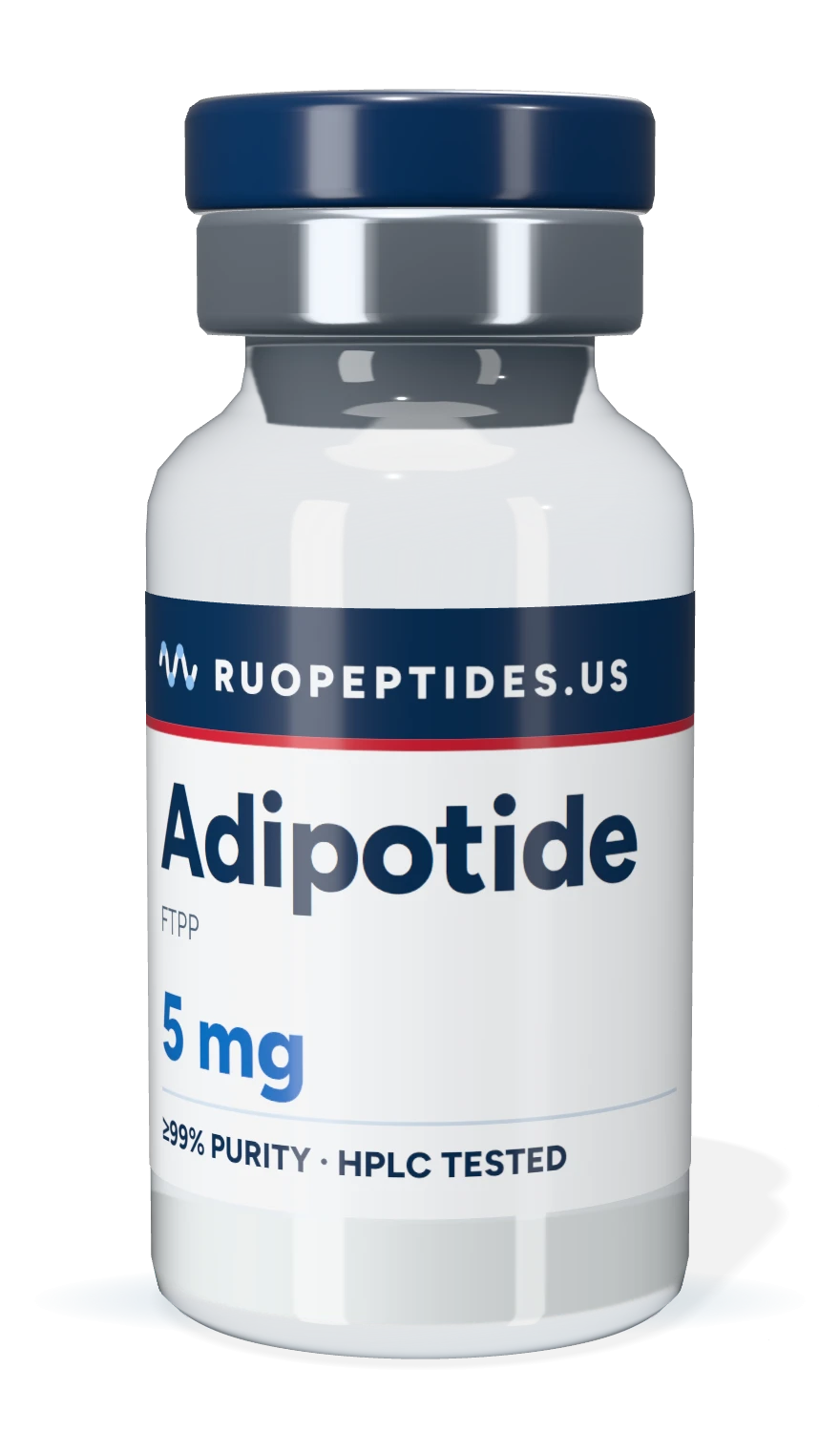
ADIPOTIDE
FOR RESEARCH USE ONLYNot for human or veterinary use of any kind
Full label. Lot number and expiry differ per batch and are printed on each vial.
Mitochondrial & Metabolic Research
Adipotide (FTPP)
Also known as: FTPP, Prohibitin-targeting peptide
RUOPeptides offers Adipotide as an experimental peptidomimetic only for use in laboratory and scientific studies. Adipotide is also referred to as FTPP (Fat-Targeted Proapoptotic Peptide) in scientific literature.
- CAS
- 859216-15-2
- M.W.
- 2,555.22 g/mol
- Formula
- C₁₁₁H₂₀₄N₃₆O₂₈S₂
- Form
- Lyophilized powder
$49.00per vial
Price shown per vial. Quantity discounts below.
In stock
Buy more, pay less per vial
Add 1 more vial to save 3%: $47.53 per vial.
- Safe credit card paymentVisa, Mastercard and American Express
- 30-day money-back guarantee
- Super-fast 1-2 day shippingTo all 50 states and DC
- Free shipping on orders over $200Applied automatically at checkout
Adipotide (FTPP)
5 mg · $49.00/vial
Lyophilized Adipotide storage
Lyophilized Adipotide peptide should be stored in a dry place, protected from sunlight and moisture.
The following storage conditions are generally recommended:
- Room temperature (15-25 °C / 59-77 °F): Up to ~3-8 months
- Refrigerated (2-8 °C / 35.6-46.4 °F): Up to 6 months
- Frozen (-20 °C / -4 °F or below): 3-5 years
Prior reconstituting with a suitable solvent or Saline, allow the vial to reach room temperature after taking it out of the refrigerator or freezer.
Reconstituted Adipotide storage
Once in solution, Adipotide is generally less stable compared to their lyophilized (powdered) form and should be stored at cold temperatures when possible.
These storage conditions are generally recommended:
- Room temperature (15-25 °C / 59-77 °F): Avoid longer than 2-4 day storage
- Refrigerated (2-8 °C / 35.6-46.4 °F): Typically 4-8 weeks
- Frozen (-20 °C / -4 °F or below): Up to 3-4 months
However, to preserve peptide efficacy and amino-acid bonds, avoid repeatedly freezing and unfreezing the peptide.
Adipotide delivery and shipping
Adipotide ships from US stock to United States addresses only. Orders are packed and dispatched within 1-2 business days.
- Standard: $9.95, 1-2 business days after dispatch.
- Express: $24.95, next business day after dispatch.
Lyophilized Adipotide ships in a sealed glass vial with protective packaging. The dry powder is stable at room temperature for the length of domestic transit, so no cold pack is needed. Move it to the storage conditions above when it arrives.
Follow your parcel any time on the Track Order page.
Adipotide lab testing and COA
The certificate of analysis for Adipotide is being uploaded. Ask support for the current report before you order if you need it now.
Every vial label has a lot number. Check it on the Verify page to confirm the vial is genuine. All reports are on the Lab Reports page.
For laboratory research use only. All products are sold for laboratory research use only. They are not drugs, foods, cosmetics or dietary supplements, and are not for human or veterinary use.
Adipotide specifications
- Product
- Adipotide (FTPP)
- Also known as
- FTPP, Prohibitin-targeting peptide
- Compound class
- Mitochondrial & Metabolic Research
- Product type
- Peptide
- Form
- Lyophilized powder
- Amounts available
- 5 mg ($49.00), 10 mg ($89.00)
- Sequence
- Cys-Lys-Gly-Gly-Arg-Ala-Lys-Asp-Cys-Gly-Gly-(D-Lys-Leu-Ala-Lys-Leu-Ala-Lys)₂
- Molecular weight
- 2,555.22 g/mol
- Molecular formula
- C₁₁₁H₂₀₄N₃₆O₂₈S₂
- CAS number
- 859216-15-2
- Storage as supplied
- Sealed, dry, dark; -20 °C for long-term storage
- Lab report
- COA on request
- Research areas
- Mitochondrial & Metabolic Research
- Intended use
- Laboratory research only. Not for human or veterinary use.
Research overview
About Adipotide (FTPP)
Scientifically reviewed by John Johnson · Updated November 2026RUOPeptides offers Adipotide as an experimental peptidomimetic only for use in laboratory and scientific studies. Adipotide is also referred to as FTPP (Fat-Targeted Proapoptotic Peptide) in scientific literature.
Adipotide has been investigated as a targeted construct designed around a peptide motif that recognizes prohibitin associated with white adipose tissue vasculature, making it relevant to research into adipose vasculature, targeted cellular processes, and metabolic biology. The foundational research identified the CKGGRAKDC motif as a white-fat-vasculature-homing sequence associated with prohibitin. [1]
What Is Adipotide (FTPP)?
Adipotide, also known as FTPP is an experimental chimeric peptidomimetic designed around two functional components.
Its targeting component, the CKGGRAKDC sequence, was identified for its ability to home specifically to white adipose tissue vasculature and associate with the vascular cell surface marker prohibitin. This homing motif is synthetically linked to a proapoptotic component, a D-amino-acid (KLAKLAK)₂ sequence investigated for its ability to disrupt mitochondrial membranes and induce programmed cell death (apoptosis) within targeted vascular endothelial cells. [2]
This dual-domain design makes Adipotide fundamentally different from compounds acting primarily through metabolic or central appetite receptors. Adipotide has been investigated in preclinical models examining targeted disruption of white adipose tissue vasculature rather than directly targeting adipocytes or modulating systemic appetite pathways.
Adipotide Research Applications
- Adipose-vasculature research - Investigating the molecular targeting and disruption of specialized blood vessels associated with white adipose tissue depots. [3]
- Prohibitin-targeting research - Examining prohibitin as a specific vascular biomarker and homing site within white fat microvasculature. [4]
- Targeted apoptosis research - Studying the localized delivery of proapoptotic (KLAKLAK)₂ constructs to induce programmed cell death in selected endothelial cells. [5]
- Adipose-tissue biology - Examining the functional relationships between vascular support networks and white-adipose-tissue maintenance or regression.
- Metabolic research - Investigating systemic metabolic alterations associated with the experimental manipulation of adipose tissue in preclinical animal models. [6]
- Targeted-delivery research - Exploring ligand-directed peptide motifs as vehicle tools for directing experimental active compounds toward specific tissue targets. [7]
In-Depth Overview of Vascular Targeting in Obesity Models
In vascular and metabolic biology research, Adipotide represents a unique subclass of peptidomimetics known as vascular-targeting agents. Traditional metabolic compounds focus on receptor-mediated pathways within the central nervous system or liver to alter energy expenditure or food intake. However, investigations using Adipotide have solely revolved around the relationship between white adipose tissue dependence and its vascular support.
Pre-clinical studies carried out on animals have examined the specificity with which ligand-directed molecules recognize markers that are unique to certain tissues. Prohibitin is a membrane protein that exists intracellularly in various cells, but is uniquely expressed at high levels in endothelial cells that supply the white adipose tissue in the hypertrophic state. Using the homing motif CKGGRAKDC, studies can be done regarding the selective concentration of molecules in certain vessels without affecting systemic vasculature.
Once localized to white fat blood vessels, the amphipathic alpha-helical (KLAKLAK)₂ domain disrupts mitochondrial membrane integrity upon cellular internalization. This triggers an apoptotic cascade within endothelial cells, resulting in localized vascular regression.
In experimental setups, researchers monitor the downstream effects of this ischemia on white adipose depots, tracking changes in tissue mass, cellular turnover, and secondary metabolic parameters over controlled observation periods.
Adipotide FAQ
What does FTPP stand for?
FTPP stands for Fat-Targeted Proapoptotic Peptide. This descriptive name highlights its primary scientific design: a targeted sequence engineered to direct a cell-death mechanism specifically toward the blood vessels supporting white adipose tissue.
Is Adipotide a peptide?
Adipotide is classified as a synthetic chimeric peptidomimetic. It functions as an engineered peptide construct, combining a specific tissue-homing peptide motif with a secondary peptide sequence designed to trigger targeted cellular apoptosis.
What does Adipotide target?
Adipotide specifically targets prohibitin receptors expressed on the surface of endothelial cells. These particular blood vessel cells form the supportive microvasculature network that supplies nutrients and oxygen to white adipose tissue depots.
What is prohibitin?
Prohibitin is a multifunctional membrane protein found within cells. In expanding white adipose tissue, it acts as a selective surface biomarker on endothelial cells, making it an ideal target for homing sequences.
How is prohibitin related to Adipotide research?
Prohibitin acts as the specific molecular docking point in Adipotide studies. The homing domain of the peptide selectively binds to surface prohibitin, allowing researchers to concentrate the compound directly within targeted fat microvasculature.
What is the CKGGRAKDC sequence?
The CKGGRAKDC motif is a cyclic 9-amino-acid peptide sequence stabilized by a Cys-Cys disulfide bridge. It acts as the homing mechanism that selectively recognizes and binds to prohibitin in white fat blood vessels.
Is Adipotide studied in adipose-tissue research?
Yes, Adipotide is widely examined in preclinical research. Scientists use it to evaluate white fat regression, vascular targeting mechanisms, local tissue ischemia, and downstream metabolic adjustments in controlled animal models.
Is Adipotide the same as AOD9604?
No, they operate through completely different mechanisms. Adipotide is a vascular-targeting peptidomimetic designed to disrupt fat blood supply, whereas AOD9604 is a growth hormone fragment studied for direct lipolysis in fat cells.
Scientific references
- [1]Reversal of obesity by targeted ablation of adipose tissue
- [2]A peptidomimetic targeting white fat causes weight loss and improved insulin resistance in obese monkeys
- [3]Peptide designed to elicit apoptosis in adipose tissue endothelium reduces food intake and body weight
- [4]Prohibitin/annexin 2 interaction regulates fatty acid transport in adipose tissue
- [5]A comparative study between nanoparticle-targeted therapeutics and bioconjugates as obesity medication
- [6]Rapid and weight-independent improvement of glucose tolerance induced by a peptide designed to elicit apoptosis in adipose tissue endothelium
- [7]Importance of thorough tissue and cellular level characterization of targeted drugs in the evaluation of pharmacodynamic effects
Buying Adipotide for research in the USA
Price
From $49.00. 5 mg: $49.00, 10 mg: $89.00. Quantity discounts per size: 3% off 2 vials, 5% off 3-4 vials, 7% off 5+ vials.
Shipping
US addresses only. Orders are packed and dispatched within 1-2 business days. Standard from $9.95.
Proof it's genuine
Check the lot number on your vial on the Verify page.
Lab reports
COA and SDS documents are on the Lab Reports page.
Scientifically reviewed
Scientifically reviewed by John Johnson
Scientific reviewer · Last reviewed November 2026
John Johnson reviewed this Adipotide page for scientific accuracy: the compound's identity and specifications, the summaries of published studies, and the references they cite. The page describes laboratory and preclinical research only. It is not medical advice and gives no usage guidance.
Research information on this page summarizes published laboratory and preclinical studies. It is not usage guidance.