For laboratory research use only. Not for human or veterinary use.
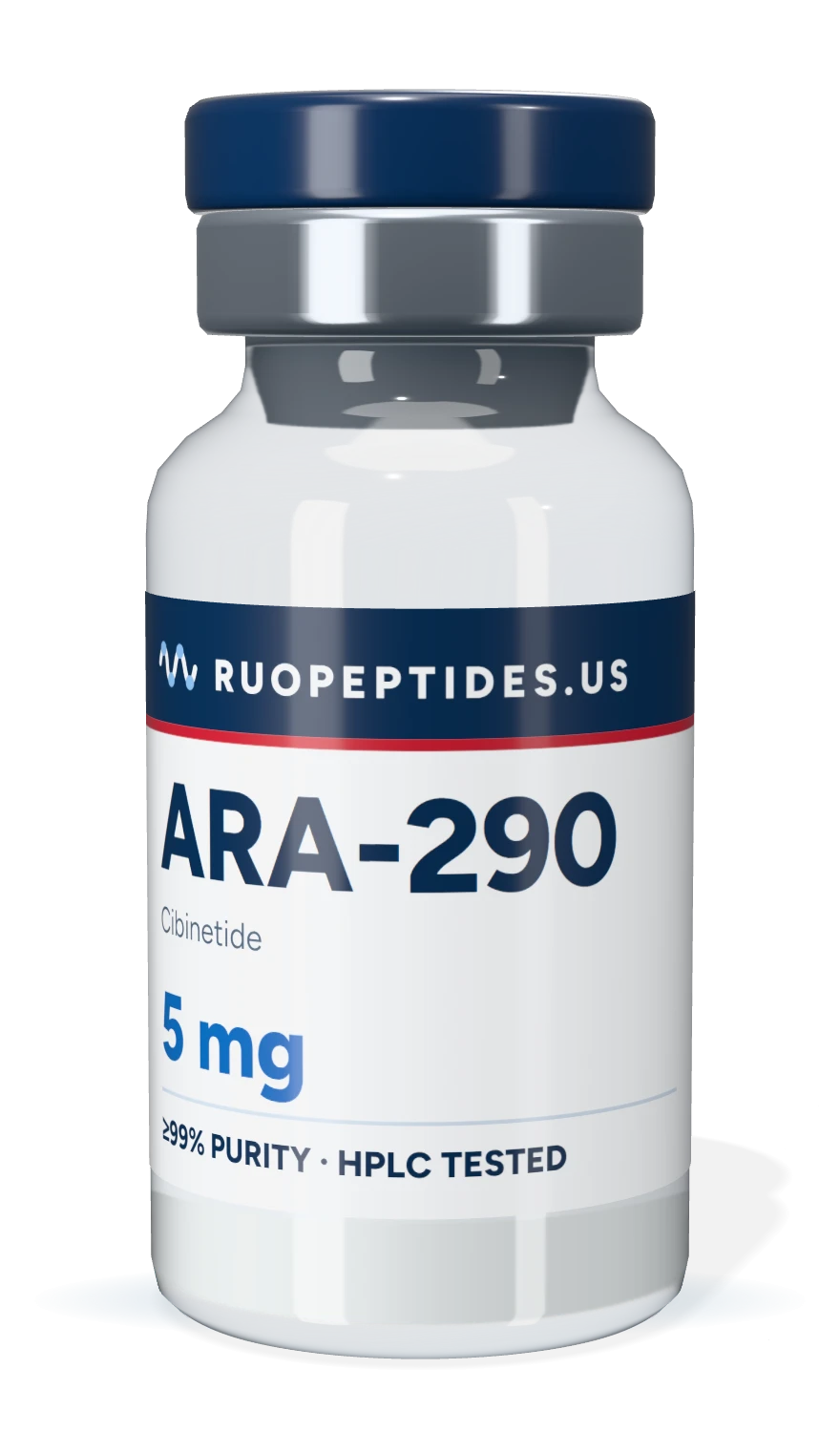
ARA-290

FOR RESEARCH USE ONLYNot for human or veterinary use of any kind
Full label. Lot number and expiry differ per batch and are printed on each vial.
Tissue & Matrix ResearchImmune Signaling Research
ARA-290
Also known as: Cibinetide
ARA-290 Peptide A synthetic 11-amino-acid peptide, ARA-290 is derived from a three-dimensional structure of erythropoietin (EPO); it is sold for research use in laboratory settings.
- CAS
- 901573-94-8
- M.W.
- 1339.5 g/mol
- Formula
- C59H99N19O16
- Form
- Lyophilized powder
$49.00per vial
Price shown per vial. Quantity discounts below.
In stock
Buy more, pay less per vial
Add 1 more vial to save 3%: $47.53 per vial.
- Safe credit card paymentVisa, Mastercard and American Express
- 30-day money-back guarantee
- Super-fast 1-2 day shippingTo all 50 states and DC
- Free shipping on orders over $200Applied automatically at checkout
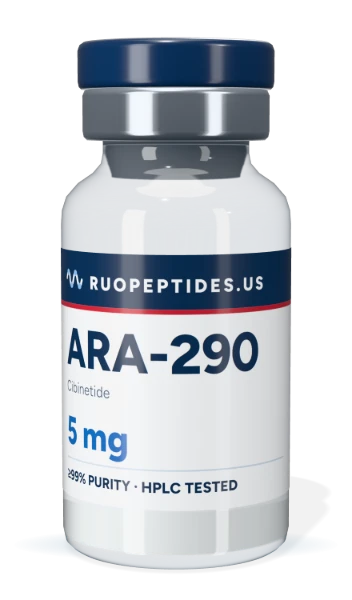
ARA-290
5 mg · $49.00/vial
Lyophilized ARA-290 storage
Lyophilized ARA-290 peptide should be stored in a dry place, protected from sunlight and moisture.
The following storage conditions are generally recommended:
- Room temperature (15-25 °C / 59-77 °F): Up to ~3-8 months
- Refrigerated (2-8 °C / 35.6-46.4 °F): Up to 6 months
- Frozen (-20 °C / -4 °F or below): 3-5 years
Prior reconstituting with a suitable solvent or Saline, allow the vial to reach room temperature after taking it out of the refrigerator or freezer.
Reconstituted ARA-290 storage
Once in solution, ARA-290 is generally less stable compared to their lyophilized (powdered) form and should be stored at cold temperatures when possible.
These storage conditions are generally recommended:
- Room temperature (15-25 °C / 59-77 °F): Avoid longer than 2-4 day storage
- Refrigerated (2-8 °C / 35.6-46.4 °F): Typically 4-8 weeks
- Frozen (-20 °C / -4 °F or below): Up to 3-4 months
However, to preserve peptide efficacy and amino-acid bonds, avoid repeatedly freezing and unfreezing the peptide.
ARA-290 delivery and shipping
ARA-290 ships from US stock to United States addresses only. Orders are packed and dispatched within 1-2 business days.
- Standard: $9.95, 1-2 business days after dispatch.
- Express: $24.95, next business day after dispatch.
Lyophilized ARA-290 ships in a sealed glass vial with protective packaging. The dry powder is stable at room temperature for the length of domestic transit, so no cold pack is needed. Move it to the storage conditions above when it arrives.
Follow your parcel any time on the Track Order page.
ARA-290 lab testing and COA
The certificate of analysis for ARA-290 is being uploaded. Ask support for the current report before you order if you need it now.
Every vial label has a lot number. Check it on the Verify page to confirm the vial is genuine. All reports are on the Lab Reports page.
For laboratory research use only. All products are sold for laboratory research use only. They are not drugs, foods, cosmetics or dietary supplements, and are not for human or veterinary use.
ARA-290 specifications
- Product
- ARA-290
- Also known as
- Cibinetide
- Compound class
- Tissue & Matrix Research
- Product type
- Peptide
- Form
- Lyophilized powder
- Amounts available
- 5 mg ($49.00), 10 mg ($89.00)
- Sequence
- N-His-Ser-Asp-Leu-Pro-Arg-Leu-Arg-Ser-Leu-Leu-OH
- Molecular weight
- 1339.5 g/mol
- Molecular formula
- C59H99N19O16
- CAS number
- 901573-94-8
- Storage as supplied
- Sealed, dry, dark; -20 °C for long-term storage
- Lab report
- COA on request
- Research areas
- Tissue & Matrix Research, Immune Signaling Research
- Intended use
- Laboratory research only. Not for human or veterinary use.
Research overview
About ARA-290
Scientifically reviewed by John Johnson · Updated November 2026A synthetic 11-amino-acid peptide, ARA-290 is derived from a three-dimensional structure of erythropoietin (EPO); it is sold for research use in laboratory settings.
It is also known as cibinetide and pyroglutamate helix B surface peptide (pHBSP). ARA-290 was designed to investigate tissue-protective signaling that’s associated with EPO, without stimulating erythropoiesis.
There has been published research, with a particularly close look at innate repair signaling, inflammation and neural injury, along with tissue-repair pathways [1].
What is ARA-290?
Erythropoietin (EPO) is known for regulating red blood cell production. That said, for a long time scientific literature has investigated its secondary signaling pathways in both cellular repair and tissue protection.
These dual functions are proposed to involve distinct receptor configurations.
For the isolation of tissue protection from erythropoiesis, researchers pinpointed specific regions in the structural domain of EPO’s helix B. Short peptides were engineered to reproduce tissue-protective signaling, but without stimulating red blood cell formation [1].
ARA-290 is an 11-amino-acid erythropoietin-derived peptide that is derived from the aqueous-facing portion of EPO helix B, and it’s commonly designated as pHBSP and cibinetide in published literature.
Frequently, laboratory research describes ARA-290 as targeting the innate repair receptor (IRR); this is a complex formed by the erythropoietin receptor monomer (EPOR) and the β-common receptor monomer (CD131) [2]. Despite the EPOR/CD131 framework being widely utilized, subsequent biophysical research has raised consistent questions about the precise physical interactions between these subunits.
As the receptor interaction dynamics are often debated, the structural research now continues to analyze how ARA-290 engages cell surface complexes, and clarifying these precise binding kinetics means scientists can better evaluate how short synthetic peptides initiate tissue-protective signals without needing full erythropoietin receptor homodimerization.
ARA-290 and Innate Repair Receptor Signaling
Published literature has characterized ARA-290 as a selective ligand for the innate repair receptor pathway associated with EPOR and CD131. In contrast to traditional EPO signaling driving erythropoiesis, this particular pathway is evaluated in experimental cellular protection models, inflammatory responses and tissue integrity [2].
While it has a short plasma half-life, experimental models report biological effects extending further than the compound's circulating exposure. Simply, this is a phenomenon, and one that has been a catalyst for research to keep going to look at its potential downstream repair signaling mechanisms [2].
This studied activity has suggested that brief receptor engagement potentially triggers long-lasting intracellular cascades. As a result, it’s common practice for laboratory protocols to focus on downstream gene expression, anti-inflammatory cytokine release, and local cellular maintenance rather than relying solely on continuous plasma presence.
ARA-290 in Neuropathic Pain and Nerve-Injury Models
Much of ARA-290’s neurological profile was actually established through preclinical studies; within rodent models of peripheral nerve injury, investigators evaluated ARA-290, looking at it in relation to tactile and cold allodynia.
Wild-type animals were used in comparison, alongside β-common receptor knockout mice, which ended up indicating that CD131-associated signaling was vital to observed physiological responses [3].
The findings mentioned above offered foundational evidence which supported additional research into ARA-290/cibinetide within human small-fiber neuropathy studies. In these preclinical rodent models, researchers specifically monitored structural changes in nerve fiber density and localized inflammatory markers. The resulting experimental data established a clear precedent when it came to examining how localized tissue-protective signaling functions within peripheral neural tissue.
Clinical Research on ARA-290 and Small-Fiber Neuropathy
A randomized and double-blind pilot trial investigated ARA-290 in subjects with sarcoidosis-associated small-fiber neuropathy. This trial recorded measurements that were related to neuropathic symptoms, pain, physical functioning, fatigue and safety profiles, with researchers noting various improvements in specific neuropathy-related endpoints compared to placebo [4].
From there, a placebo-controlled trial evaluated expanded endpoints, and pointed out changes in corneal small nerve-fiber density, sensory parameters and exercise capacity [5].
They collected quantitative endpoint data, which in turn helped them establish standardized measurement frameworks for subsequent research.
ARA-290 in Metabolic and Inflammatory Research
There were many big changes investigators found, and they spanned several different parameters. These included HbA1c, lipid profiles, subject-reported symptoms and corneal nerve-fiber measurements in specific cohorts [6].
Additionally, cibinetide has also been studied in preclinical research on inflammation. Studies on experimental colitis looked at how the peptide affects innate immune cells, inflammatory markers, and gut wall integrity; furthermore, researchers noted the link between these outcomes, in part, to signaling through the CD131/JAK2 pathway [7].
ARA-290, Cibinetide, and Erythropoietin: What's the Difference?
There is a clear functional distinction separating erythropoietic and tissue-protective pathways; this highlights why ARA-290 was engineered [1], [2].
- Erythropoietin (EPO): This glycoprotein hormone is naturally occurring, and one that’s known predominantly for regulating red blood cell production. This protein molecule is large, and it also engages secondary tissue-protective signaling.
- ARA-290 / Cibinetide: A short synthetic 11-amino-acid peptide modeled from structural features of EPO's helix B. It’s specifically engineered to observe tissue-protective pathways without triggering erythropoiesis, and ARA-290 and cibinetide are synonymous names in scientific literature for the exact same compound.
- pHBSP: This is an abbreviation for pyroglutamate helix B surface peptide. pHBSP is an alternate chemical nomenclature that is often used to describe ARA-290 in literature. When you clearly recognize these distinct terms as a researcher, you’ll find it far easier to navigate this literature smoothly, because early papers sometimes only refer to pHBSP or cibinetide when describing the exact same 11-amino-acid sequence.
ARA-290 FAQ
Is ARA-290 the same as cibinetide?
Yes: ARA-290 and cibinetide are actually identical terms that both refer to the same synthetic 11-amino-acid research peptide. Both designations, as well as pHBSP, appear interchangeably and consistently throughout published scientific literature on relevant topics.
What does pHBSP mean?
pHBSP stands for pyroglutamate helix B surface peptide and reflects the chemical structure of the molecule. This is derived from the aqueous-facing surface of helix B within the erythropoietin structure.
Is ARA-290 the same as erythropoietin?
No, they are not the same. Erythropoietin (EPO) is a large naturally occurring hormone, whereas ARA-290 is a short, 11-amino-acid synthetic sequence modeled from EPO’s helix B domain to study tissue protection independently of full-length EPO.
Does ARA-290 stimulate red blood cell production?
No, ARA-290 does not stimulate the production of red blood cells. ARA-290 was specifically engineered for the isolation of tissue-protective signaling without activating the classical erythropoietic pathways that are responsible for the stimulation of red blood cells.
Why is ARA-290 studied?
In laboratory settings, ARA-290 is studied to investigate innate repair receptor signaling, inflammatory pathways, small-fiber neural responses, metabolic parameters, and cellular protection models relevant to tissue repair and immune regulation.
Scientific references
- [1]Brines M, Patel NSA, Villa P, et al. Nonerythropoietic, tissue-protective peptides derived from the tertiary structure of erythropoietin. Proceedings of the National Academy of Sciences of the United States of America. 2008;105(31):10925-10930. Available at
- [2]Brines M, Dunne AN, van Velzen M, et al. Flipping the molecular switch for innate protection and repair of tissues: Long-lasting effects of a non-erythropoietic small peptide engineered from erythropoietin. Pharmacological Research. 2015;100:219-238. Available at
- [3]Swartjes M, Morariu A, Niesters M, et al. ARA290, a peptide derived from the tertiary structure of erythropoietin, produces long-term relief of neuropathic pain: an experimental study in rats and B-common receptor knockout mice. Anesthesiology. 2011;115(5):1084-1092. Available at
- [4]Heij L, Niesters M, Swartjes M, et al. Safety and efficacy of ARA 290 in sarcoidosis patients with symptoms of small fiber neuropathy: a randomized, double-blind, pilot study. Molecular Medicine. 2012;18(1):1430-1436. Available at
- [5]Dahan A, Dunne A, Swartjes M, et al. ARA 290 improves symptoms in patients with sarcoidosis-associated small nerve fiber loss and increases corneal nerve fiber density. Molecular Medicine. 2013;19(1):334-345. Available at
- [6]Brines M, Dunne AN, van Velzen M, et al. ARA 290, a nonerythropoietic peptide engineered from erythropoietin, improves metabolic control and neuropathic symptoms in patients with type 2 diabetes. Molecular Medicine. 2015;20(1):658-666. Available at
- [7]Bohr S, Patel SJ, Shen K, et al. Cibinetide dampens innate immune cell functions thus ameliorating the course of experimental colitis. Scientific Reports. 2017;7(1):13289. Available at
Buying ARA-290 for research in the USA
Price
From $49.00. 5 mg: $49.00, 10 mg: $89.00. Quantity discounts per size: 3% off 2 vials, 5% off 3-4 vials, 7% off 5+ vials.
Shipping
US addresses only. Orders are packed and dispatched within 1-2 business days. Standard from $9.95.
Proof it's genuine
Check the lot number on your vial on the Verify page.
Lab reports
COA and SDS documents are on the Lab Reports page.
Scientifically reviewed
Scientifically reviewed by John Johnson
Scientific reviewer · Last reviewed November 2026
John Johnson reviewed this ARA-290 page for scientific accuracy: the compound's identity and specifications, the summaries of published studies, and the references they cite. The page describes laboratory and preclinical research only. It is not medical advice and gives no usage guidance.
Research information on this page summarizes published laboratory and preclinical studies. It is not usage guidance.