For laboratory research use only. Not for human or veterinary use.
GHK-CU
FOR RESEARCH USE ONLYNot for human or veterinary use of any kind
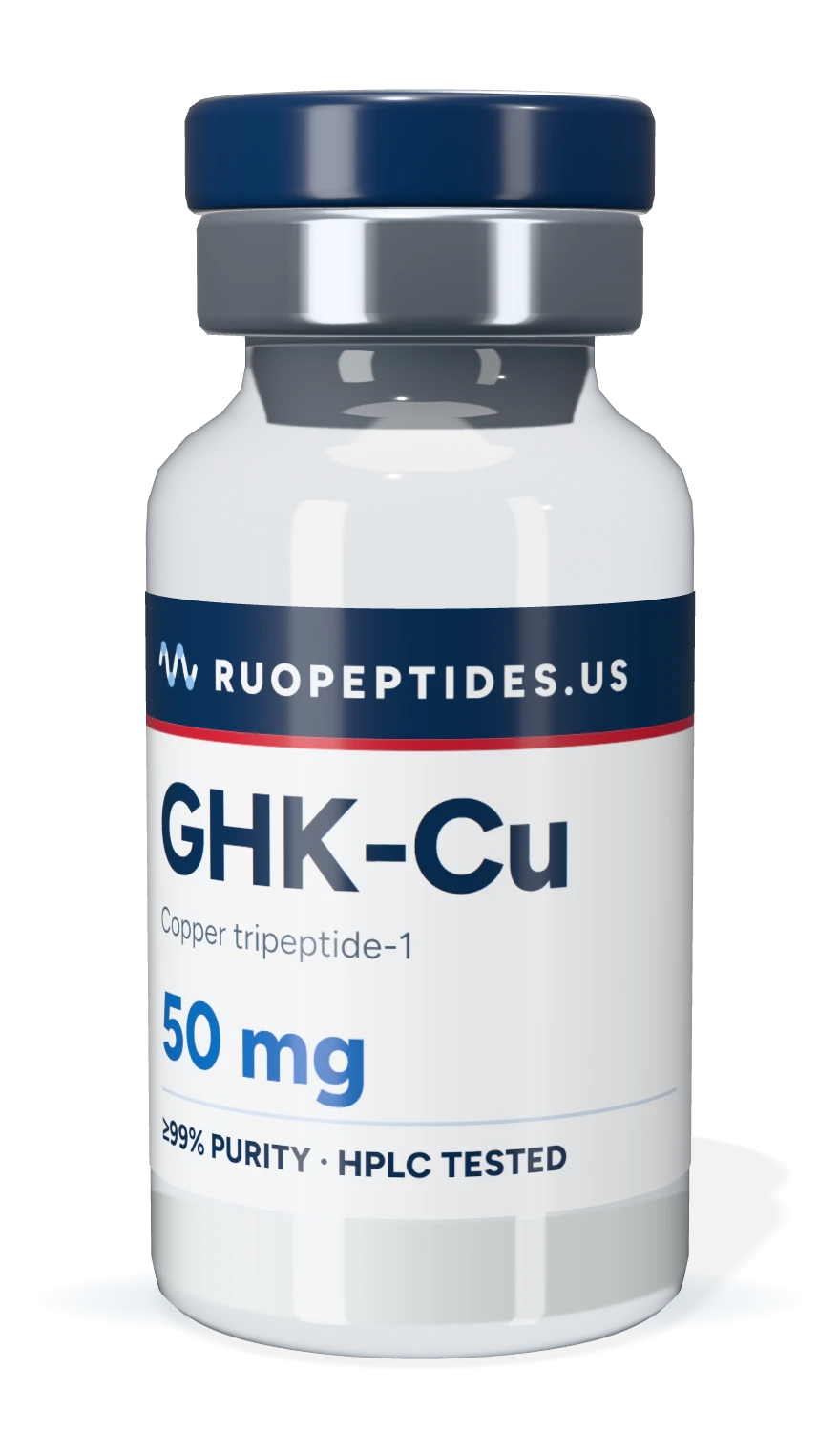
Full label. Lot number and expiry differ per batch and are printed on each vial.
Tissue & Matrix ResearchCellular Aging ResearchSkin & Pigmentation Research
GHK-Cu
Also known as: Copper tripeptide-1, Glycyl-L-histidyl-L-lysine copper
RUOPeptides supplies GHK-Cu as a 50mg lyophilized vial for laboratory research. GHK is glycyl-L-histidyl-L-lysine, a tripeptide that occurs naturally in human plasma. What draws researchers to it is copper.
- CAS
- 49557-75-7
- M.W.
- About 400.9 g/mol (PubChem copper tripeptide)
- Form
- Lyophilized powder
$55.00per vial
Price shown per vial. Quantity discounts below.
In stock
Buy more, pay less per vial
Add 1 more vial to save 3%: $53.35 per vial.
- Safe credit card paymentVisa, Mastercard and American Express
- 30-day money-back guarantee
- Super-fast 1-2 day shippingTo all 50 states and DC
- Free shipping on orders over $200Applied automatically at checkout
GHK-Cu
50 mg · $55.00/vial
Lyophilized GHK-Cu storage
Lyophilized GHK-Cu peptide should be stored in a dry place, protected from sunlight and moisture.
The following storage conditions are generally recommended:
- Room temperature (15-25 °C / 59-77 °F): Up to ~3-8 months
- Refrigerated (2-8 °C / 35.6-46.4 °F): Up to 6 months
- Frozen (-20 °C / -4 °F or below): 3-5 years
Prior reconstituting with a suitable solvent or Saline, allow the vial to reach room temperature after taking it out of the refrigerator or freezer.
Reconstituted GHK-Cu storage
Once in solution, GHK-Cu is generally less stable compared to their lyophilized (powdered) form and should be stored at cold temperatures when possible.
These storage conditions are generally recommended:
- Room temperature (15-25 °C / 59-77 °F): Avoid longer than 2-4 day storage
- Refrigerated (2-8 °C / 35.6-46.4 °F): Typically 4-8 weeks
- Frozen (-20 °C / -4 °F or below or below): Up to 3-4 months
However, to preserve peptide efficacy and amino-acid bonds, avoid repeatedly freezing and unfreezing the peptide.
GHK-Cu delivery and shipping
GHK-Cu ships from US stock to United States addresses only. Orders are packed and dispatched within 1-2 business days.
- Standard: $9.95, 1-2 business days after dispatch.
- Express: $24.95, next business day after dispatch.
Lyophilized GHK-Cu ships in a sealed glass vial with protective packaging. The dry powder is stable at room temperature for the length of domestic transit, so no cold pack is needed. Move it to the storage conditions above when it arrives.
Follow your parcel any time on the Track Order page.
GHK-Cu lab testing and COA
The certificate of analysis for GHK-Cu is being uploaded. Ask support for the current report before you order if you need it now.
Every vial label has a lot number. Check it on the Verify page to confirm the vial is genuine. All reports are on the Lab Reports page.
For laboratory research use only. All products are sold for laboratory research use only. They are not drugs, foods, cosmetics or dietary supplements, and are not for human or veterinary use.
GHK-Cu specifications
- Product
- GHK-Cu
- Also known as
- Copper tripeptide-1, Glycyl-L-histidyl-L-lysine copper
- Compound class
- Tissue & Matrix Research
- Product type
- Peptide
- Form
- Lyophilized powder
- Amounts available
- 50 mg ($55.00), 100 mg ($99.00)
- Full name
- Copper tripeptide, glycyl-L-histidyl-L-lysine copper(II)
- Sequence
- Gly-His-Lys
- Copper complex
- 1:1 complex with Cu(II)
- Molecular weight
- About 400.9 g/mol (PubChem copper tripeptide)
- CAS number
- 49557-75-7
- Product format
- Lyophilized powder, single sealed vial
- Storage as supplied
- Sealed, dry, dark; -20 °C for long-term storage
- Lab report
- COA on request
- Research areas
- Tissue & Matrix Research, Cellular Aging Research, Skin & Pigmentation Research, Popular Research Peptides
- Intended use
- Laboratory research only. Not for human or veterinary use.
Research overview
About GHK-Cu
Scientifically reviewed by John Johnson · Updated November 2026RUOPeptides supplies GHK-Cu as a 50mg lyophilized vial for laboratory research. GHK is glycyl-L-histidyl-L-lysine, a tripeptide that occurs naturally in human plasma.
What draws researchers to it is copper. GHK binds Cu(II) readily, and the resulting complex has been investigated across extracellular-matrix remodeling, cellular repair processes, oxidative-stress responses, and skin and hair biology.
What is GHK-Cu?
GHK is three amino acids: glycine, histidine, lysine, in that order. It was identified in human plasma in 1973, and plasma levels fall with age, from around 200 ng/mL at 20 to roughly 80 ng/mL by 60.
The histidine is why the copper sticks. Its imidazole side chain, working with the peptide's N-terminal amine and a backbone nitrogen, closes a stable chelate around a single Cu(II) ion. That assembly is the complex.
Which makes the two names non-interchangeable. GHK is the free tripeptide. GHK-Cu is GHK holding copper, and almost all of the research interest attaches to the complex rather than to the bare peptide. Research has examined it in relation to extracellular-matrix remodeling, fibroblast activity, oxidative-stress responses, inflammatory signaling, and regenerative processes.
GHK-Cu Research Applications
- Extracellular-Matrix Research: The most striking entry came from lung tissue. A 2012 Genome Medicine study built a 127-gene emphysema signature across 64 lung samples, ran it through the Connectivity Map, and GHK came back as a compound predicted to reverse it.
- Fibroblast Biology: The same group followed the prediction into three-dimensional collagen gels. At 10 nM, GHK restored collagen I contraction and remodeling in fibroblasts taken from COPD lungs, organized the actin cytoskeleton, and raised integrin beta-1 expression.
- Wound-Repair Research: Experimental models examining tissue repair and regeneration, across several tissue types rather than skin alone.
- Oxidative-Stress Research: Antioxidant and oxidative-stress pathways associated with the copper complex, including work on the byproducts of lipid peroxidation.
- Inflammatory Signaling: Pathways connecting inflammatory response and tissue remodeling.
- Skin Biology: Dermal remodeling, extracellular matrix composition, collagen-related processes and skin regeneration.
- Hair and Follicle Research: Copper tripeptides appear in follicle work covering VEGF, dermal fibroblasts and vascularization. Compound names carry more weight here than anywhere else, since GHK-Cu and AHK-Cu both travel under the label 'copper peptide' in that literature.
Underneath all of that sits a gene-expression story. Pickart and Margolina's 2018 review reports that 31.2% of human genes shifted by 50% or more in response to GHK, with expression rising in 59% of those and falling in 41%. A tripeptide with that reach is difficult to describe through any single pathway, which is roughly why the research areas above are as scattered as they are.
GHK-Cu FAQ
What does GHK-Cu stand for?
GHK is the single-letter shorthand for glycine, histidine and lysine, the three amino acids in the peptide. Cu is copper. Together: the glycyl-histidyl-lysine copper complex.
What purity is RUOPeptides GHK-Cu?
The published COA for lot 2026323 reports 98.9% (+/- 0.5), tested by Liquilabs s.r.o. in Czechia. The same document covers endotoxin, bioburden and elemental impurities.
Is GHK-Cu a peptide?
It's a peptide complexed with a metal ion. The peptide part is a tripeptide, three residues long, and the copper is coordinated to it rather than mixed in alongside it.
Is GHK-Cu the same as copper peptide?
Copper peptide is a loose umbrella term.
What is the difference between GHK and GHK-Cu?
GHK is the free tripeptide. GHK-Cu is that same tripeptide bound to a copper(II) ion. Different molecular weights, different chemistry, and the published research overwhelmingly concerns the complex.
Why does GHK bind copper?
Histidine does the work. Its imidazole side chain, together with the peptide's N-terminal amine and a backbone nitrogen, forms a stable chelate ring around a Cu(II) ion, which is why the complex holds together rather than dissociating.
What is GHK-Cu studied for?
Extracellular-matrix remodeling, fibroblast biology, wound repair, oxidative-stress pathways, inflammatory signaling, and skin and hair-follicle biology. Most of that work sits in cell culture and animal models.
What is the molecular weight of GHK-Cu?
About 400.9 g/mol on PubChem's copper tripeptide entry. Some listings quote 403.9, which is GHK plus a copper atom added arithmetically without accounting for the protons displaced during coordination.
Is GHK-Cu the same as Copper Tripeptide-1?
Yes. Copper Tripeptide-1 is the INCI name used in cosmetic ingredient listings for the same GHK-Cu complex. Different naming systems, one compound, though the grade and specification behind each can differ considerably.
Buying GHK-Cu for research in the USA
Price
From $55.00. 50 mg: $55.00, 100 mg: $99.00. Quantity discounts per size: 3% off 2 vials, 5% off 3-4 vials, 7% off 5+ vials.
Shipping
US addresses only. Orders are packed and dispatched within 1-2 business days. Standard from $9.95.
Proof it's genuine
Check the lot number on your vial on the Verify page.
Lab reports
COA and SDS documents are on the Lab Reports page.
Scientifically reviewed
Scientifically reviewed by John Johnson
Scientific reviewer · Last reviewed November 2026
John Johnson reviewed this GHK-Cu page for scientific accuracy: the compound's identity and specifications, the summaries of published studies, and the references they cite. The page describes laboratory and preclinical research only. It is not medical advice and gives no usage guidance.
Research information on this page summarizes published laboratory and preclinical studies. It is not usage guidance.