For laboratory research use only. Not for human or veterinary use.
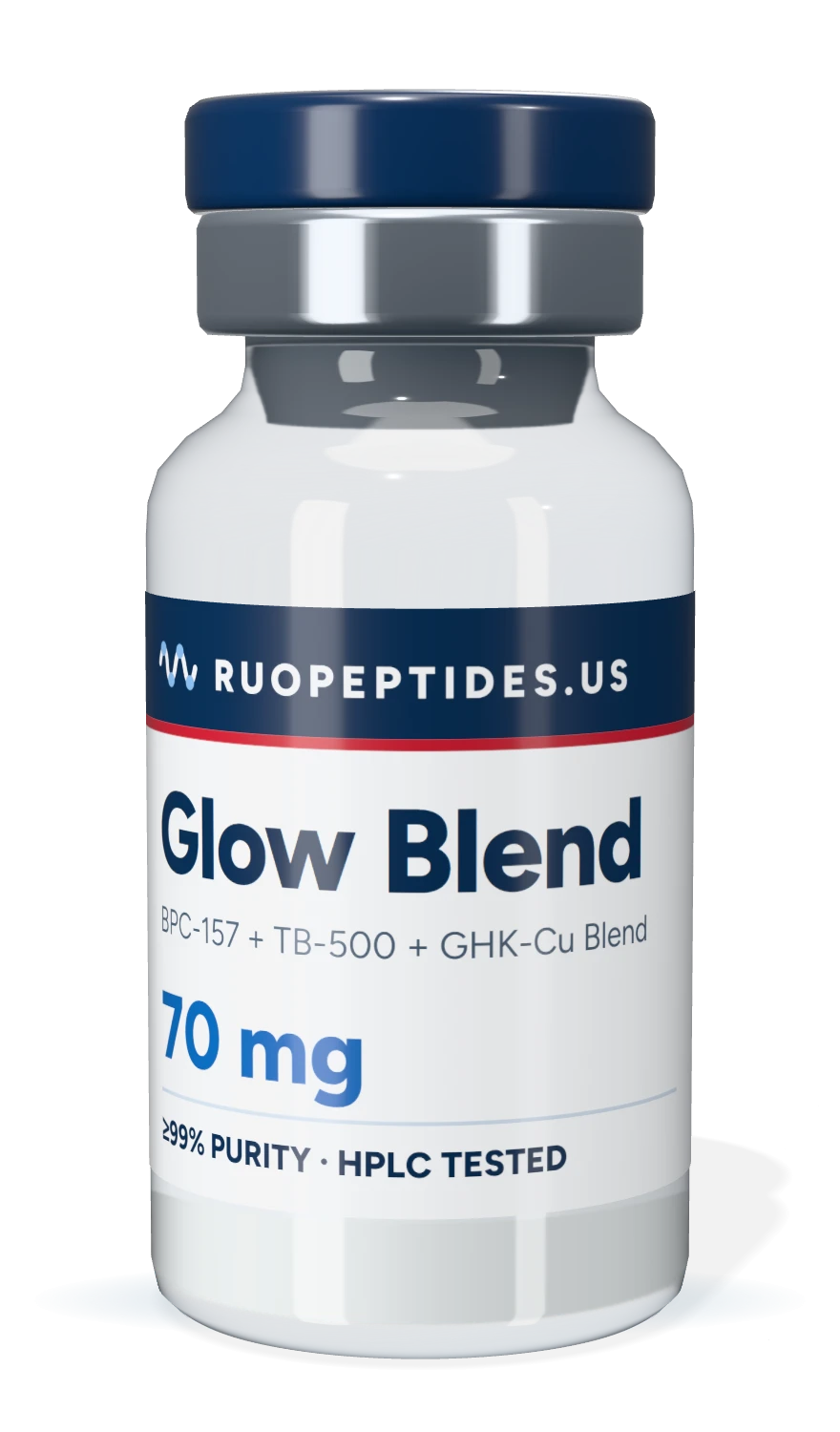
GLOW BLEND
FOR RESEARCH USE ONLYNot for human or veterinary use of any kind
Full label. Lot number and expiry differ per batch and are printed on each vial.
Tissue & Matrix ResearchPeptide BlendsSkin & Pigmentation Research
Glow Blend (BPC-157 + TB-500 + GHK-Cu)
Also known as: BPC-157 + TB-500 + GHK-Cu Blend
Glow Blend combines three research peptides, BPC-157, TB-500 and GHK-Cu, each studied for different aspects of tissue-repair biology.
$109.00per vial
Price shown per vial. Quantity discounts below.
In stock
Buy more, pay less per vial
Add 1 more vial to save 3%: $105.73 per vial.
- Safe credit card paymentVisa, Mastercard and American Express
- 30-day money-back guarantee
- Super-fast 1-2 day shippingTo all 50 states and DC
- Free shipping on orders over $200Applied automatically at checkout
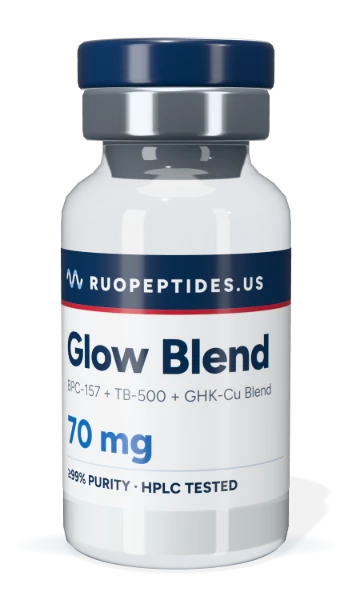
Glow Blend (BPC-157 + TB-500 + GHK-Cu)
70 mg · $109.00/vial
Lyophilized Glow Blend storage
Store lyophilized material sealed, dry and protected from light. Refrigerate (2-8 °C) for short-term storage; freeze (−20 °C or below) for long-term storage.
Reconstituted Glow Blend storage
Material in solution is less stable than the lyophilized form. Keep refrigerated (2-8 °C), protect from light, and avoid repeated freeze-thaw cycles.
Glow Blend delivery and shipping
Glow Blend ships from US stock to United States addresses only. Orders are packed and dispatched within 1-2 business days.
- Standard: $9.95, 1-2 business days after dispatch.
- Express: $24.95, next business day after dispatch.
Lyophilized Glow Blend ships in a sealed glass vial with protective packaging. The dry powder is stable at room temperature for the length of domestic transit, so no cold pack is needed. Move it to the storage conditions above when it arrives.
Follow your parcel any time on the Track Order page.
Glow Blend lab testing and COA
The certificate of analysis for Glow Blend is being uploaded. Ask support for the current report before you order if you need it now.
Every vial label has a lot number. Check it on the Verify page to confirm the vial is genuine. All reports are on the Lab Reports page.
For laboratory research use only. All products are sold for laboratory research use only. They are not drugs, foods, cosmetics or dietary supplements, and are not for human or veterinary use.
Glow Blend specifications
- Product
- Glow Blend (BPC-157 + TB-500 + GHK-Cu)
- Also known as
- BPC-157 + TB-500 + GHK-Cu Blend
- Compound class
- Tissue & Matrix Research
- Product type
- Blend
- Form
- Lyophilized powder
- Amounts available
- 70 mg ($109.00), 140 mg ($189.00)
- Components
- BPC-157, TB-500 (thymosin β4) and GHK-Cu in one vial
- Total amount
- 70 mg per vial
- BPC-157 CAS
- 137525-51-0
- TB-500 CAS
- 77591-33-4
- GHK-Cu CAS
- 89030-95-5
- Storage as supplied
- Sealed, dry, dark; -20 °C for long-term storage
- Lab report
- COA on request
- Research areas
- Tissue & Matrix Research, Peptide Blends, Skin & Pigmentation Research, Popular Research Peptides
- Intended use
- Laboratory research only. Not for human or veterinary use.
Research overview
About Glow Blend (BPC-157 + TB-500 + GHK-Cu)
Scientifically reviewed by John Johnson · Updated November 2026Glow Blend combines three research peptides, BPC-157, TB-500 and GHK-Cu, each studied for different aspects of tissue-repair biology. Research has explored areas including angiogenesis, cell migration, extracellular matrix remodeling and inflammatory signaling. However, most available evidence concerns the individual compounds or related parent peptides rather than their combined formulation. RUOPeptides supplies Glow Blend as a 70 mg research blend.
What Is Glow Blend?
Glow Blend brings together three compounds that have been studied in overlapping areas of repair biology. BPC-157 is a 15-amino-acid synthetic peptide that has been studied in preclinical models of tissue injury, gastrointestinal conditions, angiogenesis and inflammation. [1]
TB-500 is associated with research on thymosin β4, a distinct 43-amino-acid peptide involved in actin regulation, cell migration, angiogenesis and tissue repair. [2] The two should not be treated as interchangeable when identifying a product.
GHK-Cu, the copper complex of the tripeptide glycyl-L-histidyl-L-lysine, has been investigated in collagen pathways, extracellular matrix remodeling, wound biology and skin research. [3]
These shared research themes explain the BPC-157 TB-500 GHK-Cu blend, but studies of the individual compounds do not establish additive or synergistic effects in this formulation.
For single-compound background, see the BPC-157, TB-500 and GHK-Cu pages.
Overview of Published Research Behind Glow Blend
Research related to Glow Blend spans connective-tissue injury, cell migration, blood-vessel formation and extracellular matrix remodeling. The evidence largely concerns BPC-157, thymosin β4 or its fragments, and GHK-Cu studied separately. These findings provide biological context for the formulation, not proof that combining the ingredients improves their effects.
BPC-157 and Tissue-Repair Research
BPC-157 is a synthetic 15-amino-acid peptide studied mainly in laboratory and animal models. Investigations have examined tendon, ligament and muscle injuries, alongside gastrointestinal damage, vascular responses and inflammatory processes. Much of this work asks how cells respond after injury and which signaling pathways may take part in tissue repair. [1]
Connective-tissue studies are especially relevant to Glow Blend. In experiments with rat Achilles tendon fibroblasts, researchers reported increased cell migration and spreading after exposure to BPC-157. The same work examined focal adhesion kinase (FAK) and paxillin, proteins involved in the interactions that let cells attach and move. [4] Changes in these pathways may help explain observations in tendon models, although they do not establish the same response in humans.
Another investigation found increased growth hormone receptor expression in rat tendon fibroblasts treated with BPC-157. When growth hormone was then added, researchers observed changes in cell proliferation and downstream signaling. [5] This is a specific experimental finding, not evidence that the peptide produces a predictable growth hormone effect in people.
Animal studies have also reported changes in collagen formation, angiogenesis and the structure of healing tissue. Study design, injury model and measured outcomes vary considerably, and the BPC-157 evidence base remains mostly preclinical, with limited reliable human data. Cell and animal findings cannot establish clinical effectiveness or safety, either for BPC-157 alone or within a three-component blend.
TB-500, Thymosin β4 and Cell Migration
TB-500 is commonly discussed alongside thymosin β4 (Tβ4), a naturally occurring 43-amino-acid peptide. Tβ4 binds actin, a protein essential to the cell skeleton. By influencing actin dynamics, it takes part in processes associated with cell shape and movement, which makes it a subject of research into wound biology and tissue remodeling. [2]
Experimental studies have examined full-length Tβ4 in skin and wound models. In a rat wound study, researchers reported changes in re-epithelialization, collagen deposition and angiogenesis after Tβ4 exposure. Laboratory experiments in the same work also observed increased keratinocyte migration. Keratinocytes are skin cells that help cover a wound as the surface barrier is restored. [6]
Other studies have explored the peptide's relationship with endothelial cell migration, vascular formation and inflammatory signaling. Together, these observations make actin regulation and cell movement central subjects in Tβ4 research.
An important distinction concerns the identity of commercial TB-500. The term may refer to a synthetic fragment associated with Tβ4 rather than the complete 43-amino-acid parent peptide, so fragment sequence and product identity matter when interpreting laboratory results.
Research performed with full-length Tβ4 cannot automatically be treated as direct evidence for every product labeled TB-500. Likewise, results from isolated fragments do not confirm the performance of the Glow peptide blend. Without formulation-specific studies, the biological findings remain background research rather than demonstrated product outcomes.
GHK-Cu and Extracellular Matrix Remodeling
GHK is a naturally occurring tripeptide made of glycine, histidine and lysine. It binds copper ions to form GHK-Cu, a complex investigated for its involvement in tissue remodeling, wound-related signaling and skin biology. [3]
GHK-Cu has drawn particular interest because the extracellular matrix gives tissues their structural support. This network includes collagen, elastin and other molecules that influence how cells attach, communicate and respond to damage. Research has examined whether GHK-Cu changes the synthesis or breakdown of these components.
Laboratory investigations have reported effects on fibroblast activity, collagen production and the balance between matrix metalloproteinases and their inhibitors, which take part in extracellular matrix turnover. Studies have also explored antioxidant responses, inflammatory mediators and signaling associated with wound repair.
Published skin research includes experiments with cultured cells, animal models and small human studies of topical copper-peptide preparations. Some studies have assessed skin thickness, elasticity, collagen-related measures and visible appearance parameters. [7] Results depend on the preparation, application method and research setting.
These findings do not mean Glow Blend improves skin appearance or reverses aging. Evidence for a topical copper-peptide preparation cannot be transferred automatically to a different multi-peptide formulation, so separating GHK-Cu's investigated mechanisms from demonstrated product effects is essential.
Why Study BPC-157, TB-500 and GHK-Cu Together?
The rationale for BPC-157 TB-500 GHK-Cu research comes from several partly overlapping biological interests. Each component has been examined through different experimental questions:
- BPC-157: Preclinical injury models, fibroblast migration, vascular responses and repair-associated signaling.
- TB-500 / Tβ4-related research: Actin dynamics, cell movement, angiogenesis and wound-model responses.
- GHK-Cu: Copper-associated signaling, fibroblast activity, collagen pathways and extracellular matrix turnover.
These areas intersect because tissue responses depend on coordinated cell movement, extracellular support, vascular activity and inflammatory signaling. A blend containing all three compounds may therefore be of interest for carefully designed laboratory comparisons across these pathways.
Shared research themes are not evidence of additive effects. Interactions between compounds could differ from their behavior when tested individually, and outcomes may depend on concentration, experimental conditions and the identity of each ingredient.
At present, individual-peptide findings do not establish the efficacy, synergy or safety of the exact Glow Blend formulation. Any claim about combined activity would need direct, formulation-specific research.
BPC-157 vs TB-500 vs GHK-Cu: What's the Difference?
Although grouped in Glow Blend, these compounds differ in structure and research focus. Their overlapping relevance to tissue-repair research does not make them interchangeable.
| Feature | BPC-157 | TB-500 / Tβ4-related research | GHK-Cu |
|---|---|---|---|
| Compound type | Synthetic 15-amino-acid peptide | Thymosin β4-related peptide research | Copper-binding tripeptide complex |
| Major research focus | Tissue injury and repair signaling | Actin dynamics and cell migration | Extracellular matrix remodeling and tissue biology |
| Angiogenesis research | Investigated | Investigated | Investigated |
| Fibroblast / ECM research | Connective-tissue focused | Indirect, repair-related | Stronger research focus |
| Key distinguishing feature | Broad preclinical injury models | Cell-movement and actin biology | Copper-dependent signaling activity |
Studies of individual compounds do not establish the combined formulation's safety, effectiveness or synergy without dedicated combination studies.
Before designing a controlled experiment, review the current certificate of analysis on the Lab Reports page and confirm the component amounts and ratio for your lot.
Glow Blend FAQ
What is Glow Blend?
Glow Blend is a research formulation containing BPC-157, TB-500 and GHK-Cu. The compounds are grouped for laboratory investigation of cell migration, tissue remodeling, vascular signaling and repair-related biology. RUOPeptides supplies it in 70 mg vials. Research on the individual ingredients does not establish specific outcomes for their combination.
Why are BPC-157, TB-500 and GHK-Cu combined?
The components share overlapping research interests but differ in structure and studied mechanisms. BPC-157 is explored in preclinical injury models, thymosin β4-related research examines actin dynamics and cell migration, and GHK-Cu is studied in extracellular matrix biology. Combining them offers a plausible research rationale, not evidence of additive or synergistic effects.
What is BPC-157 studied for?
Scientists have investigated BPC-157 mainly in cell and animal studies of tendon, ligament, muscle, gastrointestinal and vascular injury. Experiments have examined fibroblast migration, growth hormone receptor expression, angiogenesis and repair-associated signaling. High-quality controlled human evidence remains limited, so preclinical findings should not be described as established medical benefits or clinical outcomes.
What is TB-500 studied for?
TB-500 is often discussed alongside thymosin β4, a peptide investigated for actin regulation, cell migration, vascular responses and wound-related processes. Commercial TB-500 may be a fragment rather than full-length thymosin β4, so researchers must confirm peptide identity before applying findings from studies of the parent molecule to a specific product.
What is GHK-Cu studied for?
GHK-Cu is a copper complex of the tripeptide glycyl-L-histidyl-L-lysine. Research has examined its involvement in fibroblast activity, collagen synthesis, extracellular matrix remodeling, inflammatory signaling and wound biology. Some topical skin studies also look at appearance-related measures, but these findings cannot establish that a different multi-peptide formulation improves skin or reverses aging.
Have BPC-157, TB-500 and GHK-Cu been studied as a combined formulation?
Published research largely concerns BPC-157, full-length thymosin β4 or particular fragments, and GHK-Cu studied separately. Robust evidence for the exact three-component Glow Blend formulation has not been established, and individual findings cannot confirm that the combination is safe, effective or synergistic. Direct formulation-specific studies would be needed to answer those questions.
Scientific references
- [1]Seiwerth S, et al. J Physiol Paris. 1997. BPC 157's effect on healing.
- [2]Goldstein AL, Hannappel E, Kleinman HK. Trends Mol Med. 2005. Thymosin β4: actin-sequestering protein moonlights to repair injured tissues.
- [3]Pickart L, Vasquez-Soltero JM, Margolina A. Biomed Res Int. 2015. GHK peptide as a natural modulator of multiple cellular pathways in skin regeneration.
- [4]Chang CH, et al. J Appl Physiol. 2011. The promoting effect of pentadecapeptide BPC 157 on tendon healing involves tendon outgrowth, cell survival, and cell migration.
- [5]Chang CH, et al. Molecules. 2014. Pentadecapeptide BPC 157 enhances the growth hormone receptor expression in tendon fibroblasts.
- [6]Malinda KM, et al. J Invest Dermatol. 1999. Thymosin β4 accelerates wound healing.
- [7]Pickart L, Margolina A. Int J Mol Sci. 2018. Regenerative and protective actions of the GHK-Cu peptide in the light of the new gene data.
Buying Glow Blend for research in the USA
Price
From $109.00. 70 mg: $109.00, 140 mg: $189.00. Quantity discounts per size: 3% off 2 vials, 5% off 3-4 vials, 7% off 5+ vials.
Shipping
US addresses only. Orders are packed and dispatched within 1-2 business days. Standard from $9.95.
Proof it's genuine
Check the lot number on your vial on the Verify page.
Lab reports
COA and SDS documents are on the Lab Reports page.
Scientifically reviewed
Scientifically reviewed by John Johnson
Scientific reviewer · Last reviewed November 2026
John Johnson reviewed this Glow Blend page for scientific accuracy: the compound's identity and specifications, the summaries of published studies, and the references they cite. The page describes laboratory and preclinical research only. It is not medical advice and gives no usage guidance.
Research information on this page summarizes published laboratory and preclinical studies. It is not usage guidance.