For laboratory research use only. Not for human or veterinary use.
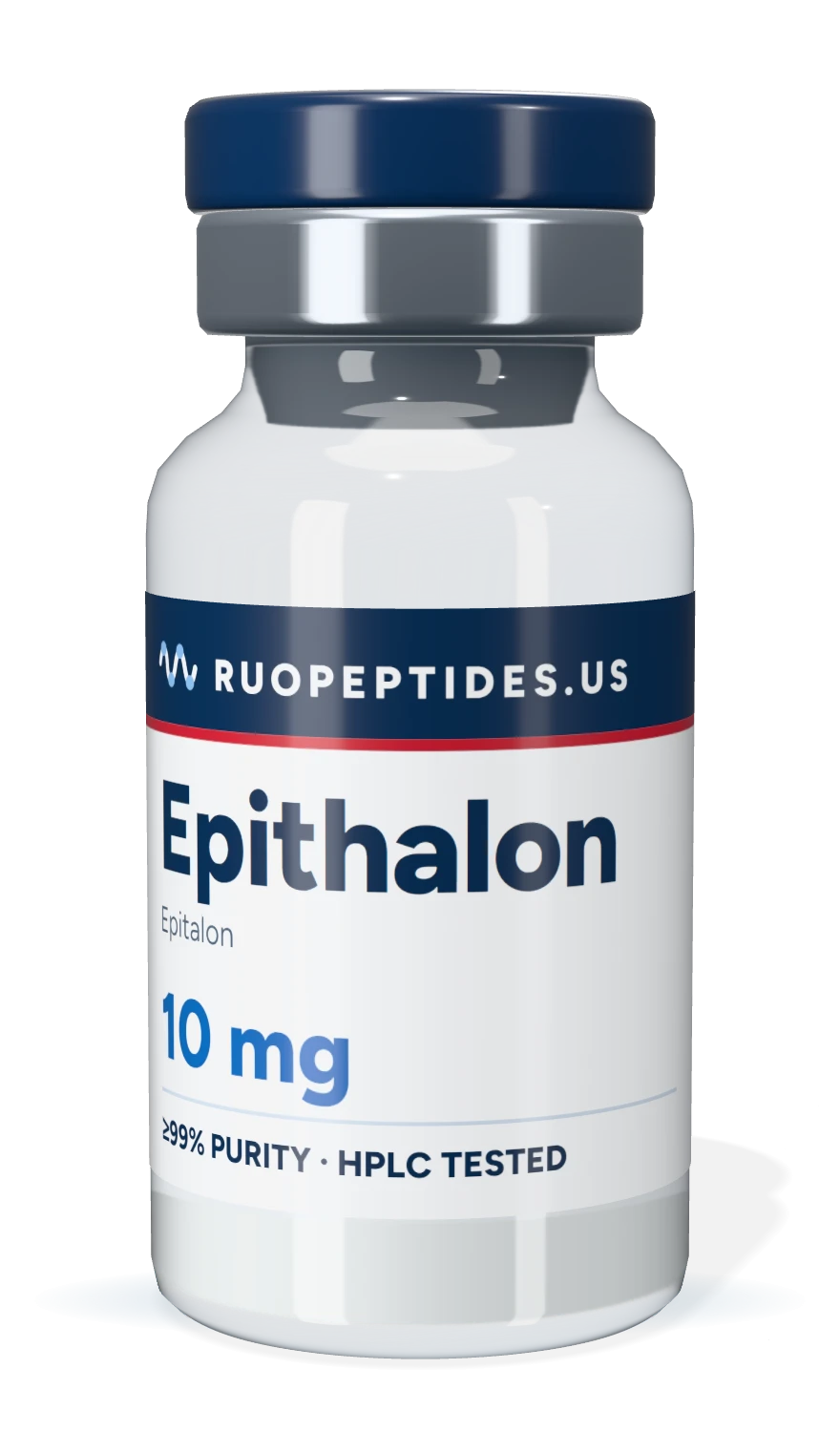
EPITHALON
FOR RESEARCH USE ONLYNot for human or veterinary use of any kind
Full label. Lot number and expiry differ per batch and are printed on each vial.
Thymic & Bioregulator PeptidesCellular Aging ResearchPopular Research Peptides
Epithalon
Also known as: Epitalon, AEDG peptide
Epithalon, also spelled Epitalon, is a synthetic tetrapeptide made up of a four-amino-acid sequence Ala-Glu-Asp-Gly (AEDG). The material is supplied strictly for in vitro and analytical research use by qualified professionals.
- CAS
- 307297-39-8
- M.W.
- 390.35 g/mol
- Formula
- C14H22N4O9
- Form
- Lyophilized powder
$39.00per vial
Price shown per vial. Quantity discounts below.
In stock
Buy more, pay less per vial
Add 1 more vial to save 3%: $37.83 per vial.
- Safe credit card paymentVisa, Mastercard and American Express
- 30-day money-back guarantee
- Super-fast 1-2 day shippingTo all 50 states and DC
- Free shipping on orders over $200Applied automatically at checkout
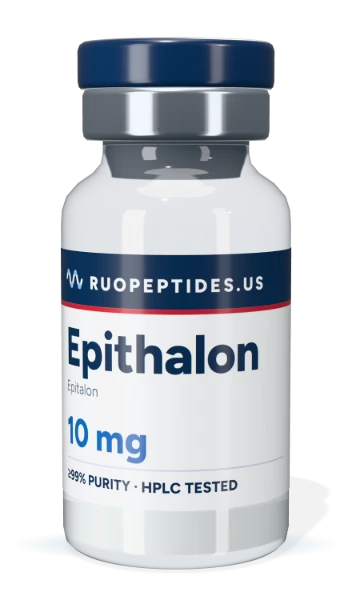
Epithalon
10 mg · $39.00/vial
Lyophilized Epithalon storage
Lyophilized Epitalon peptide should be stored in a dry place, protected from sunlight and moisture.
The following storage conditions are generally recommended:
- Room temperature (15-25 °C / 59-77 °F): Up to ~3-8 months
- Refrigerated (2-8 °C / 35.6-46.4 °F): Up to 6 months
- Frozen (-20 °C / -4 °F or below): 3-5 years
Prior reconstituting with a suitable solvent or Saline, allow the vial to reach room temperature after taking it out of the refrigerator or freezer.
Reconstituted Epithalon storage
Once in solution, Epitalon is generally less stable compared to their lyophilized (powdered) form and should be stored at cold temperatures when possible.
These storage conditions are generally recommended:
- Room temperature (15-25 °C / 59-77 °F): Avoid longer than 2-4 day storage
- Refrigerated (2-8 °C / 35.6-46.4 °F): Typically 4-8 weeks
- Frozen (-20 °C / -4 °F or below): Up to 3-4 months
However, to preserve peptide efficacy and amino-acid bonds, avoid repeatedly freezing and unfreezing the peptide.
Epithalon delivery and shipping
Epithalon ships from US stock to United States addresses only. Orders are packed and dispatched within 1-2 business days.
- Standard: $9.95, 1-2 business days after dispatch.
- Express: $24.95, next business day after dispatch.
Lyophilized Epithalon ships in a sealed glass vial with protective packaging. The dry powder is stable at room temperature for the length of domestic transit, so no cold pack is needed. Move it to the storage conditions above when it arrives.
Follow your parcel any time on the Track Order page.
Epithalon lab testing and COA
The certificate of analysis for Epithalon is being uploaded. Ask support for the current report before you order if you need it now.
Every vial label has a lot number. Check it on the Verify page to confirm the vial is genuine. All reports are on the Lab Reports page.
For laboratory research use only. All products are sold for laboratory research use only. They are not drugs, foods, cosmetics or dietary supplements, and are not for human or veterinary use.
Epithalon specifications
- Product
- Epithalon
- Also known as
- Epitalon, AEDG peptide
- Compound class
- Thymic & Bioregulator Peptides
- Product type
- Peptide
- Form
- Lyophilized powder
- Amounts available
- 10 mg ($39.00), 20 mg ($69.00)
- Sequence
- Ala-Glu-Asp-Gly
- Molecular weight
- 390.35 g/mol
- CAS number
- 307297-39-8
- Molecular formula
- C14H22N4O9
- Storage as supplied
- Sealed, dry, dark; -20 °C for long-term storage
- Lab report
- COA on request
- Research areas
- Thymic & Bioregulator Peptides, Cellular Aging Research, Popular Research Peptides
- Intended use
- Laboratory research only. Not for human or veterinary use.
Research overview
About Epithalon
Scientifically reviewed by John Johnson · Updated November 2026Epithalon, also spelled Epitalon, is a synthetic tetrapeptide made up of a four-amino-acid sequence Ala-Glu-Asp-Gly (AEDG). The material is supplied strictly for in vitro and analytical research use by qualified professionals.
Its sequence and origin have made it a subject of investigation in research on telomere biology, telomerase activity, cellular ageing, gene regulation, and pineal and neuroendocrine biology, with more recent literature continuing to examine telomerase-related pathways in human cell lines.
What Is Epithalon (Epitalon)?
Epitalon is a synthetic tetrapeptide consisting of a sequence of four amino acids: alanine, glutamic acid, aspartic acid, and glycine, namely Ala-Glu-Asp-Gly (AEDG). It is one of the most researched synthetic peptides in the field of bioregulation over several decades, with a substantial published literature.
Its development is associated with research into Epithalamin, a pineal-derived polypeptide preparation studied in earlier bioregulatory research. A recent scientific review uses the term AEDG to describe Epithalon peptide and discusses the substance’s relation to Epithalamin. It is important to highlight that Epitalon and Epithalamin are distinct substances; Epitalon is not a direct extract or equivalent of the earlier preparation.
Epitalon has since been investigated across research examining telomere biology, telomerase activity, gene regulation, and pineal and neuroendocrine biology, establishing it as a well-characterized subject of experimental inquiry across these converging fields.
Epithalon Research Applications
Epithalon 10mg is discussed in research spanning telomere biology, cellular ageing, and neuroendocrine function. Earlier cell-culture research involving human fibroblasts reported telomerase activation and observed telomere elongation. [1]
In 2025, researchers investigated the Epitalon peptide across several human cell lines and reported changes in telomere length associated with telomerase/hTERT expression. ALT was also reported in certain cell types. [2]
Researchers apply Epitalon 10mg across the following documented areas:
- Telomere biology: investigating changes in telomere length and telomere-associated cellular processes across experimental cell models.
- Telomerase research: studying telomerase activity and the regulation of hTERT, a key element of telomerase.
- Cellular ageing research: examining cellular senescence, replicative capabilities of cells, and their age-related changes.
- Gene-expression research: studying changes in transcription and pathways that go beyond regulatory pathways. [3]
- Chromatin research: studying age-associated chromatin organization and gene activity patterns. [4]
- Pineal/neuroendocrine research: investigating pineal-associated regulatory pathways and melatonin-related biology. [5]
- Circadian biology: research examining age-associated changes in neuroendocrine and circadian regulatory processes. [6]
- Oxidative stress research: experimental studies examining oxidative stress pathways and antioxidant cellular responses. [7]
Epithalon, Epitalon, and Epithalamin: What's the Difference?
Researchers encountering Epithalon terminology across published literature and supplier listings should note the following distinctions:
Epithalon, Epitalon, and Epithalone all mean the same tetrapeptide - the AEDG peptide with sequence (Ala-Glu-Asp-Gly) (CAS 307297-39-8). They are variations of the same name. The word "Epitalon" is, by far, the most commonly used name in connection with the Epitalon telomerase studies; “Epithalon” is used more often in commercial contexts.
Epithalamin is a distinct compound, a pineal-derived polypeptide preparation associated with earlier research originating from bovine pineal tissue. Epitalon was synthesized based on the amino acid composition associated with Epithalamin but is not simply an alternative spelling for it. The two are chemically distinct.
Epithalon FAQ
Are Epithalon and Epitalon the same peptide?
Yes. Epithalon and Epitalon are alternative spellings and transliterations of the same synthetic tetrapeptide, sequence Ala-Glu-Asp-Gly (AEDG), CAS 307297-39-8. Epithalone is another variant occasionally encountered in literature and commercial references.
Is Epitalon a peptide?
Yes. Epitalon is a synthetic tetrapeptide. A short peptide composed of four amino acids: alanine, glutamic acid, aspartic acid, and glycine, in the sequence Ala-Glu-Asp-Gly (AEDG).
How many amino acids are in Epitalon?
Epitalon contains four amino acids, making it a tetrapeptide. Its sequence - Ala-Glu-Asp-Gly - is abbreviated as AEDG using standard single-letter amino-acid notation.
What is the Epitalon peptide sequence?
The amino acid sequence of Epitalon is Ala-Glu-Asp-Gly, abbreviated AEDG. Its molecular formula is C₁₄H₂₂N₄O₉, molecular weight 390.35 g/mol, CAS number 307297-39-8.
What does AEDG mean?
AEDG is the single-letter amino acid abbreviation for Epitalon's sequence: Alanine (A), Glutamic acid (E), Aspartic acid (D), and Glycine (G). It is a shorthand used in published research and product documentation.
What is the difference between Epitalon and Epithalamin?
Epithalamin is a pineal-derived polypeptide preparation from bovine pineal tissue. Epitalon is a synthetic tetrapeptide developed based on amino acid composition associated with Epithalamin. They are chemically distinct; Epitalon is not simply a synthetic version or alternative spelling of Epithalamin.
Is Epitalon studied in telomerase research?
Yes.
Is Epitalon studied in cellular aging research?
Yes. Published research has investigated Epitalon in the context of cellular senescence, replicative capacity, and age-associated cellular changes. These remain active areas of experimental investigation documented in peer-reviewed literature.
Is Epitalon studied in circadian-rhythm research?
Yes. Research has examined relationships between Epitalon, pineal biology, and age-associated changes in neuroendocrine and circadian regulatory processes, particularly in the context of melatonin-related pathways and circadian rhythm changes observed in ageing models.
Scientific references
- [1]Epithalon peptide induces telomerase activity and telomere elongation in human somatic cells
- [2]Epitalon increases telomere length in human cell lines through telomerase upregulation or ALT activity
- [3]AEDG Peptide (Epitalon) Stimulates Gene Expression and Protein Synthesis during Neurogenesis: Possible Epigenetic Mechanism
- [4]Peptide Epitalon activates chromatin at the old age
- [5]Effect of a synthetic pineal tetrapeptide (Ala-Glu-Asp-GLy) on melatonin secretion by the pineal gland of young and old rats
- [6]Synthetic tetrapeptide epitalon restores disturbed neuroendocrine regulation in senescent monkeys
- [7]The Antioxidant Tetrapeptide Epitalon Enhances Delayed Wound Healing in an in Vitro Model of Diabetic Retinopathy
Buying Epithalon for research in the USA
Price
From $39.00. 10 mg: $39.00, 20 mg: $69.00. Quantity discounts per size: 3% off 2 vials, 5% off 3-4 vials, 7% off 5+ vials.
Shipping
US addresses only. Orders are packed and dispatched within 1-2 business days. Standard from $9.95.
Proof it's genuine
Check the lot number on your vial on the Verify page.
Lab reports
COA and SDS documents are on the Lab Reports page.
Scientifically reviewed
Scientifically reviewed by John Johnson
Scientific reviewer · Last reviewed November 2026
John Johnson reviewed this Epithalon page for scientific accuracy: the compound's identity and specifications, the summaries of published studies, and the references they cite. The page describes laboratory and preclinical research only. It is not medical advice and gives no usage guidance.
Research information on this page summarizes published laboratory and preclinical studies. It is not usage guidance.