For laboratory research use only. Not for human or veterinary use.
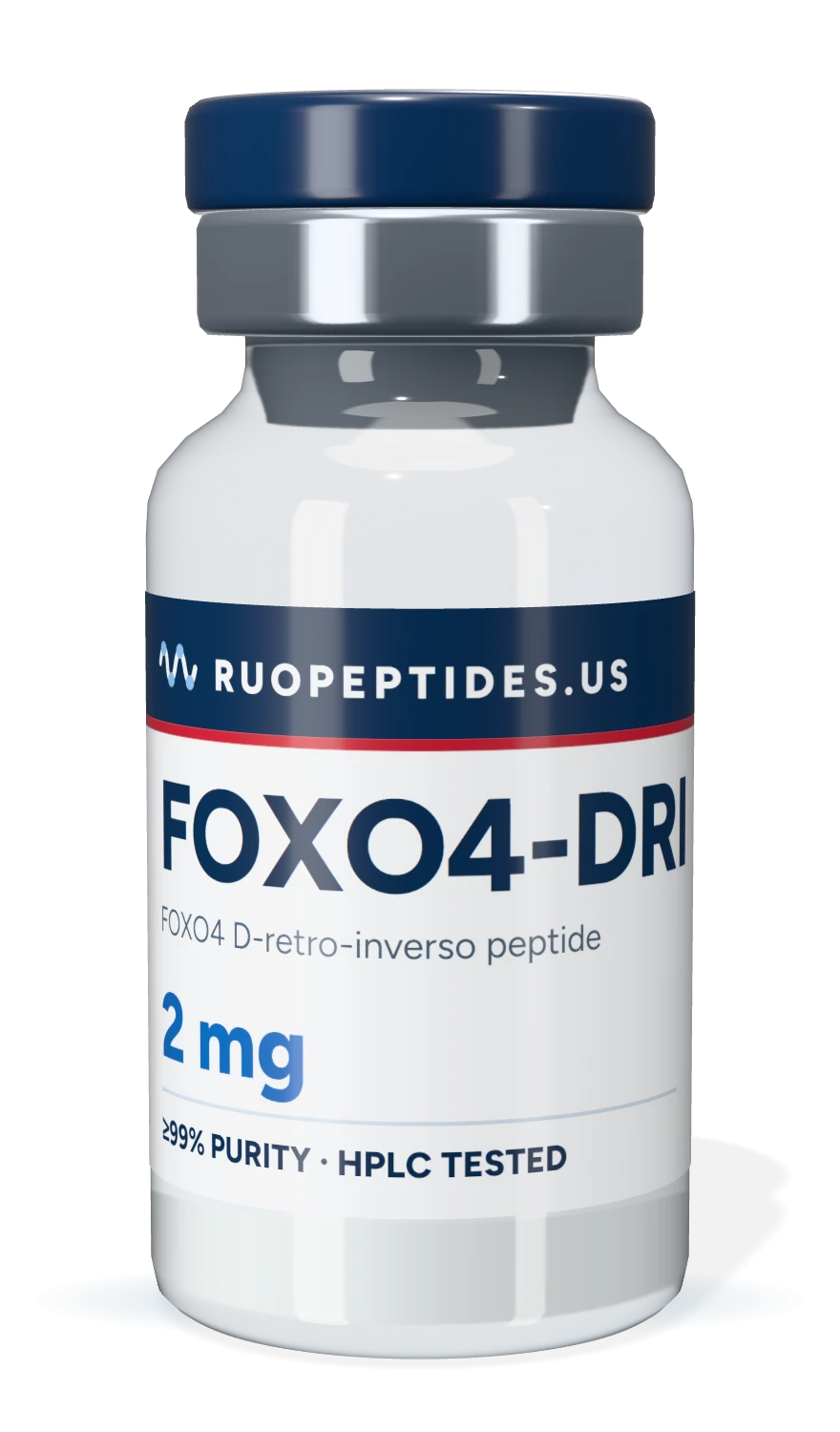
FOXO4-DRI
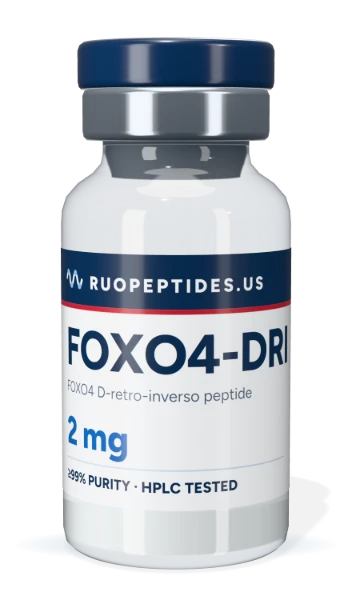
FOR RESEARCH USE ONLYNot for human or veterinary use of any kind
Full label. Lot number and expiry differ per batch and are printed on each vial.
Thymic & Bioregulator PeptidesCellular Aging Research
FOXO4-DRI
Also known as: FOXO4 D-retro-inverso peptide
RUOPeptides provides FOXO4-DRI (FOXO4-D-Retro-Inverso) as an experimental senolytic research compound developed to investigate the role of the FOXO4 p53 interaction in senescent-cell survival.
- CAS
- 2460055-10-9
- M.W.
- 5,358.06 g/mol
- Formula
- C₂₂₈H₃₈₈N₈₆O₆₄
- Form
- Lyophilized powder
$59.00per vial
Price shown per vial. Quantity discounts below.
In stock
Buy more, pay less per vial
Add 1 more vial to save 3%: $57.23 per vial.
- Safe credit card paymentVisa, Mastercard and American Express
- 30-day money-back guarantee
- Super-fast 1-2 day shippingTo all 50 states and DC
- Free shipping on orders over $200Applied automatically at checkout
FOXO4-DRI
2 mg · $59.00/vial
Lyophilized FOXO4-DRI storage
Lyophilized FOXO4 peptide should be stored in a dry place, protected from sunlight and moisture.
The following storage conditions are generally recommended:
- Room temperature (15-25 °C / 59-77 °F): Up to ~3-8 months
- Refrigerated (2-8 °C / 35.6-46.4 °F): Up to 6 months
- Frozen (-20 °C / -4 °F or below): 3-5 years
Prior reconstituting with a suitable solvent or Saline, allow the vial to reach room temperature after taking it out of the refrigerator or freezer.
Reconstituted FOXO4-DRI storage
Once in solution, FOXO4 is generally less stable compared to their lyophilized (powdered) form and should be stored at cold temperatures when possible.
These storage conditions are generally recommended:
- Room temperature (15-25 °C / 59-77 °F): Avoid longer than 2-4 day storage
- Refrigerated (2-8 °C / 35.6-46.4 °F): Typically 4-8 weeks
- Frozen (-20 °C / -4 °F or below): Up to 3-4 months
However, to preserve peptide efficacy and amino-acid bonds, avoid repeatedly freezing and unfreezing the peptide.
FOXO4-DRI delivery and shipping
FOXO4-DRI ships from US stock to United States addresses only. Orders are packed and dispatched within 1-2 business days.
- Standard: $9.95, 1-2 business days after dispatch.
- Express: $24.95, next business day after dispatch.
Lyophilized FOXO4-DRI ships in a sealed glass vial with protective packaging. The dry powder is stable at room temperature for the length of domestic transit, so no cold pack is needed. Move it to the storage conditions above when it arrives.
Follow your parcel any time on the Track Order page.
FOXO4-DRI lab testing and COA
The certificate of analysis for FOXO4-DRI is being uploaded. Ask support for the current report before you order if you need it now.
Every vial label has a lot number. Check it on the Verify page to confirm the vial is genuine. All reports are on the Lab Reports page.
For laboratory research use only. All products are sold for laboratory research use only. They are not drugs, foods, cosmetics or dietary supplements, and are not for human or veterinary use.
FOXO4-DRI specifications
- Product
- FOXO4-DRI
- Also known as
- FOXO4 D-retro-inverso peptide
- Compound class
- Thymic & Bioregulator Peptides
- Product type
- Peptide
- Form
- Lyophilized powder
- Amounts available
- 2 mg ($59.00), 4 mg ($99.00)
- Sequence
- D-Leu-D-Thr-D-Leu-D-Arg-D-Lys-D-Glu-D-Pro-D-Ala-D-Ser-D-Glu-D-Ile-D-Ala-D-Gln-D-Ser-D-Ile-D-Leu-D-Glu-D-Ala-D-Tyr-D-Ser-D-Gln-D-Asn-D-Gly-D-Trp-D-Ala-D-Asn-D-Arg-D-Arg-D-Ser-D-Gly-D-Gly-D-Lys-D-Arg-D-Pro-D-Pro-D-Pro-D-Arg-D-Arg-D-Arg-D-Gln-D-Arg-D-Arg-D-Lys-D-Lys-D-Arg-D-Gly-OH
- Molecular weight
- 5,358.06 g/mol
- Molecular formula
- C₂₂₈H₃₈₈N₈₆O₆₄
- CAS number
- 2460055-10-9
- Storage as supplied
- Sealed, dry, dark; -20 °C for long-term storage
- Lab report
- COA on request
- Research areas
- Thymic & Bioregulator Peptides, Cellular Aging Research
- Intended use
- Laboratory research only. Not for human or veterinary use.
Research overview
About FOXO4-DRI
Scientifically reviewed by John Johnson · Updated November 2026RUOPeptides provides FOXO4-DRI (FOXO4-D-Retro-Inverso) as an experimental senolytic research compound developed to investigate the role of the FOXO4 p53 interaction in senescent-cell survival. Researchers designed FOXO4-DRI to interfere with FOXO4 p53 binding, with the foundational study reporting that disruption of this interaction promoted p53 nuclear exclusion and apoptosis preferentially in senescent cells [1]. RUOPeptides currently supplies FOXO4-DRI in a 2 mg research format for laboratory applications.
What Is FOXO4-DRI?
FOXO4 is a member of the forkhead box O (FOXO) family of transcription factors involved in cellular stress responses and cell-fate regulation. p53 is another important transcription factor that participates in DNA-damage responses, cell-cycle regulation, and apoptosis.
Senescent cells are cells that have permanently exited the normal cell cycle in response to cellular stress or damage. Although they no longer divide, they can remain metabolically active and develop mechanisms that make them resistant to apoptosis. The accumulation and behavior of senescent cells are therefore important subjects in cellular aging and senescence research.
Foundational research identified the interaction between FOXO4 p53 as one mechanism that contributes to senescent-cell survival. FOXO4-DRI was subsequently designed as a D-retro-inverso peptide intended to interfere with this protein-protein interaction. By disrupting the FOXO4-p53 association, researchers investigated whether p53 could be displaced from the nucleus and whether senescent cells would consequently undergo apoptosis [1].
The D-retro-inverso design also gives the compound properties that differ from those of conventional peptides. The strategy involves reversing the sequence direction while replacing natural L-amino acids with D-amino-acid counterparts. This can approximate aspects of the original peptide's side-chain arrangement while increasing resistance to enzymatic degradation.
More recent structural research has provided additional insight into how FOXO4-DRI interacts with p53. A 2025 NMR study found that the compound targets the disordered p53 transactivation domain, particularly p53TAD2, and forms a transiently folded complex [2].
FOXO4-p53 Disruption and Senescent-Cell Apoptosis
The foundational 2017 study published in Cell established FOXO4-DRI as an important experimental tool for investigating senescent-cell survival [1]. Researchers identified FOXO4 as a factor involved in maintaining the viability of senescent cells and developed FOXO4-DRI to interfere with its interaction with p53.
In experimental senescent-cell models, FOXO4-DRI promoted the exclusion of p53 from the nucleus and induced cell-intrinsic apoptosis [1]. These findings provided an experimental basis for investigating whether selectively disrupting survival mechanisms in senescent cells could alter cellular and tissue responses.
The researchers also evaluated FOXO4-DRI in mouse models representing natural and accelerated aging. The study reported changes in several physiological measures, including physical fitness, fur density, and indicators associated with renal function [1].
The 2017 work remains central to subsequent research because it connected the FOXO4-p53 protein interaction with senescent-cell survival and provided a molecular strategy for experimentally disrupting that interaction.
Structural Research on the FOXO4-DRI-p53 Interaction
Subsequent research has examined the molecular details underlying the FOXO4-p53 interaction. A 2025 study used nuclear magnetic resonance (NMR) spectroscopy to investigate interactions involving p53 and both FOXO4 and FOXO4-DRI [2].
The researchers identified the disordered transactivation domain of p53 as an important interaction region. In particular, FOXO4-DRI was found to interact with p53TAD2 and form a transient complex rather than behaving as a simple rigid protein-peptide structure [2].
The study also indicated that different parts of the FOXO4-DRI construct contribute to its interaction with the target. Both the FOXO4-derived region and the component associated with cellular permeability contributed to the compound's binding behavior and access to the target [2].
This structural work adds molecular detail to the mechanism proposed in the original senolytic research. Rather than relying solely on observations of cellular apoptosis, researchers can now examine more closely how the engineered peptide interacts with its molecular target.
FOXO4-DRI in Fibrosis and Senescent-Fibroblast Research
Research involving FOXO4-DRI has also expanded into experimental models of pulmonary fibrosis and fibroblast-associated extracellular matrix changes.
In bleomycin-induced pulmonary fibrosis models, researchers investigated FOXO4-DRI in relation to senescent cells, myofibroblast activity, extracellular matrix (ECM) deposition, and signaling pathways associated with tissue remodeling. A 2022 study reported reductions in senescence-associated markers and collagen accumulation following FOXO4 peptide treatment and linked the findings to the ECM-receptor interaction pathway [3].
A subsequent 2023 study examined FOXO4-D-Retro-Inverso in fibroblasts and in a bleomycin-induced mouse model of pulmonary fibrosis [4]. The researchers investigated p53 localization and extracellular matrix production and reported reductions in collagen and ECM-associated changes following FOXO4-DRI exposure [4].
These studies provide additional experimental contexts in which FOXO4-DRI has been investigated. However, the findings come from cellular and animal models and should be understood as preclinical research rather than evidence that FOXO4-DRI is an established treatment for pulmonary fibrosis.
FOXO4-DRI in Vascular and Tissue-Senescence Research
FOXO4-DRI research has also been extended to different types of senescent cells, providing researchers with opportunities to examine whether disruption of the FOXO4-p53 interaction produces similar effects across tissues.
A 2021 study investigated FOXO4-DRI in in vitro-expanded human chondrocytes [5]. The researchers reported that FOXO4-DRI selectively reduced senescent-cell populations in the experimental model. However, the treatment did not fully restore the chondrogenic potential of extensively passaged cells [5]. This finding illustrates an important distinction between reducing senescent-cell numbers and restoring the complete functional properties of a cell population.
More recent research has examined FOXO4-DRI in senescent endothelial cells and aged mouse models. A 2026 study linked FOXO4-DRI activity to the p53/BAX/caspase-3 signaling pathway and investigated its association with endothelial-cell apoptosis and vascular-function measures [6].
Together, these studies illustrate the expanding experimental use of FOXO4-DRI across different cell types and tissue models.
What Does D-Retro-Inverso Mean in FOXO4-DRI?
The abbreviation DRI refers to D-retro-inverso. This describes a peptide-design strategy in which the amino-acid sequence is reversed and the naturally occurring L-amino acids are replaced with their D-amino-acid counterparts.
The purpose of this approach is to preserve aspects of the side-chain spatial arrangement of the original peptide while changing the orientation and composition of the peptide backbone. Because many naturally occurring proteases preferentially recognize and cleave peptide bonds involving L-amino acids, incorporating D-amino acids can increase resistance to enzymatic degradation.
This increased stability is one reason D-retro-inverso designs are used in experimental peptide research. However, a D-retro-inverso peptide should not be considered an exact structural copy of its parent peptide. The modified backbone and stereochemistry can affect molecular behavior, binding and biological properties.
In FOXO4-DRI, the D-retro-inverso design was used to create a more protease-resistant research compound capable of interfering with the FOXO4-p53 interaction.
FOXO4-DRI FAQ
What is FOXO4-DRI?
FOXO4-DRI is an engineered D-retro-inverso research compound designed to interfere with the interaction between FOXO4 and p53. It is studied experimentally in connection with senescent-cell survival, p53 signaling, and apoptosis.
What does FOXO4-DRI stand for?
FOXO4-DRI stands for Forkhead Box O4 D-Retro-Inverso. FOXO4 identifies the protein-derived targeting sequence, while D-retro-inverso describes the peptide-engineering strategy used to modify the sequence and increase resistance to enzymatic degradation.
What is a D-retro-inverso peptide?
A D-retro-inverso peptide contains a reversed sequence and D-amino-acid counterparts to the L-amino acids found in conventional peptides. The approach can preserve aspects of side-chain topology while changing the peptide backbone and increasing resistance to proteolytic degradation.
How does FOXO4-DRI interact with FOXO4 and p53?
FOXO4-DRI is designed to interfere with the FOXO4-p53 interaction. Research indicates that the compound interacts with the disordered p53 transactivation domain, including p53TAD2 and that this interaction is associated with changes in p53 localization and senescent-cell apoptosis.
What are senescent cells?
Senescent cells are cells that have permanently stopped dividing but can remain metabolically active. They can arise in response to cellular stress or damage and may develop resistance to apoptosis, making their biology an important area of cellular senescence research.
Why is FOXO4-DRI described as a senolytic peptide?
FOXO4-DRI is described as a senolytic research compound because experimental studies have reported preferential induction of apoptosis in senescent cells through disruption of the FOXO4-p53 survival interaction. Its effects remain an area of preclinical research.
Scientific references
- [1]Baar MP, Brandt RMC, Putavet DA, et al. “Targeted Apoptosis of Senescent Cells Restores Tissue Homeostasis in Response to Chemotoxicity and Aging.” Cell. 2017;169(1):132-147.e16.
- [2]Bourgeois B, Spreitzer E, Platero-Rochart D, et al. “The disordered p53 transactivation domain is the target of FOXO4 and the senolytic compound FOXO4-DRI.” Nature Communications. 2025;16:5672.
- [3]Han X, Yuan T, Zhang J, et al. “FOXO4 peptide targets myofibroblast ameliorates bleomycin-induced pulmonary fibrosis in mice through ECM-receptor interaction pathway.” Journal of Cellular and Molecular Medicine. 2022;26(11):3269-3280.
- [4]Liu Y, Hou Q, Wang R, Liu Y, Cheng Z. “FOXO4-D-Retro-Inverso targets extracellular matrix production in fibroblasts and ameliorates bleomycin-induced pulmonary fibrosis in mice.” Naunyn-Schmiedeberg's Archives of Pharmacology. 2023;396(10):2393-2403.
- [5]Huang Y, He Y, Makarcyzk MJ, Lin H. “Senolytic Peptide FOXO4-DRI Selectively Removes Senescent Cells From in vitro Expanded Human Chondrocytes.” Frontiers in Bioengineering and Biotechnology. 2021;9:677576.
- [6]Hu Z, Li F, Hu C, et al. “FOXO4-DRI regulates endothelial cell senescence via the P53 signaling pathway.” Frontiers in Bioengineering and Biotechnology. 2026;13:1729166.
Buying FOXO4-DRI for research in the USA
Price
From $59.00. 2 mg: $59.00, 4 mg: $99.00. Quantity discounts per size: 3% off 2 vials, 5% off 3-4 vials, 7% off 5+ vials.
Shipping
US addresses only. Orders are packed and dispatched within 1-2 business days. Standard from $9.95.
Proof it's genuine
Check the lot number on your vial on the Verify page.
Lab reports
COA and SDS documents are on the Lab Reports page.
Scientifically reviewed
Scientifically reviewed by John Johnson
Scientific reviewer · Last reviewed November 2026
John Johnson reviewed this FOXO4-DRI page for scientific accuracy: the compound's identity and specifications, the summaries of published studies, and the references they cite. The page describes laboratory and preclinical research only. It is not medical advice and gives no usage guidance.
Research information on this page summarizes published laboratory and preclinical studies. It is not usage guidance.