For laboratory research use only. Not for human or veterinary use.
THYMALIN
FOR RESEARCH USE ONLYNot for human or veterinary use of any kind
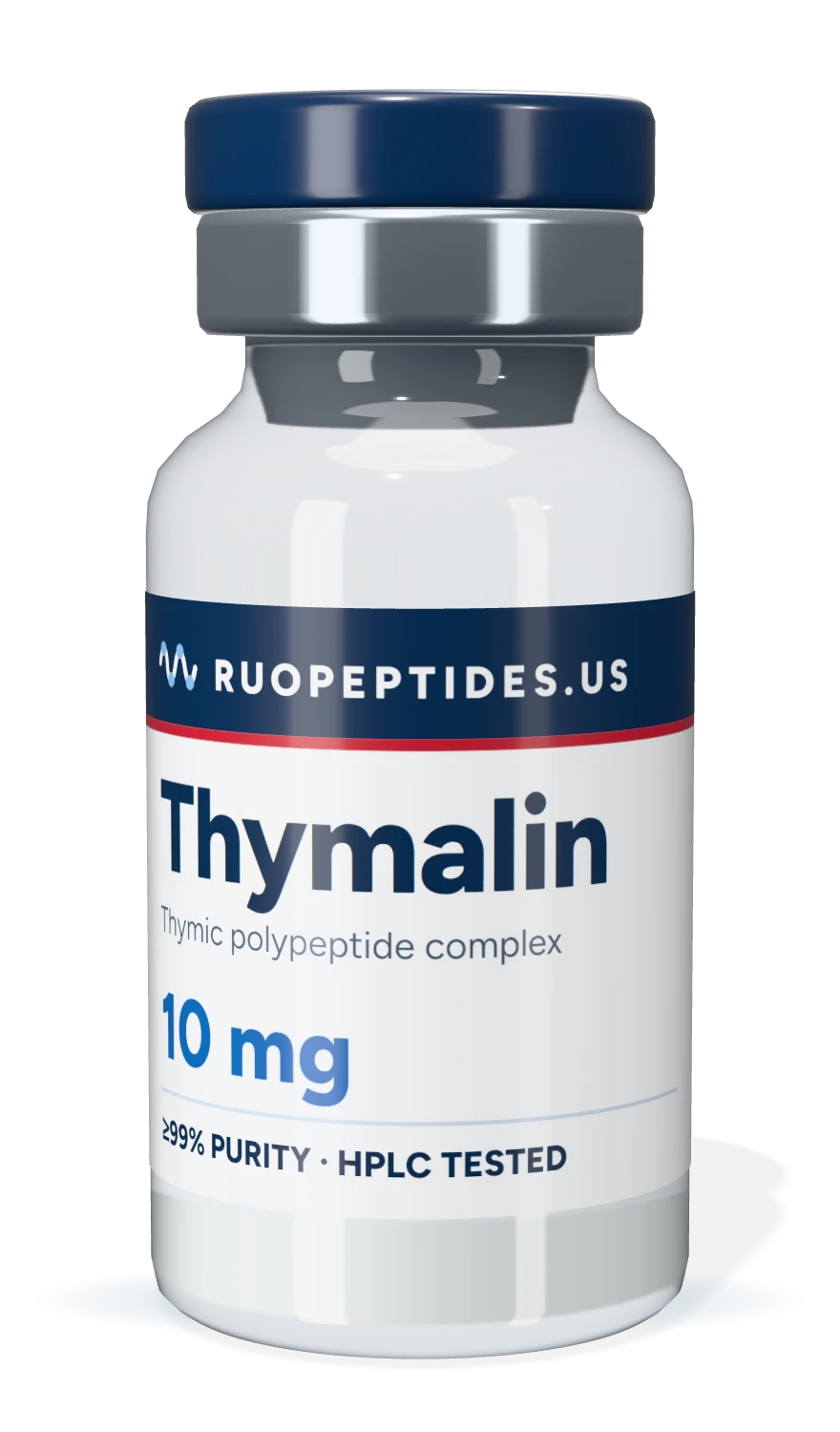
Full label. Lot number and expiry differ per batch and are printed on each vial.
Thymic & Bioregulator PeptidesCellular Aging ResearchImmune Signaling Research
Thymalin
Also known as: Thymic polypeptide complex
Thymalin is available exclusively for in vitro and analytical research.
- CAS
- 63958-90-7
- M.W.
- 858.86 g/mol
- Formula
- C₃₃H₅₄N₁₂O₁₅
- Form
- Lyophilized powder
$55.00per vial
Price shown per vial. Quantity discounts below.
In stock
Buy more, pay less per vial
Add 1 more vial to save 3%: $53.35 per vial.
- Safe credit card paymentVisa, Mastercard and American Express
- 30-day money-back guarantee
- Super-fast 1-2 day shippingTo all 50 states and DC
- Free shipping on orders over $200Applied automatically at checkout
Thymalin
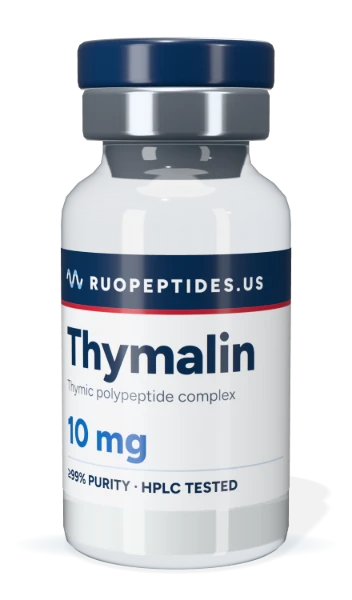
10 mg · $55.00/vial
Lyophilized Thymalin storage
Lyophilized Thymalin peptide should be stored in a dry place, protected from sunlight and moisture.
The following storage conditions are generally recommended:
- Room temperature (15-25 °C / 59-77 °F): Up to ~3-8 months
- Refrigerated (2-8 °C / 35.6-46.4 °F): Up to 6 months
- Frozen (-20 °C / -4 °F or below): 3-5 years
Prior reconstituting with a suitable solvent or Saline, allow the vial to reach room temperature after taking it out of the refrigerator or freezer.
Reconstituted Thymalin storage
Once in solution, Thymalin is generally less stable compared to their lyophilized (powdered) form and should be stored at cold temperatures when possible.
These storage conditions are generally recommended:
- Room temperature (15-25 °C / 59-77 °F): Avoid longer than 2-4 day storage
- Refrigerated (2-8 °C / 35.6-46.4 °F): Typically 4-8 weeks
- Frozen (-20 °C / -4 °F or below or below): Up to 3-4 months
However, to preserve peptide efficacy and amino-acid bonds, avoid repeatedly freezing and unfreezing the peptide.
Thymalin delivery and shipping
Thymalin ships from US stock to United States addresses only. Orders are packed and dispatched within 1-2 business days.
- Standard: $9.95, 1-2 business days after dispatch.
- Express: $24.95, next business day after dispatch.
Lyophilized Thymalin ships in a sealed glass vial with protective packaging. The dry powder is stable at room temperature for the length of domestic transit, so no cold pack is needed. Move it to the storage conditions above when it arrives.
Follow your parcel any time on the Track Order page.
Thymalin lab testing and COA
The certificate of analysis for Thymalin is being uploaded. Ask support for the current report before you order if you need it now.
Every vial label has a lot number. Check it on the Verify page to confirm the vial is genuine. All reports are on the Lab Reports page.
For laboratory research use only. All products are sold for laboratory research use only. They are not drugs, foods, cosmetics or dietary supplements, and are not for human or veterinary use.
Thymalin specifications
- Product
- Thymalin
- Also known as
- Thymic polypeptide complex
- Compound class
- Thymic & Bioregulator Peptides
- Product type
- Preparation
- Form
- Lyophilized powder
- Amounts available
- 10 mg ($55.00), 20 mg ($99.00)
- CAS number
- 63958-90-7
- Compound Type
- Thymic peptide preparation/peptide complex
- Receptor Activity
- No single established receptor-binding profile; investigated for effects on immune-cell differentiation and function
- Sequence
- Pyr-Ala-Lys-Ser-Gln-Gly-Gly-Ser-Asn
- Molecular formula
- C₃₃H₅₄N₁₂O₁₅
- Molecular weight
- 858.86 g/mol
- Form
- Lyophilized Powder
- Structural Features
- Polypeptide complex isolated from bovine thymus; identified components include Glu-Trp, Lys-Glu, and Glu-Asp-Pro
- Synonyms
- Thymus extract; thymic polypeptide complex
- Solubility
- Soluble in Reconstitution Solution as well as Sodium Chloride.
- Storage as supplied
- Sealed, dry, dark; -20 °C for long-term storage
- Lab report
- COA on request
- Research areas
- Thymic & Bioregulator Peptides, Cellular Aging Research, Immune Signaling Research
- Intended use
- Laboratory research only. Not for human or veterinary use.
Research overview
About Thymalin
Scientifically reviewed by John Johnson · Updated November 2026Thymalin is available exclusively for in vitro and analytical research.
Thymalin is a thymus-derived peptide and has been defined historically as a product made of low-molecular-weight peptides investigated in relation to thymic biology, thymus biology, and physiologic processes related to aging. [1] Its thymic origin and peptide composition have made it a subject of interest across immunological and biological ageing research.
What Is Thymalin?
Thymalin is a peptide derived from the thymus. It is formulated from thymic tissue and has low-molecular-weight peptide building blocks rather than a specific amino acid composition. This compositional profile distinguishes it from conventional synthetic peptides and reflects its origin as a biological preparation rather than a purely chemically synthesized compound.
As a Thymalin research peptide, it has been studied regarding its role in thymic biology and immune system regulation. Published research has revealed how thymic peptide preparations affect issues such as T-lymphocyte differentiation, thymic activity, and immune regulation signaling mechanisms. The Thymalin peptide complex has also been investigated in the context of age-associated changes in immune and physiological function; research reveals changes in thymic functions and immune system effectiveness in the course of ageing.
Research into Thymalin spans several decades, with a substantial body of published literature originating from Eastern European institutional and clinical research settings, contributing to its established profile as a subject of immunological and biological ageing investigation. [2]
Thymalin Research Applications
Research-grade Thymalin has a wide-ranging application in immunological research and thymic biology research. Below are some areas that have been investigated in scientific publications:
- Thymic biology: investigation of physiological processes associated with the thymus and mechanisms linked to thymic function. [3]
- Immune regulation: study examining the connection between thymic peptides and immune cell activity.
- T-cell biology: investigation of thymus-associated mechanisms involved in T-cell development, differentiation, and regulation. [4]
- Age-associated immune changes: research exploring thymic involution and changes in immune regulation observed in ageing models. [5]
- Cellular regulation: studies examining potential regulatory activity of low-molecular-weight peptide components in experimental settings. [6]
- Gerontology research: historical literature has investigated thymic peptide for research applications relating to age-associated physiological processes, though findings vary across study designs and models. [7]
All applications reflect parameters documented in peer-reviewed literature and are intended exclusively for qualified laboratory researchers.
Thymalin FAQ
Is Thymalin a peptide?
Thymalin is more accurately described as a thymic peptide preparation, a complex of low-molecular-weight peptide components derived from thymic tissue, rather than a single conventional synthetic peptide with one defined amino-acid sequence.
What is Thymalin studied for?
Published research documents Thymalin investigation across thymic biology, immune regulation, T-cell development, age-associated immune changes, cellular regulation, and gerontology research. All parameters referenced reflect peer-reviewed scientific literature and are framed as research areas only.
Why are thymic peptides studied in immune research?
The thymus plays a central role in T-cell development and immune regulation. Thymic peptide preparations have been investigated for their relationships with immune-cell activity, thymic function, and age-associated changes in immune competence, areas extensively documented in published immunological research.
Is Thymalin an anti-aging peptide?
Thymalin is not classified as an anti-aging therapeutic. It is a thymic peptide preparation investigated in research examining age-associated changes in immune and physiological function. Published literature has explored these relationships in experimental models; findings should not be interpreted as established clinical outcomes.
Is Thymalin the same as Thymosin Beta-4?
No. Thymalin and Thymosin Beta-4 are distinct compounds with different compositions and research profiles. Thymalin is a thymus-derived peptide preparation; Thymosin Beta-4 is a specific single-sequence synthetic peptide.
What is the difference between Thymalin and other thymic peptides?
Thymalin is a thymic peptide complex rather than a single-sequence peptide, distinguishing it from compounds such as Thymulin or individual thymic fractions.
Where can I learn more about peptide research?
RUOPeptides maintains a knowledge base covering research mechanisms, published literature, and investigated applications across its product range.
Scientific references
- [1]Thymalin: Activation of Differentiation of Human Hematopoietic Stem Cells
- [2]Experimental and clinical study of the thymus polypeptide factor thymalin
- [3]Effect of Thymalin on the Tumor and Thymus under Conditions of Activation Therapy In Vivo
- [4]
- [5]New data on the involvement of ectodermal epithelium in extrathymic differentiation of human T-lymphocytes
- [6]The Influence of KE and EW Dipeptides in the Composition of the Thymalin Drug on Gene Expression and Protein Synthesis Involved in the Pathogenesis of COVID-19
- [7]Peptides of pineal gland and thymus prolong human life
Buying Thymalin for research in the USA
Price
From $55.00. 10 mg: $55.00, 20 mg: $99.00. Quantity discounts per size: 3% off 2 vials, 5% off 3-4 vials, 7% off 5+ vials.
Shipping
US addresses only. Orders are packed and dispatched within 1-2 business days. Standard from $9.95.
Proof it's genuine
Check the lot number on your vial on the Verify page.
Lab reports
COA and SDS documents are on the Lab Reports page.
Scientifically reviewed
Scientifically reviewed by John Johnson
Scientific reviewer · Last reviewed November 2026
John Johnson reviewed this Thymalin page for scientific accuracy: the compound's identity and specifications, the summaries of published studies, and the references they cite. The page describes laboratory and preclinical research only. It is not medical advice and gives no usage guidance.
Research information on this page summarizes published laboratory and preclinical studies. It is not usage guidance.