For laboratory research use only. Not for human or veterinary use.
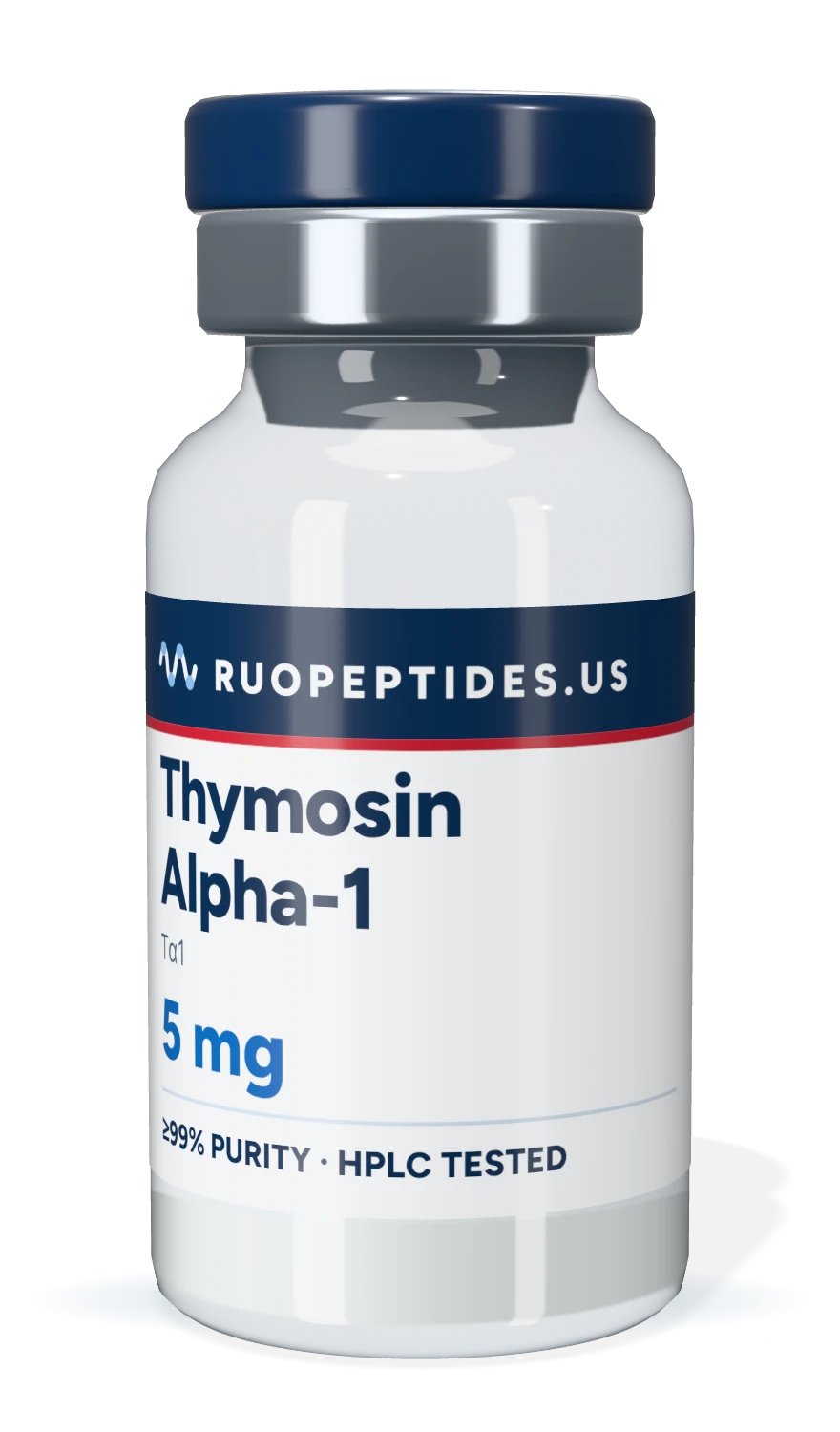
THYMOSIN ALPHA-1
FOR RESEARCH USE ONLYNot for human or veterinary use of any kind
Full label. Lot number and expiry differ per batch and are printed on each vial.
Thymic & Bioregulator PeptidesImmune Signaling Research
Thymosin Alpha-1
Also known as: Tα1, Thymalfasin
Thymosin Alpha-1, often abbreviated as Tα1 or TA1, is a naturally occurring thymic peptide made of 28 amino acids.
- CAS
- 62304-98-7
- M.W.
- 3108.3 g/mol
- Formula
- C₁₂₉H₂₁₅N₃₃O₅₅
- Form
- Lyophilized powder
$55.00per vial
Price shown per vial. Quantity discounts below.
In stock
Buy more, pay less per vial
Add 1 more vial to save 3%: $53.35 per vial.
- Safe credit card paymentVisa, Mastercard and American Express
- 30-day money-back guarantee
- Super-fast 1-2 day shippingTo all 50 states and DC
- Free shipping on orders over $200Applied automatically at checkout
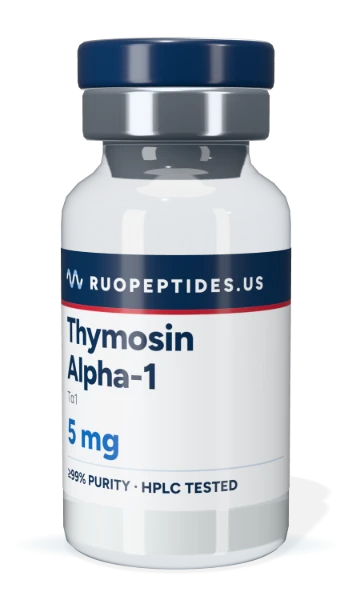
Thymosin Alpha-1
5 mg · $55.00/vial
Lyophilized Thymosin Alpha-1 storage
Store lyophilized material sealed, dry and protected from light. Refrigerate (2-8 °C) for short-term storage; freeze (−20 °C or below) for long-term storage.
Reconstituted Thymosin Alpha-1 storage
Material in solution is less stable than the lyophilized form. Keep refrigerated (2-8 °C), protect from light, and avoid repeated freeze-thaw cycles.
Thymosin Alpha-1 delivery and shipping
Thymosin Alpha-1 ships from US stock to United States addresses only. Orders are packed and dispatched within 1-2 business days.
- Standard: $9.95, 1-2 business days after dispatch.
- Express: $24.95, next business day after dispatch.
Lyophilized Thymosin Alpha-1 ships in a sealed glass vial with protective packaging. The dry powder is stable at room temperature for the length of domestic transit, so no cold pack is needed. Move it to the storage conditions above when it arrives.
Follow your parcel any time on the Track Order page.
Thymosin Alpha-1 lab testing and COA
The certificate of analysis for Thymosin Alpha-1 is being uploaded. Ask support for the current report before you order if you need it now.
Every vial label has a lot number. Check it on the Verify page to confirm the vial is genuine. All reports are on the Lab Reports page.
For laboratory research use only. All products are sold for laboratory research use only. They are not drugs, foods, cosmetics or dietary supplements, and are not for human or veterinary use.
Thymosin Alpha-1 specifications
- Product
- Thymosin Alpha-1
- Also known as
- Tα1, Thymalfasin
- Compound class
- Thymic & Bioregulator Peptides
- Product type
- Peptide
- Form
- Lyophilized powder
- Amounts available
- 5 mg ($55.00), 10 mg ($99.00)
- Sequence
- Ac-Ser-Asp-Ala-Ala-Val-Asp-Thr-Ser-Ser-Glu-Ile-Thr-Thr-Lys-Asp-Leu-Lys-Glu-Lys-Lys-Glu-Val-Val-Glu-Glu-Ala-Glu-Asn
- Molecular weight
- 3108.3 g/mol
- Molecular formula
- C₁₂₉H₂₁₅N₃₃O₅₅
- CAS number
- 62304-98-7
- Storage as supplied
- Sealed, dry, dark; -20 °C for long-term storage
- Lab report
- COA on request
- Research areas
- Thymic & Bioregulator Peptides, Immune Signaling Research
- Intended use
- Laboratory research only. Not for human or veterinary use.
Research overview
About Thymosin Alpha-1
Scientifically reviewed by John Johnson · Updated November 2026Thymosin Alpha-1, often abbreviated as Tα1 or TA1, is a naturally occurring thymic peptide made of 28 amino acids. Researchers have studied its role in immune regulation, including T-cell function, dendritic cell signaling, cytokine responses and immune activity during infections and other states of immune dysregulation. [1] RUOPeptides supplies Thymosin Alpha-1 in 5 mg vials for laboratory research.
What Is Thymosin Alpha-1?
Thymosin Alpha-1 (Tα1) is a naturally occurring 28-amino-acid peptide originally isolated from thymic preparations. It is derived from the precursor protein prothymosin alpha (ProTα). [2]
Tα1 has been investigated for its effects on T lymphocytes, dendritic cells, natural killer cells, cytokine signaling, Toll-like receptors and antigen presentation. [3] Rather than acting through a single receptor pathway, it shows pleiotropic immunomodulatory effects across several immune cell types and signaling pathways.
Its synthetic form, thymalfasin, has been approved for certain medical indications in some countries. [4] RUOPeptides Thymosin Alpha-1 is intended for laboratory research and is not equivalent to an approved thymalfasin pharmaceutical product.
Overview of Published Thymosin Alpha-1 Research
Published Thymosin Alpha-1 research has examined the peptide's effects on immune cell signaling, cellular immunity, infection and oncology. Findings from laboratory experiments, animal studies and clinical investigations show that its effects are not always the same: much depends on the immune cells involved and the conditions being studied.
Thymosin Alpha-1 and Innate Immune Signaling
Innate immunity provides the first response to pathogens. Researchers have studied how Tα1 influences this process, particularly through dendritic cells and Toll-like receptor (TLR) pathways.
Dendritic cells recognize threats, process antigens and help coordinate immune responses. Studies of myeloid and plasmacytoid dendritic cells have reported Tα1-associated changes in TLR signaling, cytokine production and immune cell activation. [3]
Experimental work has also examined MyD88-dependent signaling, which passes on signals after microbial recognition. Depending on the model, Tα1 has been associated with altered inflammatory mediators, interferon responses and dendritic cell maturation.
These observations matter because dendritic cells connect innate recognition with adaptive immunity. Once they process antigens, they can present them to T cells and help shape later responses. Responses observed in one dendritic cell subtype may differ from those in another.
Some studies also describe pathways associated with immune tolerance. [2] Tα1 is therefore investigated as an immune regulator, not simply as a substance that increases immune activation.
Thymosin Alpha-1 and T-Cell-Mediated Immunity
Adaptive immunity is another established focus of Tα1 research. Early studies investigated the thymic peptide in relation to T-cell maturation, differentiation and cellular immune function.
CD4+ T cells help coordinate responses through cytokine signaling, while CD8+ T cells recognize infected or abnormal cells. Researchers have examined how Tα1 influences both populations rather than a single T-cell subset.
Other investigations have looked at natural killer (NK) cells, which take part in immune surveillance, and antigen-presenting cells, which help start adaptive responses. [4]
Antigen presentation is a particular research interest. Studies have explored changes in major histocompatibility complex (MHC) class I expression, which lets cells display intracellular antigens for recognition by CD8+ T cells. Researchers have also investigated cytokines, including interleukins and interferons, that coordinate communication between immune cells.
Together, experimental and clinical findings suggest that Tα1 may influence several components of cellular immunity. [2] The direction and extent of these effects vary by research model, immune cell population and underlying condition. They should not be read as evidence that Tα1 universally strengthens immune function.
Thymosin Alpha-1 in Infection and Sepsis Research
Researchers have examined Tα1 in chronic viral infections and in severe systemic infections where immune dysfunction plays a role. Clinical studies have included hepatitis B and C, providing data on immune and clinical markers, with results that vary between diseases and study designs. [2]
Sepsis is another important area, because severe infection can involve both uncontrolled inflammation and impaired immune responses.
The multicenter ETASS randomized controlled trial enrolled 361 adults with severe sepsis. It compared Tα1 plus conventional treatment with conventional treatment alone, looking at mortality and immune function markers.
The 28-day mortality was 26.0% in the Tα1 group and 35.0% in the control group. The primary nonstratified analysis did not reach conventional statistical significance (P = 0.062), while a log-rank survival analysis was borderline (P = 0.049).
The researchers also reported greater increases in monocyte HLA-DR (mHLA-DR) expression on days three and seven in the Tα1 group. [5] This marker is used to assess aspects of monocyte antigen-presenting capacity.
Although these results suggest measurable immunological effects, they do not establish that Tα1 reliably reduces sepsis mortality. The difference between the two statistical analyses makes careful interpretation especially important, and larger trials are needed to clarify whether changes in immune markers translate into clinical outcomes.
Thymosin Alpha-1 in Cancer and Immunomodulation Research
Oncology research has examined Tα1 as an adjunctive immunomodulatory compound, particularly where malignancy or conventional treatment affects immune function.
Experimental and clinical investigations have explored T-cell and NK-cell activity, antigen presentation, cytokine responses and immune suppression, in conditions including melanoma, lung cancer and hepatocellular carcinoma. Clinical findings remain mixed, and changes in immune activity do not necessarily mean improved treatment outcomes. [6][7][8]
Current investigations continue to study particular immune cell populations. A recent study of CD4+ T cells, CD8+ T cells, B cells and NK cells from healthy donors reported changes in proliferation and gene expression, including notable transcriptional responses in activated CD8+ T cells.
The same study found limited direct transcriptional effects in the cancer cell lines examined. [9] The distinction matters because effects on immune cells are not the same as direct antitumor activity.
Such findings support continued investigation of Tα1 mechanisms but do not establish it as a cancer treatment, and they cannot be used to claim clinical effectiveness for RUOPeptides Thymosin Alpha-1, which is intended for laboratory research.
Thymosin Alpha-1 vs Thymosin Beta-4: What's the Difference?
The word thymosin in both names does not mean the two are similar in structure or biology. Thymosin Alpha-1 is a 28-amino-acid peptide studied in the immune system, while Thymosin Beta-4 is a separate 43-amino-acid peptide studied for actin regulation, cell movement and tissue repair.
| Feature | Thymosin Alpha-1 | Thymosin Beta-4 |
|---|---|---|
| Abbreviation | Tα1 / TA1 | Tβ4 / TB-4 |
| Length | 28 amino acids | 43 amino acids |
| Biological origin | Derived from prothymosin alpha | Widely distributed intracellular peptide |
| Major research focus | Immune regulation and immune cell signaling | Actin regulation, cell migration, tissue-repair biology |
| Common research name | Thymalfasin | Thymosin Beta-4 / TB-4 |
Thymosin Beta-4 should also not be confused with TB-500, which raises a separate product-identification question.
Thymosin Alpha-1 FAQ
What is Thymosin Alpha-1?
Thymosin Alpha-1 (Tα1 or TA1) is a naturally occurring thymic peptide derived from prothymosin alpha. It has been investigated for its role in immune regulation, particularly its effects on innate and adaptive immune responses. RUOPeptides supplies it in 5 mg vials for laboratory research.
What is another name for Thymosin Alpha-1?
It is commonly abbreviated as Tα1 or TA1. Its synthetic form is known as thymalfasin, a name often used in pharmaceutical and clinical research literature. The names refer to the same peptide sequence, although commercial formulations and regulatory classifications can differ.
How many amino acids are in Thymosin Alpha-1?
Twenty-eight. It was originally isolated from thymic preparations and is derived from the precursor protein prothymosin alpha (ProTα). Its sequence distinguishes it from other thymosin peptides, including the 43-amino-acid Thymosin Beta-4.
Is Thymosin Alpha-1 the same as thymalfasin?
Thymalfasin is the synthetic form of Thymosin Alpha-1 and shares its sequence. Research-grade Tα1 is not equivalent to an approved pharmaceutical formulation. When comparing Thymosin Alpha-1 listings, researchers should consider formulation, purity documentation, intended use and regulatory status.
What is Thymosin Alpha-1 studied for?
Published research has examined Thymosin Alpha-1 in immune regulation, T-cell function, dendritic cell signaling, chronic viral infections, sepsis and oncology. Studies have investigated its influence on immune cell activity and cytokine responses, although findings vary across experimental models and clinical settings.
How does Thymosin Alpha-1 interact with the immune system?
Thymosin Alpha-1 has been investigated for its effects on Toll-like receptor signaling, dendritic cells, antigen presentation and T-cell-mediated immunity. Research suggests it influences several immune pathways rather than a single receptor. Its immunomodulatory effects vary by biological context and should not be described as universally boosting immunity.
Scientific references
- [1]Romani L, et al. Ann N Y Acad Sci. 2012. Jack of all trades: thymosin α1 and its pleiotropy.
- [2]Romani L, et al. Ann N Y Acad Sci. 2007. Thymosin alpha1: an endogenous regulator of inflammation, immunity, and tolerance.
- [3]King R, Tuthill C. Vitam Horm. 2016. Immune Modulation with Thymosin Alpha 1 Treatment.
- [4]Dominari A, et al. World J Virol. 2020. Thymosin alpha 1: A comprehensive review of the literature.
- [5]Wu J, et al. Crit Care. 2013. The efficacy of thymosin alpha 1 for severe sepsis (ETASS): a multicenter, single-blind, randomized and controlled trial.
- [6]Costantini C, et al. Front Oncol. 2019. A Reappraisal of Thymosin Alpha1 in Cancer Therapy.
- [7]Garaci E, et al. Ann N Y Acad Sci. 2012. Thymosin α1 and cancer: action on immune effector and tumor target cells.
- [8]Garaci E, et al. Int J Immunopharmacol. 2000. Thymosin alpha 1 in the treatment of cancer: from basic research to clinical application.
- [9]Solmonese L, et al. Onco Targets Ther. 2025. The Immunomodulatory Activity of Thymosin Alpha 1 on Tumor Cell Lines and Distinct Immune Cell Subsets.
Buying Thymosin Alpha-1 for research in the USA
Price
From $55.00. 5 mg: $55.00, 10 mg: $99.00. Quantity discounts per size: 3% off 2 vials, 5% off 3-4 vials, 7% off 5+ vials.
Shipping
US addresses only. Orders are packed and dispatched within 1-2 business days. Standard from $9.95.
Proof it's genuine
Check the lot number on your vial on the Verify page.
Lab reports
COA and SDS documents are on the Lab Reports page.
Scientifically reviewed
Scientifically reviewed by John Johnson
Scientific reviewer · Last reviewed November 2026
John Johnson reviewed this Thymosin Alpha-1 page for scientific accuracy: the compound's identity and specifications, the summaries of published studies, and the references they cite. The page describes laboratory and preclinical research only. It is not medical advice and gives no usage guidance.
Research information on this page summarizes published laboratory and preclinical studies. It is not usage guidance.