For laboratory research use only. Not for human or veterinary use.
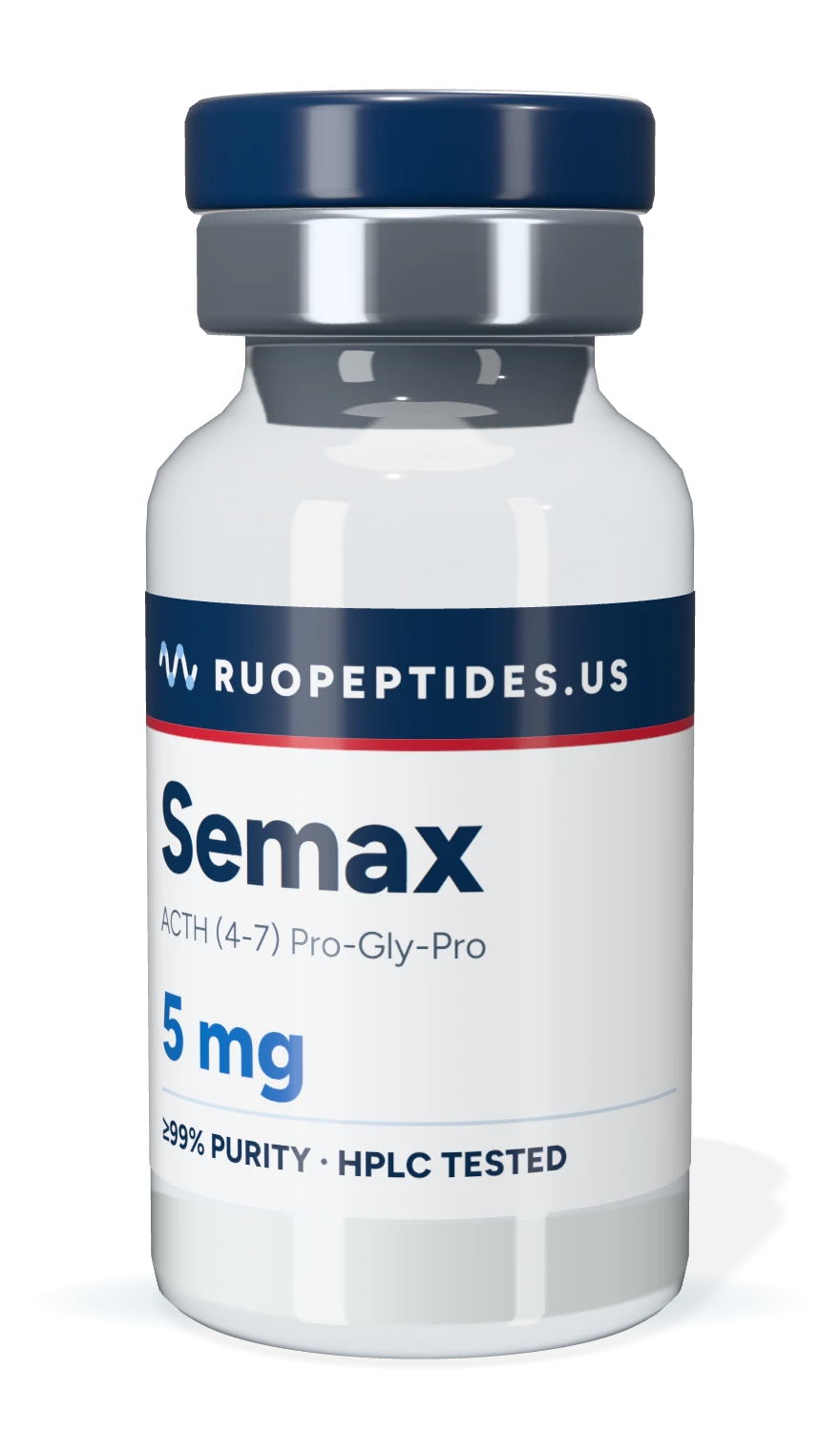
SEMAX
FOR RESEARCH USE ONLYNot for human or veterinary use of any kind
Full label. Lot number and expiry differ per batch and are printed on each vial.
Semax
Also known as: ACTH (4-7) Pro-Gly-Pro
Semax is derived from ACTH and consists of the sequence Met-Glu-His-Phe-Pro-Gly-Pro. It is intended only for in vitro and analytical research by professionals.
- CAS
- 80714-61-0
- M.W.
- 813.9 g/mol
- Formula
- C37H51N9O10S
- Form
- Lyophilized powder
$39.00per vial
Price shown per vial. Quantity discounts below.
In stock
Buy more, pay less per vial
Add 1 more vial to save 3%: $37.83 per vial.
- Safe credit card paymentVisa, Mastercard and American Express
- 30-day money-back guarantee
- Super-fast 1-2 day shippingTo all 50 states and DC
- Free shipping on orders over $200Applied automatically at checkout
Semax
5 mg · $39.00/vial
Lyophilized Semax storage
Lyophilized Semax peptide should be stored in a dry place, protected from sunlight and moisture.
The following storage conditions are generally recommended:
- Room temperature (15-25 °C / 59-77 °F): Up to ~3-8 months
- Refrigerated (2-8 °C / 35.6-46.4 °F): Up to 6 months
- Frozen (-20 °C / -4 °F or below): 3-5 years
Prior reconstituting with a suitable solvent or Saline, allow the vial to reach room temperature after taking it out of the refrigerator or freezer.
Reconstituted Semax storage
Once in solution, Semax is generally less stable compared to their lyophilized (powdered) form and should be stored at cold temperatures when possible.
These storage conditions are generally recommended:
- Room temperature (15-25 °C / 59-77 °F): Avoid longer than 2-4 day storage
- Refrigerated (2-8 °C / 35.6-46.4 °F): Typically 4-8 weeks
- Frozen (-20 °C / -4 °F or below): Up to 3-4 months
However, to preserve peptide efficacy and amino-acid bonds, avoid repeatedly freezing and unfreezing the peptide.
Semax delivery and shipping
Semax ships from US stock to United States addresses only. Orders are packed and dispatched within 1-2 business days.
- Standard: $9.95, 1-2 business days after dispatch.
- Express: $24.95, next business day after dispatch.
Lyophilized Semax ships in a sealed glass vial with protective packaging. The dry powder is stable at room temperature for the length of domestic transit, so no cold pack is needed. Move it to the storage conditions above when it arrives.
Follow your parcel any time on the Track Order page.
Semax lab testing and COA
The certificate of analysis for Semax is being uploaded. Ask support for the current report before you order if you need it now.
Every vial label has a lot number. Check it on the Verify page to confirm the vial is genuine. All reports are on the Lab Reports page.
For laboratory research use only. All products are sold for laboratory research use only. They are not drugs, foods, cosmetics or dietary supplements, and are not for human or veterinary use.
Semax specifications
- Product
- Semax
- Also known as
- ACTH (4-7) Pro-Gly-Pro
- Compound class
- Neuropeptides
- Product type
- Peptide
- Form
- Lyophilized powder
- Amounts available
- 5 mg ($39.00), 10 mg ($69.00)
- Sequence
- Met-Glu-His-Phe-Pro-Gly-Pro
- Molecular weight
- 813.9 g/mol
- Molecular formula
- C37H51N9O10S
- CAS number
- 80714-61-0
- Storage as supplied
- Sealed, dry, dark; -20 °C for long-term storage
- Lab report
- COA on request
- Research areas
- Neuropeptides
- Intended use
- Laboratory research only. Not for human or veterinary use.
Research overview
About Semax
Scientifically reviewed by John Johnson · Updated November 2026Semax is derived from ACTH and consists of the sequence Met-Glu-His-Phe-Pro-Gly-Pro. [1] It is intended only for in vitro and analytical research by professionals.
Its structural characteristics and documented receptor interactions have made Semax a focus of experimental research examining neurotrophin signaling, gene expression, neural plasticity, and cellular responses to neurological stress. Studies have also examined its relationship with BDNF, NGF, and related receptor systems.
What Is Semax?
Semax is a synthetic heptapeptide made up of seven amino acids and structurally related to fragments of adrenocorticotropic hormone (ACTH). Its sequence, Met-Glu-His-Phe-Pro-Gly-Pro, consists of the ACTH(4-7) fragment, Met-Glu-His-Phe, followed by a C-terminal Pro-Gly-Pro (PGP) extension.
Published literature refers to Semax using both the ACTH(4-7)-PGP compound and the ACTH 4-10 peptide analogue terminology. These references describe the same compound in different ways of representing its structure rather than different forms of Semax variants. Researchers should keep this distinction in mind when reviewing literature.
Semax BDNF research is one of the more established areas of investigation surrounding the peptide. Although Semax is structurally related to ACTH, it differs from the full-length hormone in sequence, receptor interactions, and documented pharmacological research. Other studies have examined neurotrophin receptor signaling and gene expression.
Semax Research Applications
Semax neuropeptide has been examined in published experimental research spanning neurological signaling, gene expression, and related cellular processes. As a Semax research peptide, it is studied across several areas, including:
- Neurotrophin research: Involves studying relations between Semax exposure and activity of neurotrophic agents like BDNF and NGF in experiments. [2]
- BDNF/TrkB signaling: Experimental studies have examined Semax-associated changes in BDNF expression and TrkB receptor-related signaling pathways. [3]
- Gene-expression research: studies cover processes associated with transcriptional reactions to Semax in experimental investigations of neural tissues. [4]
- Neural plasticity research: studying molecular pathways involved in neuronal adaptation and synaptic plasticity in experimental settings.
- Cerebral ischemia models: animal research has investigated Semax-related transcriptional and neurotrophin responses following experimentally induced cerebral ischemia. [5]
- Neuroinflammatory signaling: research has examined expression of inflammatory mediators in experimental neurological models following Semax exposure. [6]
- Peptide degradation research: studies have investigated Semax biodegradation pathways and biologically active fragment activity, including the Pro-Gly-Pro (PGP) component. [7]
Semax, ACTH Fragments, and Pro-Gly-Pro: What's the Difference?
Researchers reviewing Semax literature will encounter several related compounds and fragments. These are pharmacologically distinct and should not be treated as interchangeable:
- ACTH: the complete adrenocorticotropic hormone. Although Semax is derived from an ACTH-related sequence, it is distinct from the parent hormone in its biological properties.
- ACTH(4-7): the four-amino-acid N-terminal portion of the Semax peptide sequence Met-Glu-His-Phe, forming the foundation of the ACTH(4-7)-PGP compound.
- Pro-Gly-Pro (PGP): Semax's C-terminal tripeptide that has been independently researched as well.
- Semax: the complete seven-amino-acid peptide, Met-Glu-His-Phe-Pro-Gly-Pro, which combines the ACTH(4-7) sequence with the PGP extension.
Published studies have directly compared Semax with PGP and found that the two produce some overlapping but distinct transcriptional effects. Therefore, findings specific to PGP should not be assumed to apply to Semax, or vice versa.
Semax FAQ
Is Semax a peptide?
Yes. Semax is a synthetic heptapeptide and a seven-amino-acid chain structurally derived from a fragment of adrenocorticotropic hormone (ACTH), with the sequence Met-Glu-His-Phe-Pro-Gly-Pro.
How many amino acids are in Semax?
Semax contains seven amino acids, making it a heptapeptide. Its sequence combines the ACTH(4-7) fragment - Met-Glu-His-Phe - with the C-terminal Pro-Gly-Pro tripeptide extension.
What is the Semax peptide sequence?
The amino acid sequence of Semax is Met-Glu-His-Phe-Pro-Gly-Pro. Its molecular formula is C₃₇H₅₁N₉O₁₀S, molecular weight 833.93 g/mol, CAS number 80714-61-0.
Is Semax derived from ACTH?
Yes. Semax is structurally derived from ACTH(4-7), a fragment of adrenocorticotropic hormone, extended with a Pro-Gly-Pro C-terminal sequence. Despite this structural relationship, Semax is pharmacologically distinct from full-length ACTH.
Is Semax the same as ACTH(4-10)?
Not exactly. Published literature variously describes Semax as an ACTH(4-7)-PGP compound and as an ACTH(4-10) analogue. These references describe the same compound from different structural reference points; they do not represent distinct Semax variants.
What is Pro-Gly-Pro (PGP) in Semax?
Pro-Gly-Pro is the C-terminal tripeptide component of the Semax sequence. It has also been investigated independently in published research. Studies comparing Semax and PGP have identified partially overlapping but non-identical transcriptional effects. Findings for each should not be automatically attributed to the other.
What is Semax studied for?
Published research documents Semax investigation across neurotrophin signaling, BDNF and NGF expression, gene-expression responses in neural tissue, neural plasticity, cerebral ischemia models, neuroinflammatory signaling, and peptide degradation pathways including PGP fragment activity.
Is Semax studied in neuroplasticity research?
Yes. Experimental studies have investigated molecular pathways associated with neural plasticity and neuronal adaptation following Semax exposure. These remain preclinical research areas documented in peer-reviewed literature rather than established clinical applications.
What is the difference between Semax and Selank?
Both are synthetic regulatory peptides developed from peptide fragment research, but they are structurally and pharmacologically distinct. Selank is a tuftsin-derived heptapeptide investigated primarily in anxiety-related and immune-signaling research, while Semax is an ACTH-derived compound investigated across neurotrophin and gene-expression pathways.
Scientific references
- [1]The peptide semax affects the expression of genes related to the immune and vascular systems in rat brain focal ischemia: genome-wide transcriptional analysis
- [2]Neurotrophin gene expression in rat brain under the action of Semax, an analogue of ACTH 4-10
- [3]Semax, an analog of ACTH(4-10) with cognitive effects, regulates BDNF and trkB expression in the rat hippocampus
- [4]Comparison of the temporary dynamics of NGF and BDNF gene expression in rat hippocampus, frontal cortex, and retina under Semax action
- [5]Semax and Pro-Gly-Pro activate the transcription of neurotrophins and their receptor genes after cerebral ischemia
- [6]Novel Insights into the Protective Properties of ACTH(4-7)PGP (Semax) Peptide at the Transcriptome Level Following Cerebral Ischaemia-Reperfusion in Rats
- [7]
Buying Semax for research in the USA
Price
From $39.00. 5 mg: $39.00, 10 mg: $69.00. Quantity discounts per size: 3% off 2 vials, 5% off 3-4 vials, 7% off 5+ vials.
Shipping
US addresses only. Orders are packed and dispatched within 1-2 business days. Standard from $9.95.
Proof it's genuine
Check the lot number on your vial on the Verify page.
Lab reports
COA and SDS documents are on the Lab Reports page.
Scientifically reviewed
Scientifically reviewed by John Johnson
Scientific reviewer · Last reviewed November 2026
John Johnson reviewed this Semax page for scientific accuracy: the compound's identity and specifications, the summaries of published studies, and the references they cite. The page describes laboratory and preclinical research only. It is not medical advice and gives no usage guidance.
Research information on this page summarizes published laboratory and preclinical studies. It is not usage guidance.