For laboratory research use only. Not for human or veterinary use.
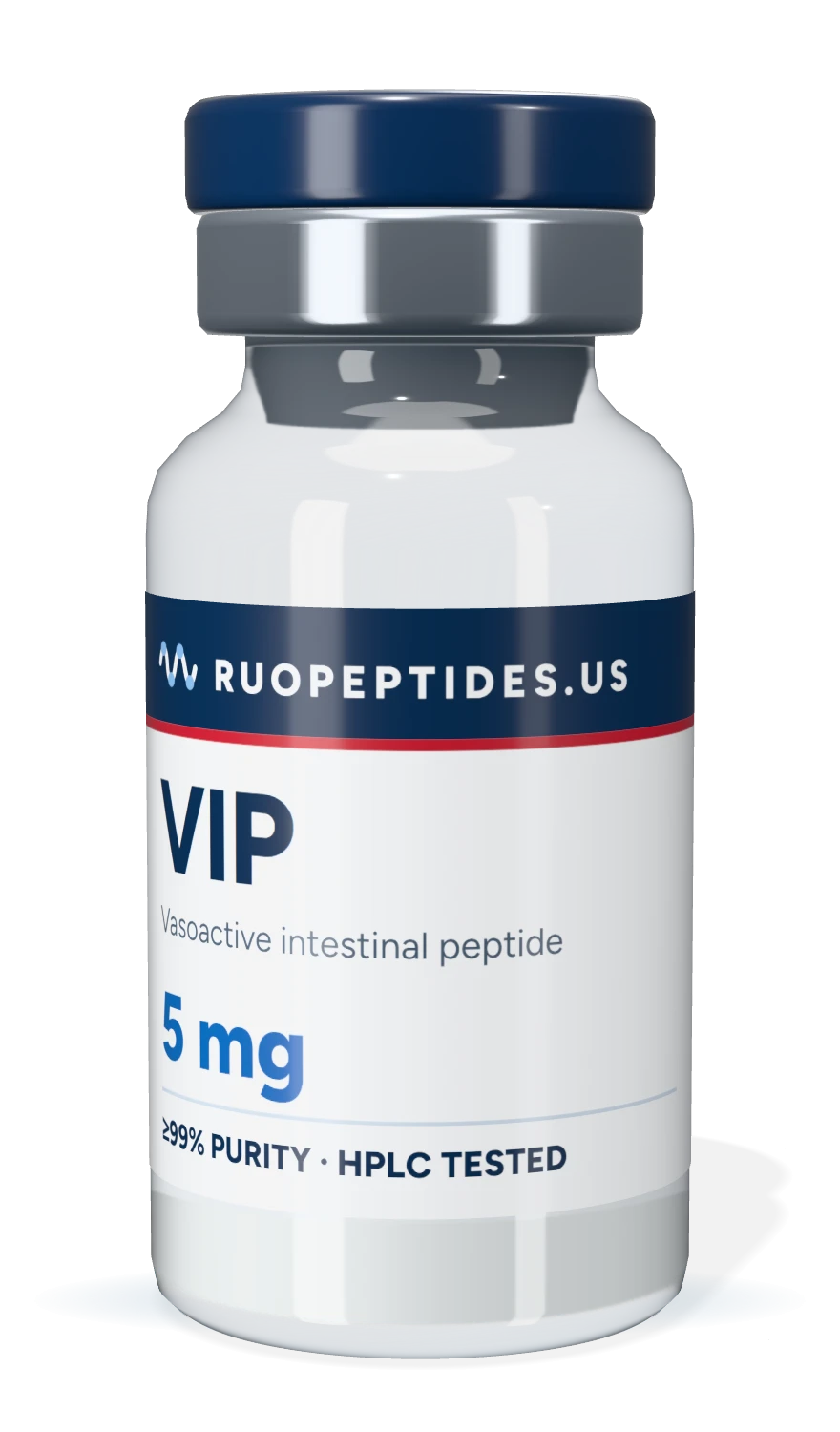
VIP
FOR RESEARCH USE ONLYNot for human or veterinary use of any kind
Full label. Lot number and expiry differ per batch and are printed on each vial.
NeuropeptidesImmune Signaling ResearchGut & Mucosal Research
VIP
Also known as: Vasoactive intestinal peptide
It participates in signaling across several major systems, including the nervous, digestive, cardiovascular, respiratory, and immune systems. VIP mainly interacts with VPAC1 and VPAC2 receptors and has a lower affinity for PAC1 receptors.
- CAS
- 40077-57-4
- M.W.
- Approximately 3323-3326 g/mol, depending on salt form and analytical source.
- Formula
- C147H238N44O42S
- Form
- Lyophilized powder
$54.00per vial
Price shown per vial. Quantity discounts below.
In stock
Buy more, pay less per vial
Add 1 more vial to save 3%: $52.38 per vial.
- Safe credit card paymentVisa, Mastercard and American Express
- 30-day money-back guarantee
- Super-fast 1-2 day shippingTo all 50 states and DC
- Free shipping on orders over $200Applied automatically at checkout
VIP
5 mg · $54.00/vial
Lyophilized VIP storage
Lyophilized VIP peptide should be stored in a dry place, protected from sunlight and moisture.
The following storage conditions are generally recommended:
- Room temperature (15-25 °C / 59-77 °F): Up to ~3-8 months
- Refrigerated (2-8 °C / 35.6-46.4 °F): Up to 6 months
- Frozen (-20 °C / -4 °F or below): 3-5 years
Prior reconstituting with a suitable solvent or Saline, allow the vial to reach room temperature after taking it out of the refrigerator or freezer.
Reconstituted VIP storage
Once in solution, VIP is generally less stable compared to their lyophilized (powdered) form and should be stored at cold temperatures when possible.
These storage conditions are generally recommended:
- Room temperature (15-25 °C / 59-77 °F): Avoid longer than 2-4 day storage
- Refrigerated (2-8 °C / 35.6-46.4 °F): Typically 4-8 weeks
- Frozen (-20 °C / -4 °F or below): Up to 3-4 months
However, to preserve peptide efficacy and amino-acid bonds, avoid repeatedly freezing and unfreezing the peptide.
VIP delivery and shipping
VIP ships from US stock to United States addresses only. Orders are packed and dispatched within 1-2 business days.
- Standard: $9.95, 1-2 business days after dispatch.
- Express: $24.95, next business day after dispatch.
Lyophilized VIP ships in a sealed glass vial with protective packaging. The dry powder is stable at room temperature for the length of domestic transit, so no cold pack is needed. Move it to the storage conditions above when it arrives.
Follow your parcel any time on the Track Order page.
VIP lab testing and COA
The certificate of analysis for VIP is being uploaded. Ask support for the current report before you order if you need it now.
Every vial label has a lot number. Check it on the Verify page to confirm the vial is genuine. All reports are on the Lab Reports page.
For laboratory research use only. All products are sold for laboratory research use only. They are not drugs, foods, cosmetics or dietary supplements, and are not for human or veterinary use.
VIP specifications
- Product
- VIP
- Also known as
- Vasoactive intestinal peptide
- Compound class
- Neuropeptides
- Product type
- Peptide
- Form
- Lyophilized powder
- Amounts available
- 5 mg ($54.00), 10 mg ($99.00)
- Sequence
- His-Ser-Asp-Ala-Val-Phe-Thr-Asp-Asn-Tyr-Thr-Arg-Leu-Arg-Lys-Gln-Met-Ala-Val-Lys-Lys-Tyr-Leu-Asn-Ser-Ile-Leu-Asn-NH2
- Molecular weight
- Approximately 3323-3326 g/mol, depending on salt form and analytical source.
- Molecular formula
- C147H238N44O42S
- CAS number
- 40077-57-4
- Storage as supplied
- Sealed, dry, dark; -20 °C for long-term storage
- Lab report
- COA on request
- Research areas
- Neuropeptides, Immune Signaling Research, Gut & Mucosal Research
- Intended use
- Laboratory research only. Not for human or veterinary use.
Research overview
About VIP
Scientifically reviewed by John Johnson · Updated November 2026It participates in signaling across several major systems, including the nervous, digestive, cardiovascular, respiratory, and immune systems. VIP mainly interacts with VPAC1 and VPAC2 receptors and has a lower affinity for PAC1 receptors. Its activity across different tissues has made it relevant to research on vascular signaling, smooth muscle function, immune responses, inflammation, and neural pathways. [1].
What Is Vasoactive Intestinal Peptide (VIP)?
The name vasoactive intestinal peptide reflects where VIP was first discovered rather than the full extent of its distribution.
VIP is part of the secretin/glucagon peptide family, which includes peptides with similar structural characteristics and related receptor activity. Its main receptors are VPAC1 and VPAC2. These class B G-protein-coupled receptors are expressed across several tissue systems, including the nervous, digestive, respiratory, cardiovascular, endocrine, and immune systems [1].
A key feature of the VIP research peptide is its structural and signaling relationship with pituitary adenylate cyclase-activating polypeptide (PACAP). This relationship is relevant to VIP peptide research investigating how receptor interactions influence downstream cAMP-mediated signaling.
VIP and VPAC Receptor Signaling
VIP exerts most of its cellular activity through VPAC1 and VPAC2 receptors. Both are class B G-protein-coupled receptors that commonly signal through Gs proteins, leading to adenylyl cyclase stimulation and elevated intracellular cyclic AMP (cAMP).
This cAMP-driven mechanism is associated with several downstream effects investigated in VIP 28 peptide research, including smooth muscle relaxation, secretory regulation, and immune-cell modulation. VPAC1 and VPAC2 can also participate in other intracellular signaling pathways, with activity shaped by tissue context and experimental conditions [1].
VPAC1 receptor expression is documented across a broad range of tissues including the brain, liver, lungs, intestine, and immune cells, while VPAC2 receptor distribution is concentrated in the central nervous system, pancreas, heart, kidneys, skeletal muscle, and reproductive organs.
The receptor composition of a tissue or cell model can strongly influence the signaling response attributed to VIP. For researchers working with vasoactive intestinal polypeptide, identifying which VPAC receptor subtypes are expressed can help support more precise experimental design and interpretation.
PAC1 receptors represent a third receptor subtype with VIP-binding capacity, though VIP exhibits considerably lower affinity for PAC1 compared with VPAC1 and VPAC2.
VIP in Immune and Inflammatory Signaling Research
Researchers have examined vasoactive intestinal polypeptide extensively for its effects on both innate and adaptive immune activity. One reason for this interest is the presence of VPAC receptors on several immune-cell types, including macrophages, dendritic cells, and T lymphocytes.
VIP has been examined in studies involving macrophages, dendritic cells, and T-cell responses, as well as cytokine regulation and NF-kB-associated inflammatory signaling. Research has also considered its relationship with regulatory immune activity and mechanisms of immune tolerance.
This mechanistic framework has consequently supported investigation of VIP 28 peptide in experimental inflammatory and autoimmune models across multiple published studies. These remain active preclinical research areas and do not position VIP as an established treatment for inflammatory or autoimmune conditions.
VIP in Pulmonary and Vascular Research
VIP is well represented in pulmonary and vascular research due to its presence in lung-associated nerve fibers and its receptor-mediated effects on smooth muscle and vascular activity. Experimental research on vasoactive intestinal polypeptide has explored airway relaxation, pulmonary vascular regulation, vasodilatory signaling, and pulmonary circulation across tissue and animal models [3].
Translational research has also investigated synthetic VIP in the form of aviptadil in the context of pulmonary arterial hypertension, providing human-level evidence for the biological significance of VIP receptor signaling in pulmonary circulation [4]. Researchers should note that clinical and pharmaceutical aviptadil research concerns a regulated investigational medicine developed under specific clinical and regulatory frameworks. These findings do not establish therapeutic equivalence between pharmaceutical aviptadil and RUOPeptides VIP, which is supplied exclusively for in vitro and analytical laboratory research purposes.
VIP in Neural and Neuroprotective Research
Vasoactive intestinal polypeptide is widely distributed throughout both the central and peripheral nervous systems, where it functions as a neurotransmitter and neuromodulator with well-documented roles in neural signaling and regulation. Its broad neural expression has made VIP 28 peptide a subject of sustained interest across multiple areas of neuroscience and neuroprotective research.
Published investigations have examined VIP signaling in relation to neuronal survival and neuroprotective responses in experimental models, glial and microglial activity, neuroinflammatory signaling pathways, circadian rhythm regulation via the suprachiasmatic nucleus, and synaptic and neuroendocrine processes. VIP has additionally been investigated as part of the signaling network connecting neural activity with peripheral immune responses, reflecting the broader neuroimmune dimension of VPAC1 receptor and VPAC2 receptor biology across published research literature [5] [6].
VIP vs PACAP: What's the Difference?
Researchers reviewing PACAP and VIP literature will frequently encounter both peptides discussed in relation to shared receptor systems. They are distinct compounds and should not be treated as interchangeable:
It is widely expressed across neural, gastrointestinal, cardiovascular, respiratory, and immune systems.
PACAP exists primarily as PACAP-38, with PACAP-27 as a second biologically active form. Like VIP, it activates VPAC1 and VPAC2, but it additionally shows particularly high affinity for PAC1 receptors, a pharmacological distinction that separates its receptor profile from VIP despite shared family membership.
Both peptides belong to the secretin/glucagon superfamily and share VPAC receptor pharmacology, but their distinct receptor profiles produce partially non-overlapping research applications [1] [7].
VIP FAQ
What does VIP peptide stand for?
VIP stands for vasoactive intestinal peptide, a name reflecting its original isolation from porcine intestinal tissue and its documented vasodilatory properties. Despite this name, VIP is expressed and studied across multiple tissue systems well beyond the gastrointestinal tract.
How many amino acids are in VIP?
VIP contains 28 amino acids. Its molecular formula is C147H238N44O42S, with a molecular weight of approximately 3,326 g/mol and CAS number 40077-57-4.
What receptors does VIP bind to?
VIP primarily binds VPAC1 and VPAC2 receptors, both class B G-protein-coupled receptors that signal through cAMP-mediated pathways. VIP receptor research has also documented lower-affinity interactions with PAC1 receptors, which are more characteristically associated with PACAP pharmacology.
What is VIP peptide studied for?
Published research documents VIP investigation across VPAC receptor signaling, immune and inflammatory regulation, pulmonary and vascular biology, neural signaling, neuroprotective responses, circadian regulation, and gastrointestinal physiology, reflecting its broad receptor distribution across multiple tissue systems.
What is the difference between VIP and PACAP?
Both belong to the secretin/glucagon peptide family and activate VPAC1 and VPAC2 receptors. The key distinction is receptor selectivity: PACAP shows high affinity for PAC1 receptors while VIP does not, producing partially non-overlapping pharmacological profiles despite their shared family membership and structural similarities.
Is VIP the same as aviptadil?
No. Aviptadil is a synthetic pharmaceutical formulation of VIP investigated in clinical research settings under specific regulatory frameworks. RUOPeptides VIP is a research-grade peptide supplied exclusively for in vitro and analytical laboratory use and carries no equivalence to regulated pharmaceutical aviptadil products.
Scientific references
- [1]Harmar AJ, Fahrenkrug J, Gozes I, et al. "Pharmacology and functions of receptors for vasoactive intestinal peptide and pituitary adenylate cyclase-activating polypeptide: IUPHAR Review 1." British Journal of Pharmacology. 2012.
- [3]Iwasaki M, Akiba Y, Kaunitz JD. "Recent advances in vasoactive intestinal peptide physiology and pathophysiology: focus on the gastrointestinal system." F1000Research. 2019.
- [4]Petkov V, et al. "Vasoactive intestinal peptide as a new drug for treatment of primary pulmonary hypertension." Journal of Clinical Investigation. 2003.
- [5]Waschek JA. "VIP and PACAP: neuropeptide modulators of CNS inflammation, injury, and repair." British Journal of Pharmacology. 2013.
- [6]Delgado M, Ganea D. "Vasoactive intestinal peptide: a neuropeptide with pleiotropic immune functions." Amino Acids. 2013.
- [7]Vaudry D, Falluel-Morel A, Bourgault S, et al. "Pituitary adenylate cyclase-activating polypeptide and its receptors: 20 years after the discovery." Pharmacological Reviews. 2009.
Buying VIP for research in the USA
Price
From $54.00. 5 mg: $54.00, 10 mg: $99.00. Quantity discounts per size: 3% off 2 vials, 5% off 3-4 vials, 7% off 5+ vials.
Shipping
US addresses only. Orders are packed and dispatched within 1-2 business days. Standard from $9.95.
Proof it's genuine
Check the lot number on your vial on the Verify page.
Lab reports
COA and SDS documents are on the Lab Reports page.
Scientifically reviewed
Scientifically reviewed by John Johnson
Scientific reviewer · Last reviewed November 2026
John Johnson reviewed this VIP page for scientific accuracy: the compound's identity and specifications, the summaries of published studies, and the references they cite. The page describes laboratory and preclinical research only. It is not medical advice and gives no usage guidance.
Research information on this page summarizes published laboratory and preclinical studies. It is not usage guidance.