For laboratory research use only. Not for human or veterinary use.
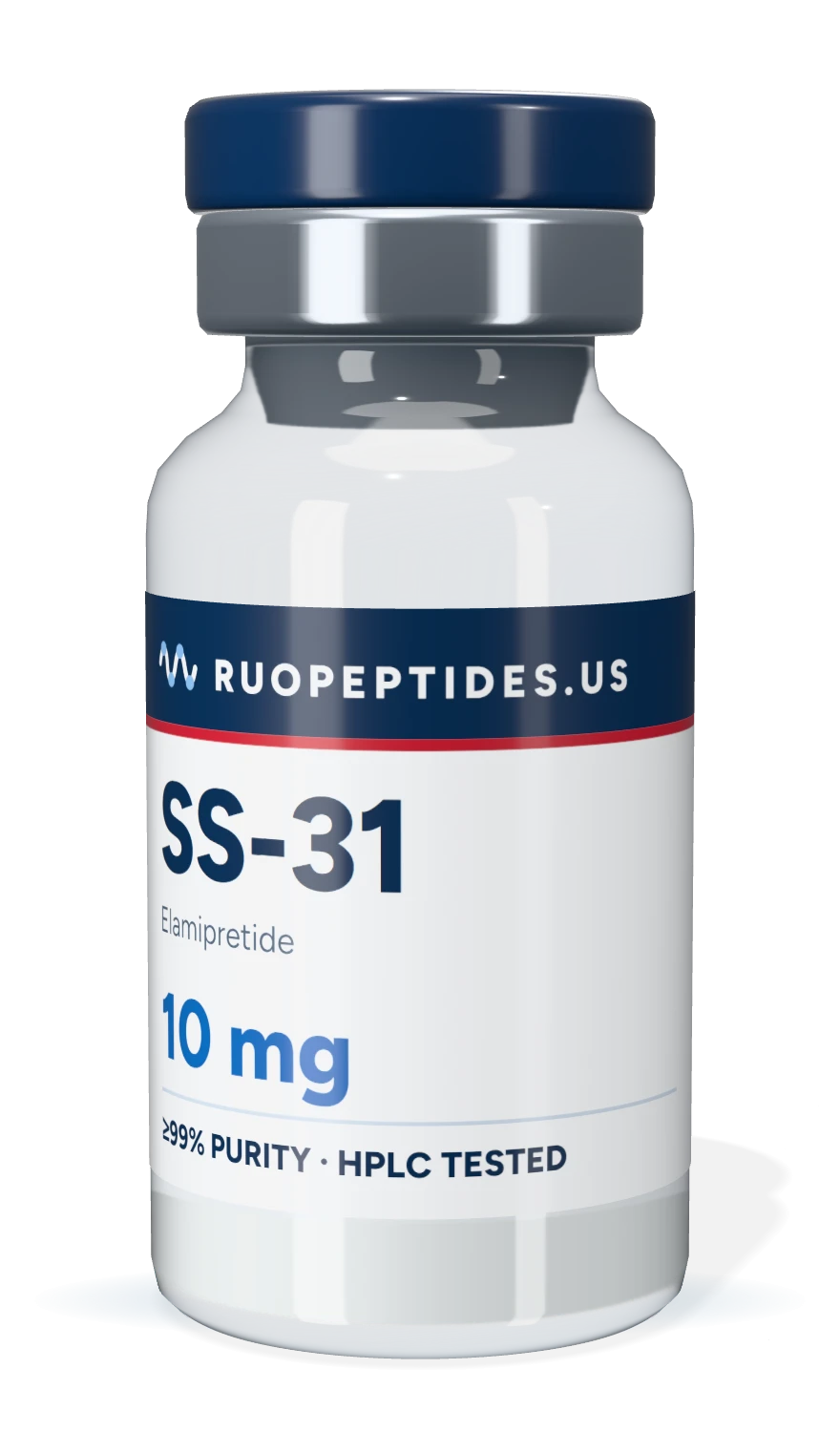
SS-31
FOR RESEARCH USE ONLYNot for human or veterinary use of any kind
Full label. Lot number and expiry differ per batch and are printed on each vial.
Mitochondrial & Metabolic ResearchCellular Aging ResearchPopular Research Peptides
SS-31 (Elamipretide)
Also known as: Elamipretide, MTP-131, Bendavia
SS-31 is a synthetic mitochondria-targeting tetrapeptide, supplied as a lyophilized 10mg vial for laboratory research. The scientific literature more often calls it elamipretide. Where it goes is what makes it interesting.
- CAS
- 736992-21-5
- M.W.
- 639.8 g/mol
- Formula
- C₃₂H₄₉N₉O₅
- Form
- Lyophilized powder
$54.00per vial
Price shown per vial. Quantity discounts below.
In stock
Buy more, pay less per vial
Add 1 more vial to save 3%: $52.38 per vial.
- Safe credit card paymentVisa, Mastercard and American Express
- 30-day money-back guarantee
- Super-fast 1-2 day shippingTo all 50 states and DC
- Free shipping on orders over $200Applied automatically at checkout
SS-31 (Elamipretide)
10 mg · $54.00/vial
Lyophilized SS-31 storage
Lyophilized SS-31 peptide should be stored in a dry place, protected from sunlight and moisture.
The following storage conditions are generally recommended:
- Room temperature (15-25 °C / 59-77 °F): Up to ~3-8 months
- Refrigerated (2-8 °C / 35.6-46.4 °F): Up to 6 months
- Frozen (-20 °C / -4 °F or below): 3-5 years
Prior reconstituting with a suitable solvent or Saline, allow the vial to reach room temperature after taking it out of the refrigerator or freezer.
Reconstituted SS-31 storage
Once in solution, SS-31 is generally less stable compared to their lyophilized (powdered) form and should be stored at cold temperatures when possible.
These storage conditions are generally recommended:
- Room temperature (15-25 °C / 59-77 °F): Avoid longer than 2-4 day storage
- Refrigerated (2-8 °C / 35.6-46.4 °F): Typically 4-8 weeks
- Frozen (-20 °C / -4 °F or below): Up to 3-4 months
However, to preserve peptide efficacy and amino-acid bonds, avoid repeatedly freezing and unfreezing the peptide.
SS-31 delivery and shipping
SS-31 ships from US stock to United States addresses only. Orders are packed and dispatched within 1-2 business days.
- Standard: $9.95, 1-2 business days after dispatch.
- Express: $24.95, next business day after dispatch.
Lyophilized SS-31 ships in a sealed glass vial with protective packaging. The dry powder is stable at room temperature for the length of domestic transit, so no cold pack is needed. Move it to the storage conditions above when it arrives.
Follow your parcel any time on the Track Order page.
SS-31 lab testing and COA
The certificate of analysis for SS-31 is being uploaded. Ask support for the current report before you order if you need it now.
Every vial label has a lot number. Check it on the Verify page to confirm the vial is genuine. All reports are on the Lab Reports page.
For laboratory research use only. All products are sold for laboratory research use only. They are not drugs, foods, cosmetics or dietary supplements, and are not for human or veterinary use.
SS-31 specifications
- Product
- SS-31 (Elamipretide)
- Also known as
- Elamipretide, MTP-131, Bendavia
- Compound class
- Mitochondrial & Metabolic Research
- Product type
- Peptide
- Form
- Lyophilized powder
- Amounts available
- 10 mg ($54.00), 20 mg ($99.00)
- Sequence
- H-D-Arg-(2',6'-dimethyl-Tyr)-Lys-Phe-NH₂
- Molecular weight
- 639.8 g/mol
- Molecular formula
- C₃₂H₄₉N₉O₅
- CAS number
- 736992-21-5
- Storage as supplied
- Sealed, dry, dark; -20 °C for long-term storage
- Lab report
- COA on request
- Research areas
- Mitochondrial & Metabolic Research, Cellular Aging Research, Popular Research Peptides
- Intended use
- Laboratory research only. Not for human or veterinary use.
Research overview
About SS-31 (Elamipretide)
Scientifically reviewed by John Johnson · Updated November 2026SS-31 is a synthetic mitochondria-targeting tetrapeptide, supplied as a lyophilized 10mg vial for laboratory research. The scientific literature more often calls it elamipretide.
Where it goes is what makes it interesting. SS-31 partitions into the cardiolipin-rich interfaces of the inner mitochondrial membrane, which is why it appears throughout research on mitochondrial structure, bioenergetics, and cellular stress pathways.
What is SS-31?
SS-31 belongs to the Szeto-Schiller peptides, named for the two researchers who developed the series. Elamipretide is the same molecule under its development name. Older papers call it MTP-131, and older ones still use Bendavia.
Most research peptides act on a cell-surface receptor. This one doesn't. It reaches the mitochondrion and associates with cardiolipin, a phospholipid found almost nowhere else in the cell.
Cardiolipin earns its own paragraph. It shapes the cristae, the folded inner membrane where oxidative phosphorylation happens, and it binds directly to respiratory chain complexes and to cytochrome c. Oxidize the cardiolipin and the machinery anchored to it stops working properly, which is a structural failure rather than a chemical one.
That's the interaction the research keeps circling. Birk and colleagues reported SS-31 binding cardiolipin with high affinity and inhibiting cytochrome c peroxidase activity, the reaction that oxidizes cardiolipin during ischemia. In rat kidney, pretreatment protected cristae structure and prevented mitochondrial swelling.
SS-31 Research Applications
The research record here is unusually specific about where the molecule sits and what it touches.
- Mitochondrial Membrane Biology: Chavez and colleagues ran cross-linking mass spectrometry on isolated mitochondria and recovered 17 cross-linked peptide pairs between SS-31 and 16 lysine residues across 12 proteins. Every one of those 12 is a known cardiolipin-interacting protein.
- Electron Transport Research: Those 12 partners included Complex III, Complex IV, ATP synthase, creatine kinase and the ADP/ATP translocase. Direct contact with the machinery of oxidative phosphorylation.
- Cellular Bioenergetics: Pharaoh and colleagues examined ADP sensitivity in aged mitochondria and attributed the change to uptake through the adenine nucleotide translocase.
- Oxidative-Stress Pathways: Work on the cytochrome c and cardiolipin complex, where the question is peroxidase activity and cardiolipin peroxidation rather than general radical scavenging.
- Cardiac and Skeletal Muscle Research: MMPOWER-3 enrolled 218 adults with primary mitochondrial myopathy for six months and missed both primary endpoints, the 6-minute walk distance and the fatigue score. Participants with nuclear DNA mutations separated out on walk distance in a secondary analysis. The Barth syndrome program went the other way and produced the accelerated approval.
- Predicted epigenetic age didn't move.
Function moved. The clocks didn't. Mitochondrial performance and biological age are apparently measuring different things.
SS-31 FAQ
Is SS-31 a peptide?
Yes, a tetrapeptide. Four residues, 639.8 g/mol, two of them non-standard: D-arginine and 2',6'-dimethyltyrosine, with an amidated C-terminus.
Is SS-31 the same as elamipretide?
Same molecule. SS-31 is the laboratory designation, elamipretide the development name. MTP-131 and Bendavia appear in older papers for the same compound.
What does SS-31 target?
Cardiolipin, a phospholipid concentrated in the inner mitochondrial membrane. It doesn't work through a cell-surface receptor, which separates it from most peptides in this catalogue.
What is cardiolipin?
A phospholipid found almost exclusively in the inner mitochondrial membrane. It shapes the cristae and binds directly to respiratory chain complexes and to cytochrome c.
Is SS-31 an antioxidant peptide?
Early descriptions leaned on radical scavenging. The mechanistic work since has centered on cardiolipin binding and suppression of cytochrome c peroxidase activity, which is a targeted interaction at one membrane rather than general antioxidant behavior.
Is SS-31 studied for ATP production?
It's been investigated in experimental models examining mitochondrial respiration, ADP sensitivity and ATP recovery. Cross-linking work places it in contact with Complex III, Complex IV, ATP synthase and the ADP/ATP translocase.
Is RUOPeptides SS-31 the same as Forzinity?
No. Forzinity is a prescription drug product containing elamipretide hydrochloride, approved in September 2025 for Barth syndrome. Research-grade SS-31 is not that product, is not a substitute for it, and carries no approved use.
Buying SS-31 for research in the USA
Price
From $54.00. 10 mg: $54.00, 20 mg: $99.00. Quantity discounts per size: 3% off 2 vials, 5% off 3-4 vials, 7% off 5+ vials.
Shipping
US addresses only. Orders are packed and dispatched within 1-2 business days. Standard from $9.95.
Proof it's genuine
Check the lot number on your vial on the Verify page.
Lab reports
COA and SDS documents are on the Lab Reports page.
Scientifically reviewed
Scientifically reviewed by John Johnson
Scientific reviewer · Last reviewed November 2026
John Johnson reviewed this SS-31 page for scientific accuracy: the compound's identity and specifications, the summaries of published studies, and the references they cite. The page describes laboratory and preclinical research only. It is not medical advice and gives no usage guidance.
Research information on this page summarizes published laboratory and preclinical studies. It is not usage guidance.